
Telenomus
Telenomus dignus
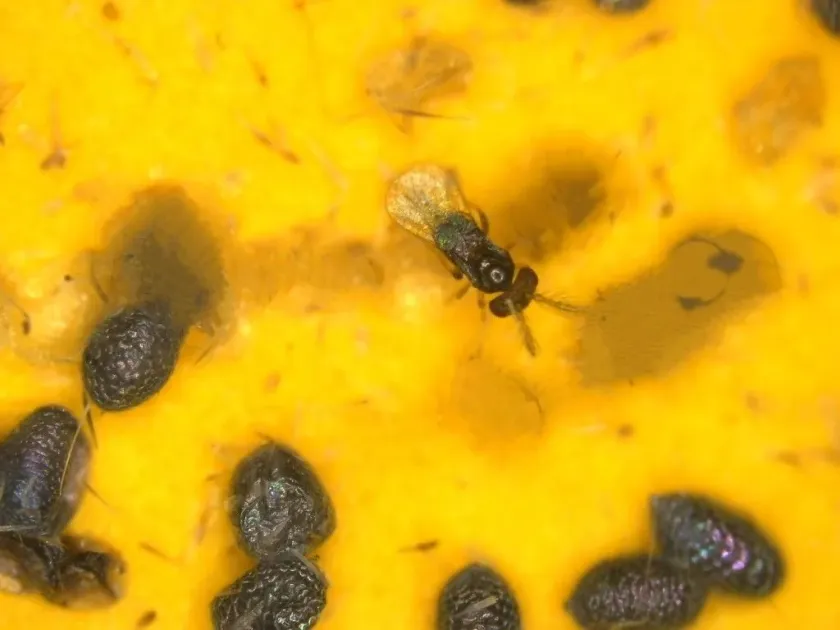
Description
How to identify
Telenomus dignus is a minute parasitic wasp belonging to the family Scelionidae. These insects are exceptionally small, often measuring approximately 1 millimeter in length.
The adults are characterized by a dark, compact body and specialized sensory antennae that allow them to locate host eggs hidden in plant tissues.
Unlike many insect species, the female Telenomus is highly skilled at finding specific host eggs, ensuring high precision in their reproductive cycle.
Morphologically, they possess robust wings for flight, enabling them to move effectively across rice paddies and other cultivation fields.
Taxonomically, they occupy a crucial niche as egg parasitoids, impacting the life cycle of various harmful moths before they reach the larval stage.
What it damages
Telenomus dignus is not a plant pest; rather, it is a highly beneficial organism that provides natural biological control against agricultural threats.
It specifically targets the eggs of the rice stem borer, effectively preventing the development of larvae that would otherwise destroy cereal stems.
By parasitizing host eggs, Telenomus disrupts the proliferation of major pests, serving as a biological safeguard for crops.
There is no record of Telenomus dignus causing any injury to agricultural crops, as they do not feed on plant foliage or stems.
Their activity results in the death of the pest embryo, providing a sustainable alternative to the use of synthetic chemical pesticides.
When it appears
The activity of Telenomus dignus follows the reproductive cycle of its primary hosts. They emerge during the peak egg-laying period of stem borers.
Favorable weather conditions, typically warm temperatures between 25°C and 30°C, significantly increase their flight activity and search capacity.
Their life cycle is relatively short, allowing for multiple generations per season, which helps in suppressing pest populations continuously.
Overwintering usually occurs as pre-pupae or adults within plant debris or soil, allowing the species to survive the winter dormant season.
Monitoring the spring emergence is essential for evaluating the potential for early-season control of lepidopteran pests in rice fields.
Signs of infestation
The primary sign of Telenomus activity is the visual alteration of host eggs, which become darkened or discolored due to the parasitoid's internal development.
Careful field scouting will reveal tiny circular exit holes in the chorion of the host eggs, indicating that the adult wasps have successfully emerged.
The reduction in the overall density of larvae in the treated fields compared to control plots confirms the success of the biological control effort.
- Darkening of pest eggs.
- Small emergence holes on egg surfaces.
- Decreased larval infestation in plant stems.
Field observations of these biological signs are fundamental for verifying the effectiveness of integrated pest management strategies.
Control measures
Conserving Telenomus dignus populations requires minimizing the use of broad-spectrum insecticides that could harm these beneficial wasps.
When chemical interventions are necessary, choosing selective insecticides that are compatible with egg parasitoids is critical for ecological safety.
Maintaining field margins and avoiding excessive removal of wintering sites helps to support a permanent population of beneficial insects.
Augmentative releases of Telenomus can be employed as part of an integrated strategy when pest egg density exceeds economic thresholds.
Integrating these biological methods promotes sustainable agricultural practices and ensures the long-term health of the ecosystem.
Taxonomy
- Latin name
- Telenomus dignus
- Order
- Hymenoptera
- Family
- Scelionidae
- EPPO code
- TELNDI
Discussion
No discussions yet — be the first.