
Telenomus closterae
Telenomus closterae
Description
How to identify
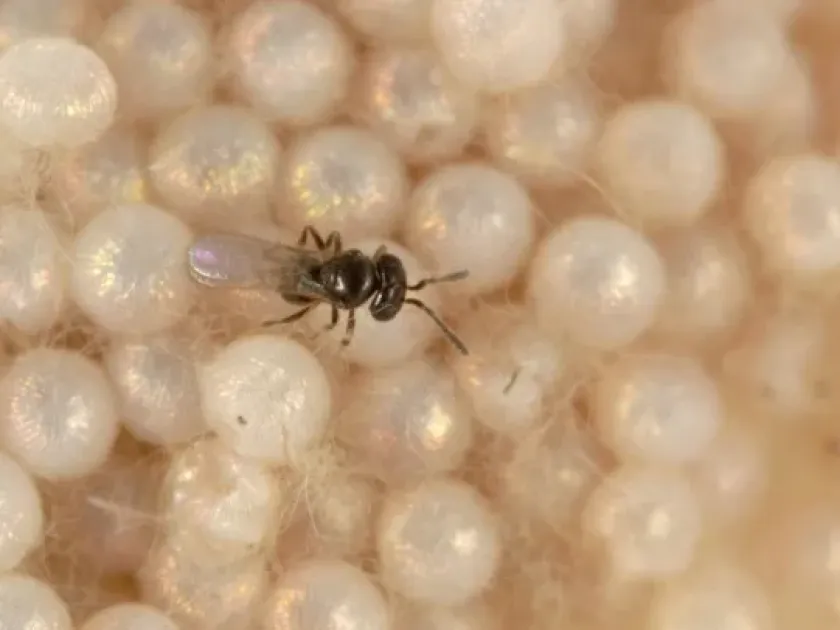
Telenomus closterae is a minute wasp belonging to the family Scelionidae within the order Hymenoptera.
This species is a highly specialized parasitoid that spends its entire developmental stage inside the eggs of its host species.
The adults are extremely small, typically measuring between 1 and 1.5 millimeters, which makes them difficult to observe without magnification.
Their bodies are generally dark-colored, helping them remain camouflaged while searching for egg clusters on tree foliage or bark.
The wings exhibit specific venation patterns characteristic of the genus Telenomus, which has evolved to target the eggs of various lepidopteran insects.
What it damages
Telenomus closterae is not a pest but rather a beneficial natural enemy that contributes to the regulation of moth populations.
By consuming the contents of the host eggs, this wasp prevents the hatching of larvae that would otherwise feed on the host plant leaves.
The ecological impact is highly positive as it helps maintain the balance of forest ecosystems and prevents mass outbreaks of defoliating insects.
In agriculture and forestry, the presence of these wasps is encouraged as part of sustainable biological control programs for trees.
Therefore, there is no damage associated with this insect; rather, it is considered a natural asset for plant protection and health.
When it appears
The lifecycle of Telenomus closterae is synchronized with the egg-laying phenology of its specific lepidopteran hosts.
Adult activity usually peaks during late spring and summer, coinciding with the reproductive periods of various Clostera moth species.
The entire development from egg to adult occurs within the host egg, allowing for multiple generations to occur during a single season.
Winter is typically spent in the larval or pupal stage inside the remnant eggshells of the host, providing protection from harsh environmental conditions.
Generation turnover is rapid, which allows the wasp population to build up quickly in response to increases in host egg abundance.
Signs of infestation
Detecting the presence of Telenomus closterae requires careful inspection of egg clusters under a microscope or high-powered lens.
A key sign of infestation is the presence of tiny, circular exit holes on the surface of the host eggs through which the adult wasps have emerged.
Infected egg clusters may often show a slight change in coloration, appearing darker or opaque compared to healthy, unparasitized eggs.
A reduced hatching rate of host larvae within a cluster is a primary indicator that a significant percentage of the eggs has been parasitized.
- Small circular exit holes in host eggshells.
- Color changes in parasitized egg masses.
- Significant decrease in larval emergence.
Control measures
No control measures are needed for Telenomus closterae, as it is a beneficial organism that acts as a natural biological control agent.
Instead, management strategies should focus on protecting and conserving these populations to enhance natural pest control services.
When chemical pest control is deemed necessary, selective insecticides should be used to minimize the mortality of these beneficial parasitoids.
Promoting habitat diversity in forest and garden areas helps provide refuges and resources for Telenomus adults to thrive throughout the year.
Monitoring the activity of these wasps is an essential component of integrated pest management (IPM) to evaluate the effectiveness of biological control.
Taxonomy
- Latin name
- Telenomus closterae
- Order
- Hymenoptera
- Family
- Scelionidae
- EPPO code
- TELNCS
Discussion
No discussions yet — be the first.