
Telenomus
Telenomus clisiocampae
Description
How to identify
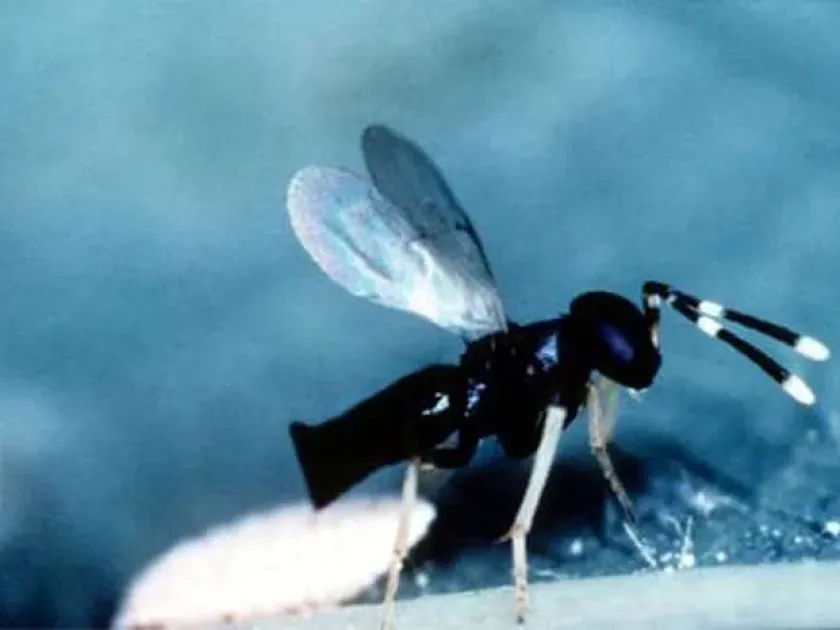
Telenomus (Telenomus clisiocampae) belongs to the order Hymenoptera, specifically the family Scelionidae. These are extremely small wasps, typically measuring only 1 to 2 millimeters in length.
Adult insects are generally black, equipped with well-developed wings and specialized antennae that enable the female to detect chemical signals from host egg masses.
Their morphological structure is highly specialized for a parasitic life cycle, allowing them to exploit the eggs of other insects effectively.
Larvae develop internally within the host egg, consuming the embryo completely before pupating inside the protective shell of the victim.
Identifying specific species within the genus requires professional entomological expertise and microscopic examination due to their minute size and similarity to other parasitoids.
What it damages
It is crucial to define that Telenomus is not a plant pest; it is a beneficial parasitoid that provides essential biological control against various moth species.
These wasps do not damage leaves, stems, fruits, or roots. Instead, they protect crops by killing the potential pest population at the egg stage.
By preventing the hatching of larvae, Telenomus significantly reduces the risk of defoliation and crop loss caused by caterpillars in orchards and woodlands.
Therefore, they are considered valuable allies in agricultural production, contributing to the stability of the ecosystem and reducing the need for chemical intervention.
Maintaining their population is an essential strategy in sustainable and integrated pest management programs.
When it appears
The life cycle of Telenomus is strictly synchronized with the egg-laying periods of its insect hosts, ensuring a continuous supply of victims.
Adult wasps emerge in early spring, coinciding with the initiation of oviposition by destructive lepidopterans in fruit-bearing trees and shrubs.
The species is capable of producing multiple generations within a single season, provided that host availability remains high during the warm period.
Pupation takes place directly inside the host egg, which provides a safe environment for development throughout the warmer months or, in some cases, for overwintering.
This precise timing allows the population of the parasitoid to grow effectively in proportion to the population of the pest it regulates.
Signs of infestation
The primary indicator of Telenomus activity is the observation of host eggs that appear discolored, darkened, or exhibit a metallic sheen different from the healthy eggs.
Close inspection of the egg masses often reveals tiny, perfectly circular exit holes, which indicate that the adult wasp has successfully emerged after completing its development.
A lack of larval emergence from known egg clusters of target pests is a clear sign that the parasitoids have been active and effective in the area.
In many cases, the physical destruction of the host embryo inside the egg prevents the characteristic damage caused by the emerging larvae.
Monitoring these signs helps agronomists evaluate the success of natural pest control without the need for additional chemical applications.
Control measures
Protection strategies for Telenomus involve creating and maintaining a farm environment that favors their survival and reproductive success.
- Reducing the application of broad-spectrum insecticides during the critical peak egg-laying phase of pests.
- Integrating nectar-producing flowers into the landscape to provide supplemental food sources for adult wasps.
- Preserving buffer zones with natural vegetation to support diverse parasitoid populations.
- Prioritizing biological pest control products that have low toxicity to beneficial hymenopterans.
- Avoiding unnecessary prophylactic treatments that could disrupt the natural balance between parasitoids and their hosts.
Taxonomy
- Latin name
- Telenomus clisiocampae
- Order
- Hymenoptera
- Family
- Scelionidae
- EPPO code
- TELNCL
Discussion
No discussions yet — be the first.