
Beech bark beetle
Taphrorychus villifrons
Description
How to identify
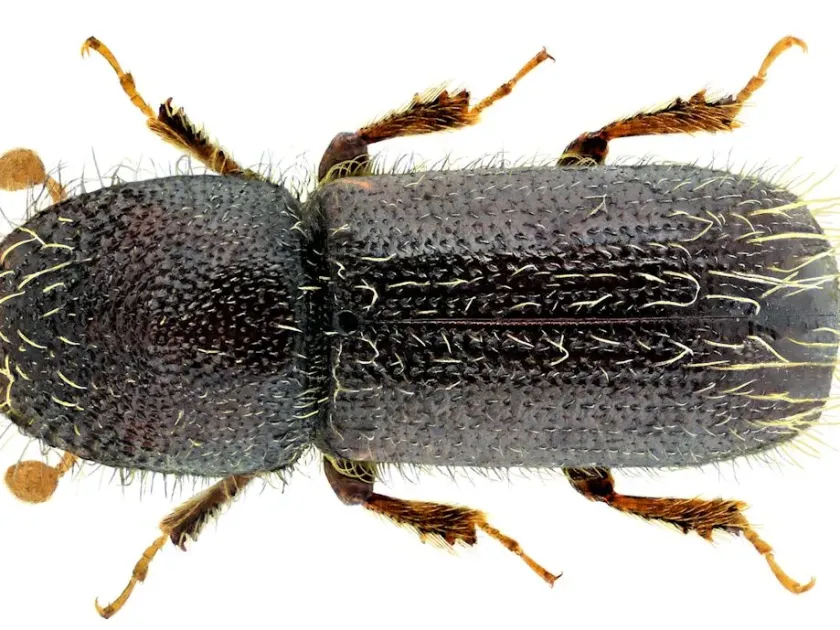
The beech bark beetle, Taphrorychus villifrons, is a small insect belonging to the Curculionidae family and the Scolytinae subfamily. These beetles are typically 2–3 mm long with a cylindrical shape.
Their bodies are dark brown to black and covered in fine, hair-like structures. These physical characteristics allow them to navigate effectively within the narrow spaces between the bark and the wood.
The larvae are white, C-shaped, and legless, with a hard, dark head capsule. They spend their entire developmental period tunneling through the cambium layer.
These beetles are highly specialized to inhabit beech trees, although they can occasionally colonize other deciduous trees in cases of extreme stress or high pest density.
The lifecycle includes complete metamorphosis, progressing through egg, larval, pupal, and adult stages, often completing one or more generations per year depending on the climate.
What it damages
Taphrorychus villifrons primarily attacks beech trees by boring into the bark to create galleries for egg-laying and larval feeding.
This activity disrupts the flow of nutrients and water within the tree's vascular system, leading to rapid physiological decline and stress.
Infested trees often show reduced vigor, making them more susceptible to secondary infections by fungi and other wood-rotting pathogens.
Severe infestations can lead to the death of the tree, especially when drought or other environmental factors have already weakened the host plant.
The economic impact is significant in forestry, as the beetles degrade the quality of timber and can lead to massive losses in forest stand productivity.
When it appears
Adult beetle activity typically begins in early spring, as temperatures rise, signaling the start of the primary flight and mating season.
The peak emergence usually occurs between late April and June, when adults search for suitable host trees to initiate new colonies.
The summer months are characterized by intense larval development under the bark, where they feed and grow until they reach the pupal stage.
By autumn, the development of the generation is often complete, and mature beetles may either emerge or overwinter in the bark galleries.
Seasonal patterns can vary significantly based on regional weather conditions, requiring local monitoring for accurate timing of management efforts.
Signs of infestation
The most reliable sign of an infestation is the presence of small, round exit or entry holes on the bark surface, accompanied by fine wood dust (frass) at the base.
Wilting of foliage on individual branches is a clear indication that the internal water transport system has been compromised by the beetle galleries.
Peeling away the outer bark reveals the characteristic gallery patterns created by the adults and their larvae, which are diagnostic for this species.
In advanced stages of attack, large sections of the canopy may turn yellow or brown, indicating that the tree is in a state of terminal decline.
Increased woodpecker activity on specific trees can also be a secondary sign, as these birds often target infested bark to feed on the larvae.
Control measures
The most effective management strategy is sanitation, which involves the prompt removal and destruction of infested trees to stop the spread to healthy ones.
Maintaining forest health through proper silvicultural practices is essential to minimize the number of susceptible trees in the stand.
Fheromone traps can be employed to monitor population levels and determine the optimal timing for implementing control measures.
While chemical treatments exist, they are generally impractical for forest-wide use and are reserved for high-value individual specimen trees.
- Sanitation harvesting of infested beech trees.
- Monitoring via pheromone-baited traps.
- Promoting biodiversity to encourage natural predators of bark beetles.
Taxonomy
- Latin name
- Taphrorychus villifrons
- Order
- Coleoptera (beetles)
- Family
- Curculionidae
- EPPO code
- TAPRVI
Discussion
No discussions yet — be the first.