
Beech twig beetle
Taphrorychus ramicola
Description
How to identify
The beech twig beetle (Taphrorychus ramicola) is a small wood-boring insect belonging to the family Curculionidae, specifically the subfamily Scolytinae.
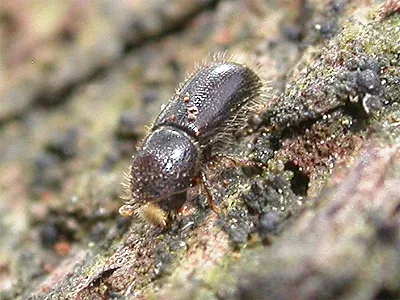
Adult beetles are tiny, typically measuring 2 to 3 mm in length, with a dark brown or black cylindrical body adapted for life inside galleries under the bark.
Larvae are small, white, and legless, developing within the woody tissues of the host tree, where they feed on the inner bark and nutrient-rich layers.
This species is highly specific to beech trees, showing a strong preference for thinner branches and twigs rather than the thick bark of main trunks.
Their life strategy involves targeting stressed or weakened branches, making them a significant factor in the decline of individual tree branches in forest stands.
What it damages
The primary host for this pest is the European beech (Fagus sylvatica), though it may occasionally colonize related species in mixed forest environments.
Damage is caused by both adults and larvae boring into the twigs, which disrupts the vascular system and prevents the transport of water and nutrients to the foliage.
Trees suffering from environmental stress, such as severe drought or storm damage, are the most susceptible to successful colonization by this bark beetle.
Infestation usually results in the dieback of affected twigs, which, in cases of high population density, can lead to the thinning of the tree's crown.
Chronic infestations make trees more susceptible to secondary wood-decay fungi, which can further degrade the structural integrity of the affected beech branches.
When it appears
The adult beetles emerge in late spring as temperatures rise, signaling the beginning of their active phase and search for new host material for reproduction.
Mating and egg-laying occur throughout the early summer months, as beetles tunnel into suitable twigs to establish galleries for their future offspring.
The beetle typically completes one generation per year, with the larvae developing throughout the summer before pupating within the host tissue.
Overwintering occurs in the adult stage, with the beetles hiding either under the bark of branches or within the protective leaf litter at the base of the tree.
Monitoring for adult flight activity in spring is a crucial component of forest management to determine the necessity of intervention before egg-laying begins.
Signs of infestation
The presence of this pest is often revealed by tiny entry holes found on the smooth bark of young branches, which are characteristic of bark beetle activity.
Fine wood dust, often called "frass," accumulates around entry points, providing a visual indicator of beetle tunneling progress under the bark layer.
Wilting, yellowing, or premature browning of leaves on specific twigs during the growing season is a common symptom of interrupted sap flow caused by tunneling.
Closer inspection of damaged branches will reveal intricate galleries etched into the surface of the wood, which are specific to the species' boring patterns.
- Circular entry holes approximately 1-2 mm in diameter.
- Accumulation of wood flour or frass on the branch bark.
- Localized yellowing or wilting of the leaf canopy.
- Sudden dieback of twigs during the growing season.
- Secondary fungal infection signs around beetle entry points.
Control measures
The most effective management strategy is the timely pruning and destruction of infested branches to interrupt the beetle's life cycle before they emerge.
Maintaining high forest hygiene, including the removal of wind-thrown or severely stressed trees, reduces the availability of breeding sites for the population.
Promoting a healthy and diverse ecosystem by encouraging natural predators such as woodpeckers and parasitic wasps helps in maintaining low beetle numbers.
In ornamental or nursery settings, systemic insecticides may be used as a last resort, applied during the adult flight period to prevent successful colonization.
Ensuring adequate tree vitality through proper soil management and drought mitigation significantly increases the tree's natural resistance to beetle attacks.
Taxonomy
- Latin name
- Taphrorychus ramicola
- Order
- Coleoptera (beetles)
- Family
- Curculionidae
- EPPO code
- TAPRRA
Discussion
No discussions yet — be the first.