
Two-colored bark beetle
Taphrorychus bicolor
Description
How to identify
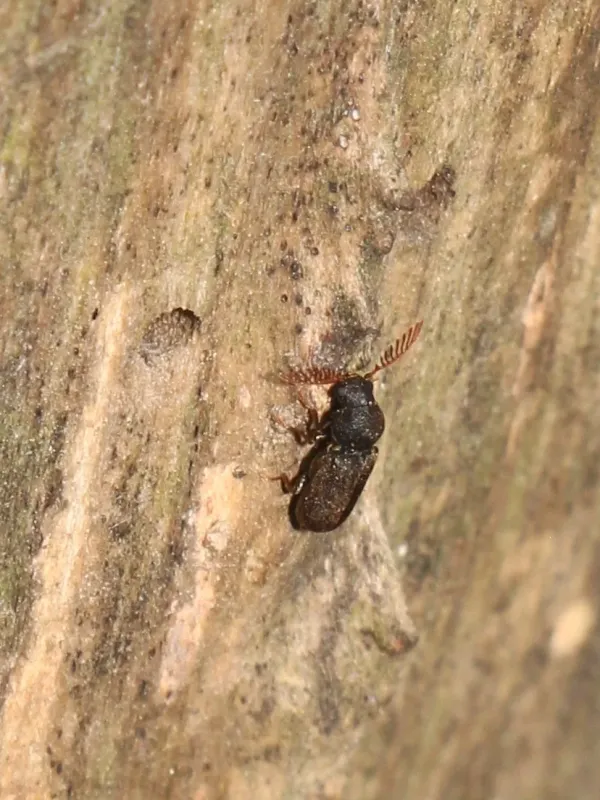
The two-colored bark beetle (Taphrorychus bicolor) is a small wood-boring insect belonging to the family Curculionidae (subfamily Scolytinae). It is a significant pest primarily known for affecting broad-leaved trees.
Adult beetles are typically 2 to 2.5 mm long. The name "two-colored" refers to the subtle difference in coloration between the pronotum (which is generally darker) and the elytra, providing a distinct look.
The body is sparsely covered with light-colored hairs, giving it a somewhat matte appearance. Like many other bark beetles, its head is largely concealed by the pronotum when viewed from above.
The larvae are white, legless, and have a curved body shape with a prominent brownish head capsule. They spend their entire developmental period within the host plant's bark and phloem layers.
Professional identification often relies on the pattern of their galleries under the bark, as different species of bark beetles create unique tunnels that reflect their specific biological requirements.
What it damages
This species is a typical xylophagous insect, favoring hardwoods such as beech, oak, hornbeam, and certain fruit-bearing trees found in orchards or ornamental parks.
The damage is caused by both adults and larvae. Adults bore into the bark to establish egg-laying galleries, while larvae feed extensively on the cambium and phloem, creating intricate tunnels.
The primary impact of these galleries is the disruption of the tree's nutrient transport system. As the beetles destroy the cambium, they interfere with the movement of water and sugars throughout the plant.
Symptoms of heavy infestation include the premature yellowing and dropping of leaves, drying of individual branches, and in severe cases, the death of the entire tree over several seasons.
Trees that are already stressed—whether by drought, poor soil quality, or mechanical injury—are most susceptible to colonization by the two-colored bark beetle.
When it appears
The flight period of the adult beetles typically begins in early spring, usually when temperatures reliably rise in April and May, initiating their search for suitable host trees.
Once a suitable host is found, the beetles mate and females bore into the bark to lay their eggs. The development from larvae to adults takes place over the summer months.
The species typically overwinters in the adult or larval stage beneath the bark of the host tree, remaining in a state of diapause until the return of warmer weather the following year.
In regions with particularly long and warm autumns, a partial second generation might occur, though a single annual cycle is most common in temperate climates.
Monitoring for the presence of these beetles is best conducted during their peak flight activity, which allows arborists and foresters to apply management techniques before colonization begins.
Signs of infestation
The first external sign of infestation is often the presence of "boring dust" (frass) accumulating at the base of the tree or around small entrance holes in the bark.
Entrance holes appear as tiny, uniform circular punctures. Removing a small patch of bark often reveals a network of branching galleries where the larvae have been feeding.
Foliage symptoms such as chlorosis, wilting, or thinning crowns are indicative of significant internal damage caused by the beetle's activity within the tree's conductive tissues.
In some cases, the bark may show dark staining or resinous discharge if the tree is attempting to repel the beetles, though this is less common in highly susceptible tree species.
The presence of these signs, especially in an area with previous history of bark beetle activity, requires immediate inspection to determine the level of damage and take necessary action.
Control measures
Managing the two-colored bark beetle focuses on maintaining tree vigor and removing potential breeding sites to lower the risk of population outbreaks.
- Remove and destroy infested trees immediately to prevent the spread of beetles to healthy specimens.
- Maintain tree health through proper irrigation, fertilization, and general care to keep the trees resistant to pests.
- Utilize pheromone traps or trap trees to monitor and reduce local beetle populations during peak flight periods.
- Apply professional-grade contact or systemic insecticides during the identified flight window to target adults.
- Keep the orchard or forest floor clear of debris and decaying wood that could harbor overwintering larvae.
Chemical control is most effective when applied at the very beginning of the infestation, before the beetles have successfully penetrated deep into the bark layers.
Integrated Pest Management (IPM) strategies, which combine cultural practices with biological controls, are generally the most sustainable approach for long-term tree protection.
Consulting with local agricultural extensions or forest health specialists is recommended to determine the most effective timing for interventions based on local climatic data.
Taxonomy
- Latin name
- Taphrorychus bicolor
- Order
- Coleoptera (beetles)
- Family
- Curculionidae
- EPPO code
- TAPRBI
Discussion
No discussions yet — be the first.