
Grey beet weevil
Tanymecus rapax
Description
How to identify
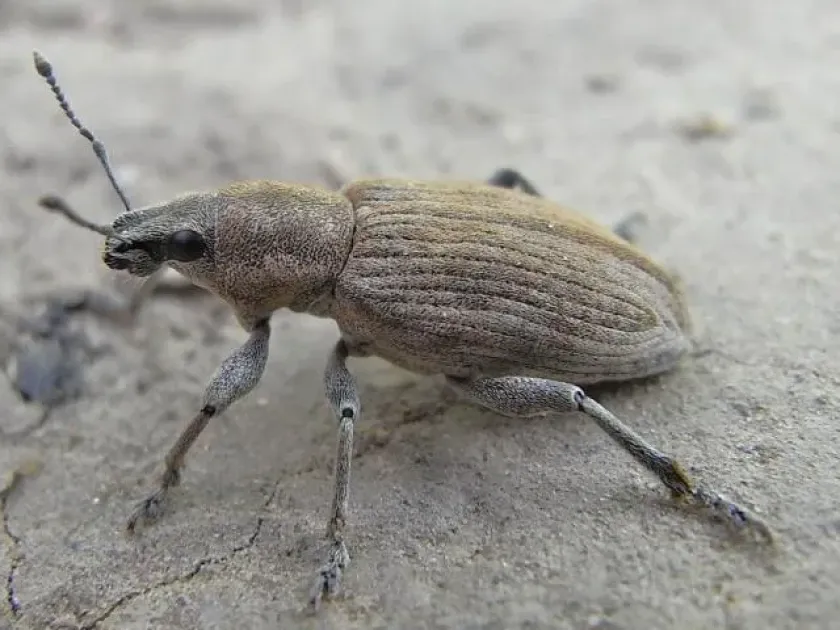
The adult grey beet weevil has a body length ranging from 8 to 12 mm. Its body is covered with dense, small scales that create a grey or brownish appearance, acting as camouflage.
The rostrum is short and wide, featuring a distinct longitudinal keel in the middle. The pronotum is cylindrical and noticeably narrower than the elytra base, which is a key identification feature.
Its eyes are large and convex, providing the beetle with excellent visual orientation while foraging. The antennae are elbowed and attached near the tip of the rostrum.
The larva, which lives in the soil, is legless, crescent-shaped, white in color, and possesses a brown head capsule. It feeds primarily on small plant roots.
Systematically, this beetle belongs to the order Coleoptera and the family Curculionidae. It is considered a polyphagous pest capable of damaging various agricultural crops.
What it damages
The grey beet weevil is a significant pest of sugar and fodder beets, particularly attacking seedlings during their most vulnerable stage of development.
It also causes extensive damage to sunflowers by gnawing on cotyledons and young true leaves, often leading to total stand failure in affected areas.
Corn and various grain crops are also susceptible to feeding damage, especially in regions with high beetle populations and slow spring growth conditions.
Due to its polyphagous nature, the pest thrives on various weed species, which serve as alternative food sources and reservoirs between cropping seasons.
While adult feeding is the most visible and damaging, larval feeding on roots can contribute to overall plant stress, although it rarely leads to immediate plant death.
When it appears
Overwintered adults emerge from the soil in early spring when the air and soil temperatures reach approximately 10-12 degrees Celsius.
The peak period of activity and field colonization occurs during April and May. During this time, the beetles are highly active and voracious, migrating from wintering sites.
Mating and egg-laying occur in the top layer of the soil. The female lays a significant number of eggs, ensuring a high reproductive potential for the species.
The life cycle is completed within one year. By the end of the summer, the new generation of beetles pupates and remains in the soil to overwinter.
Environmental factors, such as soil moisture and temperature, play a critical role in the rate of larval development and the overall population density.
Signs of infestation
The primary sign of infestation is the characteristic notched or scalloped appearance of leaf edges, often referred to as "figure-of-eight" feeding damage.
Mass infestations often result in visible gaps or empty patches in fields where seedlings have been completely consumed or severely stunted.
During the day, beetles are often found hidden under soil clods or plant debris, making them difficult to spot without careful inspection of the soil surface.
Affected seedlings exhibit stunted growth and loss of the apical meristem, which frequently allows opportunistic fungal pathogens to infect the damaged tissue.
Heavy presence along field margins, especially near perennial grasses or forests, is a major indicator that the pest is moving into the main crop area.
Control measures
Spatial isolation of new beet fields from perennial grass habitats and weed-heavy areas is the most effective preventative measure against infestation.
Deep autumn plowing is a recommended cultural practice that disrupts the pupation and wintering sites of the larvae, leading to significant population reduction.
Seed treatment with systemic insecticides is widely considered the best practice to protect young seedlings from early-season damage.
When scouting indicates that the pest density exceeds the economic threshold, application of contact-stomach insecticides is necessary to prevent severe yield loss.
- Crop rotation to break the pest life cycle.
- Monitoring with pitfall traps along field margins.
- Aggressive weed control in and around field borders.
Taxonomy
- Latin name
- Tanymecus rapax
- Order
- Coleoptera (beetles)
- Family
- Curculionidae
- EPPO code
- TANYRA
Discussion
No discussions yet — be the first.