
Bristly weevil
Tanymecus hispidus
Description
How to identify
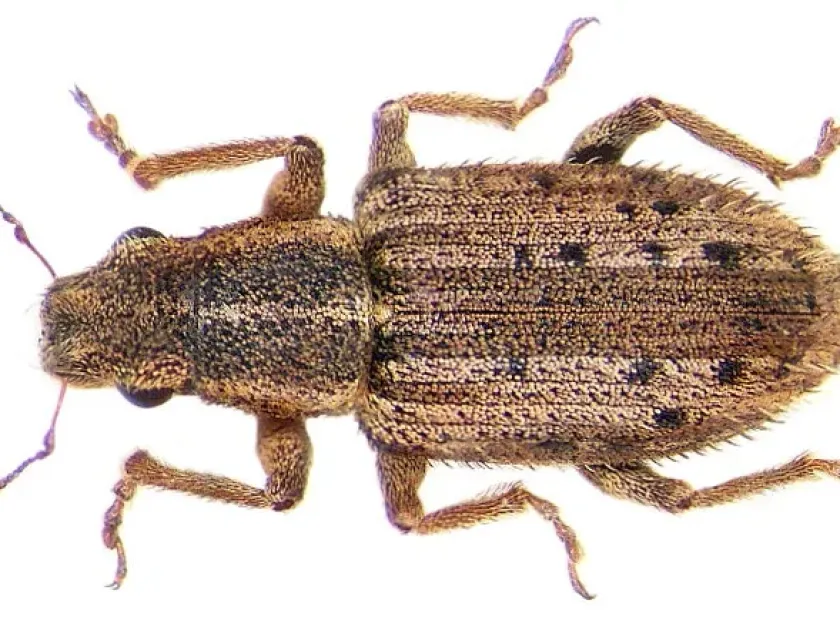
The bristly weevil (Tanymecus hispidus) is a beetle belonging to the Curculionidae family. Adults typically measure 8–10 mm in length and are densely covered with greyish or brownish scales and setae, which provide excellent camouflage against soil backgrounds.
The weevil possesses a short, broad rostrum and characteristic elbowed antennae. The larvae are C-shaped, legless, and white, spending their life cycle dwelling within the soil profile.
Morphologically, this species is distinguished from related weevils by the specific pattern of setae on the elytra and the structure of the pronotum. The insect undergoes a complete metamorphosis, progressing through egg, larva, pupa, and adult stages.
The majority of adult weevils overwinter in the soil at depths of 40–50 cm. They emerge in early spring when soil temperatures reach approximately 10 degrees Celsius, beginning their feeding phase.
Females lay their eggs in the soil near host plants. Each female can produce hundreds of eggs, allowing the population to reach high densities if environmental conditions are favorable during the spring season.
What it damages
The bristly weevil is a polyphagous pest, though it primarily causes severe damage to cereal crops, including winter and spring wheat, barley, and rye.
Both adults and larvae cause economic damage. Adults feed on the vegetative parts of young seedlings, often chewing the leaf margins, which can lead to complete stand loss if the infestation is severe.
Larvae living in the soil feed on the roots of crops. This feeding weakens the root system, reduces nutrient uptake, and makes plants more susceptible to environmental stress and opportunistic soil-borne pathogens.
The most critical window for damage is during the seedling stage. Heavy infestations during germination often necessitate field replanting, causing significant financial losses to farmers.
While cereals are the primary target, the pest can also thrive on legumes and various weed species, which helps maintain local populations in the absence of primary cereal hosts.
When it appears
Overwintering adults emerge from the soil in early spring, typically throughout April, coinciding with the tillering phase of cereal crops.
The peak activity period for adult weevils occurs during May and early June, a time of intense feeding and mating behavior.
Larval emergence from eggs begins in the first half of the summer. Larvae spend the subsequent months developing in the soil, feeding on the roots of available vegetation.
By autumn, the larvae complete their development and pupate. The insect overwinters in the pupal stage within the soil, emerging as young adults the following spring.
Consequently, the species completes one generation per year, making spring monitoring and early-season control essential for successful crop protection.
Signs of infestation
The most common sign of a bristly weevil infestation is the presence of characteristic "notched" or irregular leaf margins on young seedlings.
During the day, adult weevils are relatively inactive and hide under soil clods or near the base of the stems, making them difficult to detect without careful inspection of the ground.
Signs of larval damage include stunted growth, yellowing of leaves, and sudden wilting of seedlings, which occur when the root system has been severely compromised by larval feeding.
Infested areas often appear as patchy or thin stands, with localized clusters of weak plants that clearly contrast with the surrounding healthy crop.
- Notched or irregular chewing patterns on leaf edges.
- Adult weevils found hiding under soil surface debris.
- Delayed growth and yellowing of young cereal seedlings.
- Patchy or thinning stands in infested field sections.
Control measures
Effective crop rotation is the primary preventive measure. Avoiding continuous cereal cropping prevents the buildup of weevil populations in the soil.
Deep autumn plowing (tillage) is an effective agrotechnical practice that physically disrupts the soil, exposing pupae and larvae to predators and environmental stress.
Seed treatment with systemic insecticides prior to planting is crucial for protecting the young crop during the highly vulnerable germination and early establishment phases.
When infestation levels exceed the economic threshold, contact-stomach insecticides applied during the early morning or evening hours can successfully reduce adult populations.
Rigorous weed control around field edges and margins is also vital, as these areas provide refuge and alternative food sources for the pests during periods when main crops are not available.
Taxonomy
- Latin name
- Tanymecus hispidus
- Order
- Coleoptera (beetles)
- Family
- Curculionidae
- EPPO code
- TANYHI
Discussion
No discussions yet — be the first.