
Brazilian free-tailed bat
Tadarida brasiliensis
Description
How to identify
The Brazilian free-tailed bat (Tadarida brasiliensis) belongs to the order Chiroptera and the family Molossidae. It is a highly mobile species known for its remarkable flight speed and ability to navigate vast agricultural landscapes.
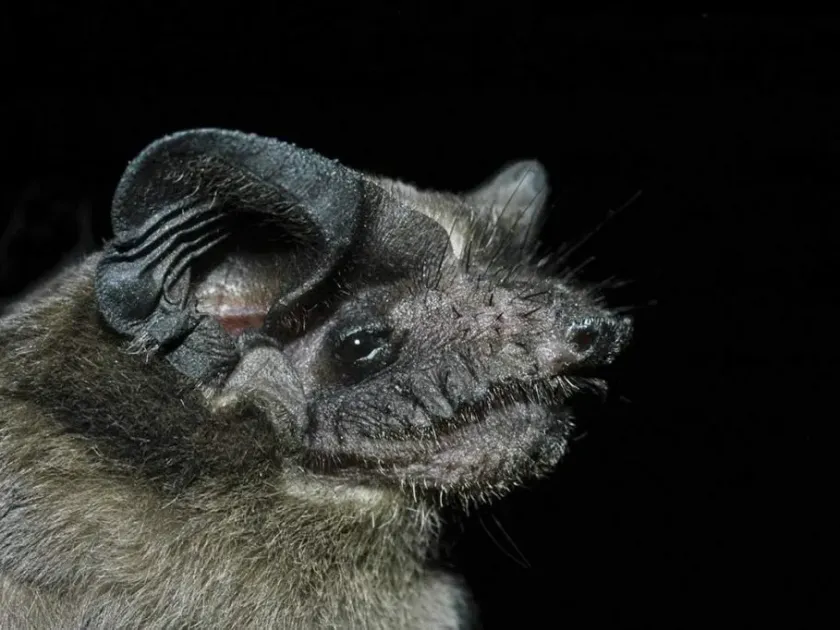
Key morphological features include a wrinkled upper lip and narrow, pointed wings. They possess a thick tail that extends well beyond the uropatagium, which is why they are referred to as "free-tailed."
Their size is relatively small, with adults reaching a forearm length of about 40-45 mm. Despite their size, they are extremely resilient and form some of the largest warm-blooded vertebrate colonies in the world.
In terms of agricultural presence, these bats are highly visual during dusk as they emerge in massive swarms to hunt. This behavior is often misunderstood by farmers who may mistakenly view them as a threat to crops.
Understanding their taxonomy and behavior is essential for farm management, as they act as natural predators to numerous moths and beetles that plague commercial crops.
What it damages
The Brazilian free-tailed bat does not cause direct damage to plants, as it is an insectivore. It does not consume leaves, stems, roots, or fruit, making it an economically neutral species regarding direct crop yield loss.
Potential issues are primarily structural. When large colonies roost in agricultural warehouses or sheds, the accumulation of guano can cause odors, material corrosion, and health concerns due to waste buildup.
Concerns regarding disease transmission or structural damage are usually manageable through proper facility maintenance and exclusion techniques rather than population eradication.
Conversely, the indirect economic benefit provided by these bats is substantial. They feed on massive quantities of pests, significantly reducing the population of crop-destroying insects during the growing season.
Ultimately, the "damage" caused is merely a nuisance management issue, while the benefits of their natural predation services often outweigh the maintenance costs associated with their presence.
When it appears
The activity of Tadarida brasiliensis is strictly seasonal, depending on environmental temperature and insect availability. They are highly active during the spring and summer months when insect populations are at their peak.
During autumn, populations often undergo migration to warmer regions to survive the winter. Their activity near agricultural facilities is minimal to non-existent during the colder months.
Reproductive cycles occur during the summer. This is when colony density is at its highest, and their demand for food is significant, directly benefiting the surrounding agricultural areas through insect suppression.
Spring emergence is a critical time for monitoring potential roosting sites in farm infrastructure. Proper planning of facility repairs should be scheduled before or after these periods of high occupancy.
Their seasonal presence aligns perfectly with the growth cycles of primary agricultural pests, making them a predictable and consistent natural control agent in commercial farming.
Control measures
Control strategies should focus on exclusion and sanitation rather than extermination. Because they are vital for ecological pest control, their conservation is generally encouraged in agricultural sectors.
Exclusion methods involve identifying access points and installing one-way devices. This allows the bats to leave the building but prevents them from re-entering, ensuring a humane management process.
Regular sanitation of roosting areas is necessary to prevent the buildup of guano and to maintain hygiene in agricultural storage buildings. Personal protective equipment should be used during cleaning.
Farmers should avoid excessive pesticide use during the active season, as chemicals can accumulate in the bats' systems and reduce the natural pest control efficiency of the local population.
- Implement humane exclusion devices.
- Schedule building maintenance during non-active seasons.
- Prioritize hygiene in storage sheds.
- Adopt integrated pest management (IPM) to protect the bats.
Taxonomy
- Latin name
- Tadarida brasiliensis
- Family
- Molossidae
- EPPO code
- TADABR
Discussion
No discussions yet — be the first.