
Fruit weevil
Tachypterellus consors
Description
How to identify
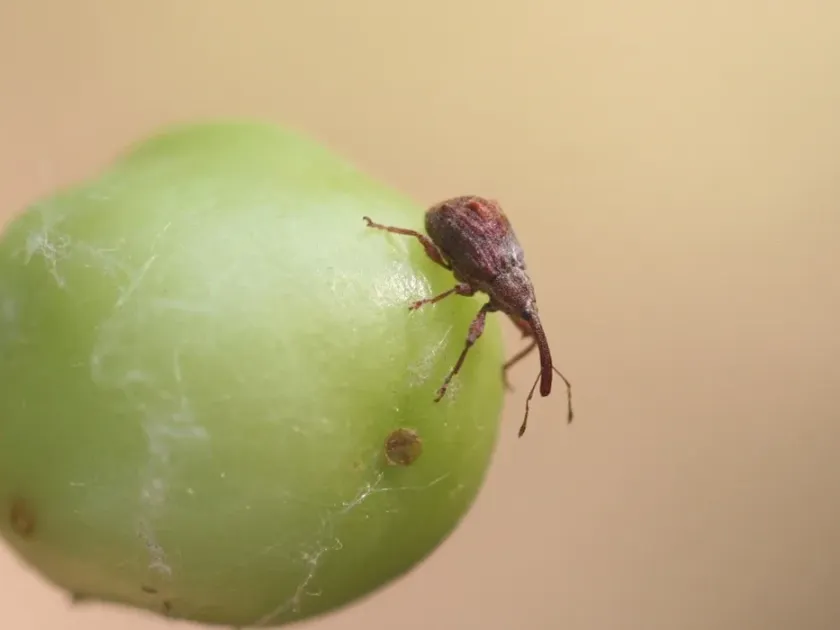
The fruit weevil belongs to the order Coleoptera and the family Curculionidae. The adult insect is a small beetle with a characteristic elongated snout, which it uses for feeding and laying eggs.
The coloration of the insect varies from dark brown to grayish-brown, which allows it to camouflage effectively on tree bark. The body is covered with fine hairs, and the elytra surface has a distinct relief texture.
The weevil larva has an arcuate shape, is legless, and is white or cream-colored with a distinct brown head. The entire development cycle takes place hidden inside the fruits or plant buds.
The biology of this species is closely linked to the phenological development phases of fruit crops. Adult weevils overwinter in sheltered places such as fallen leaves, bark crevices, or the topsoil layer.
With the onset of spring warmth, the beetles become active, starting to feed on buds and young ovaries, after which they begin their reproductive cycle.
What it damages
The main host plants are pome fruits, primarily apple and pear trees. In some cases, the pest can also be found on wild Rosaceae species.
Damage is caused by both adults and larvae, making this pest highly dangerous throughout the entire growing season.
Beetles eat buds and flowers, leading to deformation and premature shedding, which significantly reduces the fruit set percentage in the orchard.
Larvae develop inside the fruit, creating tunnels in the pulp and reaching the seed chamber, causing the fruits to fall prematurely or lose their market value.
Mass infestations can lead to substantial crop losses, especially in years with unfavorable conditions for tree growth.
When it appears
The active period of the fruit weevil begins in early spring when the average daily temperature reaches 8–10 degrees Celsius.
The orchard blooming period is a critical phase, as this is when females start laying eggs into buds or young ovaries.
Larval development inside the fruits continues throughout the summer, after which they pupate in the soil or within fallen fruits.
The emergence of the new generation of beetles usually occurs in the second half of summer, followed by preparation for winter diapause.
Only one generation is observed per season; however, the staggered feeding periods make population control quite challenging.
Signs of infestation
In the early stages, signs of infestation manifest as small punctures or "wounds" on buds and blossoms, from which plant sap may ooze.
A characteristic symptom is the premature yellowing and dropping of ovaries, which contain larval tunnels and insect frass inside.
When inspecting fallen fruit, small entry holes made by the female for egg-laying or by the larva for exiting can be found.
Trees heavily infested by the pest look weakened, with sparse canopies and deformed fruits that are prone to rapid rotting.
The presence of beetles can be confirmed by shaking them from branches onto a light-colored sheet during the early morning hours when they are less mobile.
Control measures
Agronomic measures include regular collection and destruction of fallen fruits, where larvae often complete their development.
Autumn cultivation of the soil around the tree trunks helps destroy pupae and overwintering adults through freezing or predation by birds.
The use of sticky bands on tree trunks effectively prevents the beetles from climbing up into the canopy.
In cases of high pest density, the application of systemic and contact insecticides during the "green tip" phase and after blooming is recommended.
- Maintaining proper orchard spacing and sanitation.
- Encouraging natural entomophages and insectivorous birds.
- Regular monitoring of population levels using pheromone traps.
Taxonomy
- Latin name
- Tachypterellus consors
- Order
- Coleoptera (beetles)
- Family
- Curculionidae
- EPPO code
- TACYCO
Discussion
No discussions yet — be the first.