
Fruit weevil
Tachypterellus
Description
How to identify
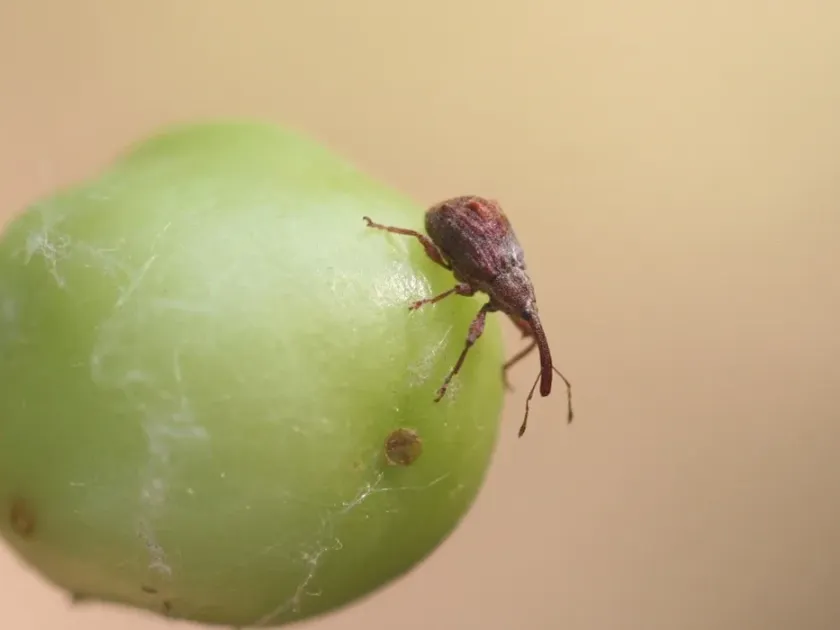
The fruit weevil, belonging to the genus Tachypterellus, is a member of the Curculionidae family within the order Coleoptera. These insects are easily identified by their elongated snout, known as a rostrum, which is essential for feeding and oviposition.
Adult weevils are typically oval-shaped, measuring approximately 4 to 6 millimeters in length. Their coloration ranges from brownish to greyish tones, providing excellent camouflage against tree bark and buds.
The larval stage consists of legless, slightly curved grubs with a distinct, hardened head capsule. These larvae spend their entire development hidden within the tissues of the host plant's fruit or buds.
The life cycle of Tachypterellus species follows a complete metamorphosis: egg, larva, pupa, and adult. In most regions, this pest completes a single generation per year, closely synchronized with the phenology of their host plants.
Adults overwinter in protected locations such as bark crevices, leaf litter, or the upper soil layer beneath the host trees. They remain in dormancy until environmental cues trigger their emergence in early spring.
What it damages
The primary hosts for these weevils are members of the Rosaceae family, specifically pome fruits like apples and pears. They can also affect other stone fruits, depending on the specific species of the pest.
Adults inflict damage by feeding on buds, blossoms, and emerging leaves. They use their snouts to drill small holes, which can lead to the deformation or necrosis of the affected plant organs.
The most severe damage is caused by the larvae, which burrow into the developing fruit. Feeding inside the fruit leads to poor development, premature fruit drop, and significant loss of harvest yield.
During years when flowering is prolonged due to cool spring weather, the buds remain vulnerable to weevil attack for a longer period, resulting in higher potential infestation rates.
The puncture wounds created by females during egg-laying also facilitate the entry of secondary pathogens, such as fungi and bacteria, leading to various types of fruit rot and quality degradation.
When it appears
Weevil activity begins in early spring as temperatures rise above 8–10 degrees Celsius, generally coinciding with the bud-swell stage of apple and pear trees.
The emergence period is typically staggered, as it depends on the temperature of the soil and the specific location of the overwintering adults relative to the sun exposure in the orchard.
Egg-laying activity is most intense during the green-tip and pink-bud stages of the host plants. During this time, the weevils are highly active as they prepare for the next generation.
Larval development occurs throughout the summer months. As the fruit continues to grow, the larvae consume internal tissue, progressing through their larval instars before eventually pupating.
New generation adults emerge in late summer or early autumn. These adults undergo a brief period of supplemental feeding on foliage before seeking out overwintering sites for the cold season.
Signs of infestation
One of the earliest indicators of an infestation is the appearance of "bleeding" buds, characterized by sap oozing from small puncture marks made by feeding adults.
Adults can often be spotted on the tree canopy early in the morning. They exhibit a "play dead" reflex, meaning they drop readily when branches are tapped or shaken, making them easy to monitor using a collection sheet.
During the flowering stage, the presence of brown, withered buds that fail to open is a hallmark sign. These buds, often called "capped" blossoms, turn brown because the larva consumes the interior parts.
In mid-summer, visible signs include small circular holes on the fruit skin, often associated with sunken areas or uneven growth on the surface of the developing pome.
Significant fruit drop, especially in June, is a common symptom in infested orchards. If these fallen fruits are dissected, one can often find a larva or the gallery it created inside.
Control measures
Cultural control strategies involve the regular removal of loose bark and clearing of orchard debris to eliminate potential overwintering shelters for adult weevils.
The use of sticky trunk bands or mechanical barriers in early spring can effectively prevent adults from climbing up the tree to reach the budding canopy.
Manual monitoring through branch tapping in the cool morning hours is a useful practice to estimate population density and decide on the necessity of further interventions.
Chemical control is most effective when applied before the bloom period, targeting the adults to prevent them from laying eggs in the developing fruit buds.
Integrated pest management also encourages the preservation of natural predators, such as parasitic wasps and predatory beetles, which can help maintain weevil populations below the economic injury level.
Taxonomy
- Latin name
- Tachypterellus
- Order
- Coleoptera (beetles)
- Family
- Curculionidae
- EPPO code
- TACYSP
Discussion
No discussions yet — be the first.