
Hudson's flea beetle
Systena hudsonias
Description
How to identify
Hudson's flea beetle (Systena hudsonias) is a member of the leaf beetle family (Chrysomelidae) within the order Coleoptera. It is a small but potentially destructive insect found in agricultural fields.
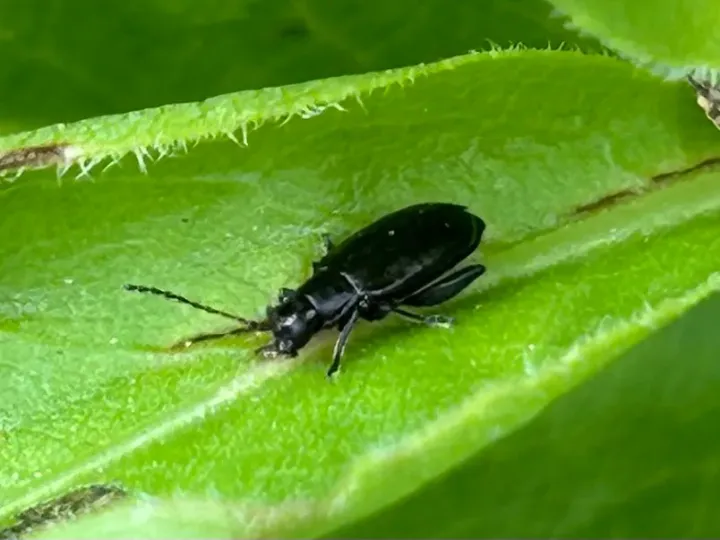
Adult beetles are typically 3.5 to 4.5 mm long, characterized by an elongated-oval, shiny black body. The elytra are covered with fine, dense punctures, giving them a slightly textured appearance.
Like other flea beetles, they possess enlarged hind femora, which grant them the ability to jump rapidly when disturbed. Their antennae are 11-segmented and thread-like.
Larvae are cream-colored or whitish, slender, and feature a dark-colored head. They inhabit the soil environment, where they feed on plant roots, making them difficult to detect until plant health declines.
Adults are highly active during warm, sunny days. They generally remain on the underside of leaves or within dense foliage, jumping away immediately if a predator or farmer approaches.
What it damages
This beetle is a generalist feeder (polyphagous), capable of attacking a wide variety of plant families, including Solanaceae, Fabaceae, and Asteraceae.
Commonly targeted crops include potatoes, tomatoes, beans, soybeans, and various crucifers. The pest also thrives on many invasive weeds, which act as alternative hosts throughout the season.
Adults cause damage by feeding on leaves, buds, and young shoots, resulting in characteristic "shothole" feeding damage. Larvae feed on roots, potentially stunting development.
Young seedlings are particularly vulnerable. Heavy infestations can lead to total crop loss if the plant's root system is severely compromised or the foliage is decimated at an early stage.
While often considered a secondary pest, large populations can significantly impact the photosynthetic potential of a crop, leading to reduced yield and poor produce quality.
When it appears
Hudson's flea beetles overwinter as adults, finding shelter in the top layer of soil, under leaf litter, or in dense vegetation at the borders of fields and wooded areas.
Emergence occurs in early spring as soil and air temperatures begin to rise. Initially, they feed on weed hosts before migrating to emerging agricultural crops.
The peak period of damage typically coincides with late spring and early summer, which is the most critical window for crop establishment.
Usually, there is one generation per year, though warmer climates may allow for a partial second generation if environmental conditions remain favorable.
By mid-to-late summer, adult activity often declines, and surviving beetles prepare for the upcoming dormant season, seeking overwintering sites as temperatures drop.
Signs of infestation
The most distinctive symptom of an infestation is the appearance of tiny, circular, or irregular holes in the leaf tissue, often creating a net-like or lacy appearance.
Affected leaves may yellow and wither if the feeding pressure is high, leading to premature leaf drop, especially in younger, more tender plants.
Below the surface, damaged root systems might show lesions, reduced root hairs, and poor overall vigor, which are indicators of larval feeding activity.
Stunted growth or wilting during the hottest parts of the day can indicate a heavy infestation that has significantly damaged the root or vascular system.
Presence of the pest can be confirmed by simply shaking a plant; the sudden, erratic jumping of small black beetles is a hallmark diagnostic feature of this species.
Control measures
Effective management requires an integrated approach focusing on crop rotation, sanitation, and timely interventions when thresholds are exceeded.
Rotation is critical; moving susceptible crops away from areas infested in the previous season helps break the pest's lifecycle and reduces overwintering success.
- Maintaining clean fields by removing weeds that act as reservoir hosts.
- Applying insecticides as a last resort when infestation levels threaten economic thresholds.
- Using yellow sticky traps for monitoring adult beetle populations during peak emergence.
Biological control efforts, including the use of entomopathogenic nematodes or fungi, can help suppress larval populations in the soil.
Promoting vigorous plant growth through proper irrigation and fertilization enables crops to better withstand minor feeding damage and recover more quickly.
Taxonomy
- Latin name
- Systena hudsonias
- Order
- Coleoptera (beetles)
- Family
- Chrysomelidae
- EPPO code
- SYSNHU
Discussion
No discussions yet — be the first.