
Fern weevil
Syagrius fulvitarsis
Description
How to identify
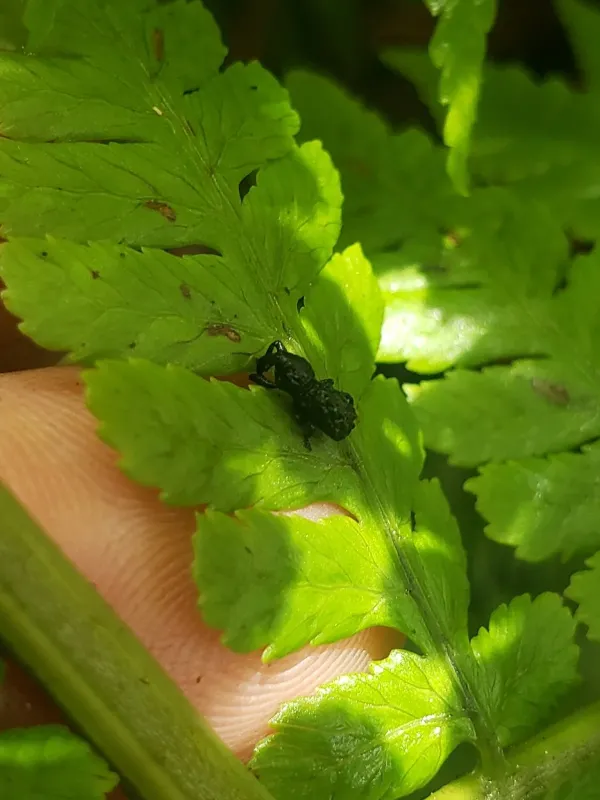
The fern weevil (Syagrius fulvitarsis) belongs to the family Curculionidae, order Coleoptera. Adult beetles have an elongated body approximately 6–8 mm in length, colored in dark brown or almost black tones with a subtle reddish tint on their legs.
The body of the beetle is covered with fine scales, which provide a matte appearance, making the insect nearly invisible against the bark or stems of the plant. A medium-length rostrum allows them to effectively bore into fern tissues for feeding and oviposition.
Larvae of this species are legless, have a curved body shape, and possess a yellowish-white coloration. They develop primarily inside the petioles or stems of the plant, which significantly complicates their visual detection during the early stages of infestation.
Pupae of the weevil are also hidden inside plant tissues. During the pupation phase, the larva creates special chambers where it undergoes metamorphosis until the adult emerges, which then bores an exit hole and leaves the damaged shoot.
This pest is most active in conditions of high humidity and moderate temperatures, making greenhouses, conservatories, and damp forest areas ideal environments for their mass reproduction.
What it damages
The primary food source for this species is various types of ferns, including both ornamental houseplants and forest species. In introduction conditions, this pest is capable of causing serious damage to greenhouse collections.
Adult beetles damage young shoots and mature fronds by chewing characteristic holes or nibbling at the base of the petioles. This disrupts the plant's vascular system integrity, hindering normal nutrition and crop growth.
The most significant damage is caused by the larvae, which tunnel inside the stem or petiole, consuming internal tissues. Such damage leads to tissue necrosis, loss of turgor, and often the complete death of individual shoots.
Severe weevil infestation causes the plant to stop producing new fronds, making the bush look sparse and deformed, ultimately losing its ornamental value, which is critical for plant nurseries.
In the natural environment, the pest can also reduce the overall vitality of fern colonies, making them more susceptible to secondary infections, such as fungal diseases that enter through wounds in the stems.
When it appears
The life cycle of the fern weevil is closely linked to climatic factors. In greenhouse conditions, the pest is capable of reproducing year-round, completing several generations per season under favorable conditions.
Adults are most active during the evening and nighttime, when they emerge to the surface for supplemental feeding and to search for mating partners. During the day, the beetles prefer to hide at the base of the plants or in leaf litter.
The peak of activity and mass reproduction often occurs in the spring-summer period, when there is active growth of new fern shoots, which are the preferred food for larvae and adults.
In outdoor conditions, insect activity decreases with the arrival of cold weather; however, in greenhouse settings, the temperature regime allows the population to remain consistently high throughout the year.
The development speed of a single generation depends on ambient temperature: as temperatures rise to optimal levels, the metamorphosis cycle shortens significantly, triggering population outbreaks.
Signs of infestation
The first sign of infestation is the appearance of multiple small holes on the fronds, which have uneven edges. As the damaged parts of the leaf grow, these holes may enlarge, leading to tearing of the leaf blade.
One of the most reliable indicators of larval presence inside the stem is the sudden yellowing and wilting of individual shoots, which seem healthy upon visual inspection but are found to be hollow when pressed.
When inspecting the base of the plant, one can often observe "frass" — fine sawdust-like waste expelled by larvae as they bore tunnels inside the petioles. This is a clear indicator of hidden pest presence.
Adults can be detected by carefully inspecting the undersides of leaves or leaf axils at night using a flashlight, as beetles have an instinct to freeze when threatened.
General growth retardation of the plant and deformation of young coiled "fiddlehead" fronds can also indicate that the pest has begun feeding at the growth point.
Control measures
The foundation of management is rigorous phytosanitary control. Infested plants should be immediately isolated from healthy ones to prevent the spread of adults within the collection.
Mechanical control involves hand-picking adult beetles in the evening. To increase efficiency, one can place a light-colored cloth under the bushes and gently shake the plant; the beetles fall down and are easy to collect.
Chemical protection includes the use of systemic insecticides that penetrate plant tissues. This is particularly effective against larvae inside stems, as they inevitably ingest the product while feeding.
Agronomic measures include the regular removal of plant debris, fallen leaves, and sanitary pruning of damaged fern parts that may contain weevil larvae or pupae.
Biological control methods may include the use of entomopathogenic nematodes applied to the substrate to suppress larval stages of the pest developing in the lower parts of the plant or directly in the soil.
Taxonomy
- Latin name
- Syagrius fulvitarsis
- Order
- Coleoptera (beetles)
- Family
- Curculionidae
- EPPO code
- SYAIFU
Discussion
No discussions yet — be the first.