
Club tunicate
Styela clava
Description
How to identify
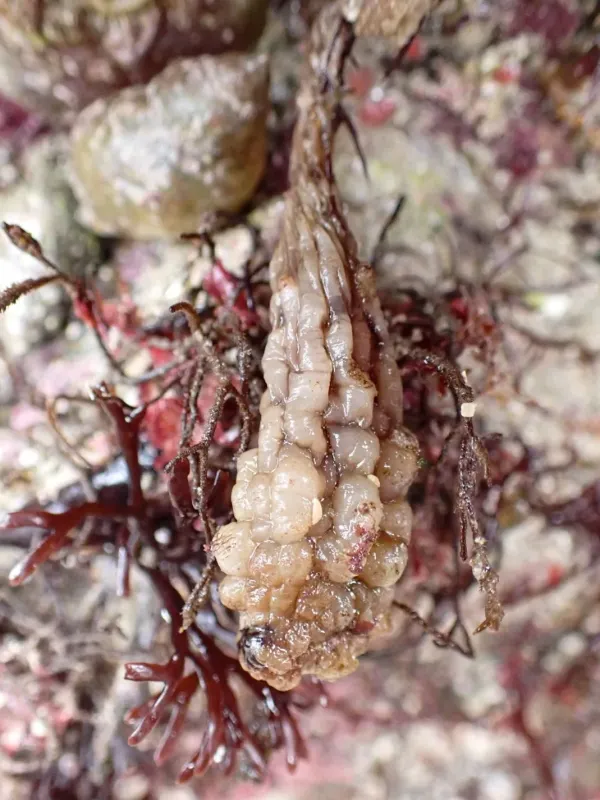
The club tunicate, scientifically known as Styela clava, is a solitary ascidian characterized by its elongated, club-shaped body and a narrow stalk.
Its outer covering, or tunic, is thick, leathery, and brown, often marked with small bumps or ridges that give it a rough, distinct texture.
These organisms can grow quite large, typically reaching lengths between 10 and 15 centimeters, making them easily identifiable on artificial surfaces.
The body features two prominent siphons—an oral and an atrial siphon—which are used for drawing in and expelling water during continuous filtration.
Belonging to the family Styelidae, this species is recognized globally as a highly successful and resilient invasive marine organism.
What it damages
The primary economic impact of the club tunicate is its role as a significant biofouling agent in shellfish aquaculture operations.
By settling on farming equipment like ropes and collectors, they compete directly with mussels and oysters for essential plankton and nutrients.
The heavy weight of large tunicate colonies can cause structural damage to submerged equipment, leading to line breaks and potential harvest loss.
Tunicates physically crowd out shellfish, restricting their growth rates and access to fresh, oxygenated water flow, which stunts the crop development.
Furthermore, they complicate harvesting processes, requiring intensive manual labor to remove the pests from the marketable shellfish and equipment.
When it appears
The reproductive strategy of Styela clava is temperature-dependent, with peak breeding activity occurring during warmer summer months.
They release larvae into the water column, where they exist as planktonic organisms, spreading rapidly via ocean currents to colonize new areas.
After a short swimming phase, the larvae attach themselves to solid surfaces, where they undergo metamorphosis into sedentary adults.
Growth is relatively rapid, and in temperate waters, multiple generations can emerge within a single growing season, leading to sudden outbreaks.
Adults exhibit high tolerance to environmental stress, including changes in salinity and temperature, ensuring their survival across diverse coastal zones.
Signs of infestation
A primary indicator of infestation is the presence of numerous leathery, cylindrical bodies attached to submerged ropes or harvesting nets.
Farmers often notice a sharp decline in shellfish weight and growth performance, directly correlated with the density of tunicate colonies.
Massive build-ups of brown, rough-textured organisms on aquaculture infrastructure serve as a clear sign of a severe, established infestation.
Visual inspections of mooring lines and buoyancy floats frequently reveal dense clusters of adult tunicates covering significant surface areas.
Difficulties in sorting harvested shellfish due to the presence of firmly attached tunicates are a common sign of a significant pest pressure.
Control measures
Management focuses on regular mechanical cleaning of equipment and ropes to minimize the buildup of mature tunicate colonies.
Strategic scheduling of equipment deployment can help avoid peak larval settlement periods, reducing the risk of colonization.
Immersion in concentrated salt brine or temporary air-drying of equipment are effective methods to kill juvenile tunicates without harming the crop.
The implementation of biosecurity protocols during the movement of aquaculture gear prevents the unintentional spread of the invasive species.
- Continuous monitoring of recruitment patterns in coastal areas.
- Application of specialized antifouling coatings on submerged structures.
- Culling and safe disposal of highly infested substrate materials.
Taxonomy
- Latin name
- Styela clava
- Family
- Styelidae
- EPPO code
- STYECL
Discussion
No discussions yet — be the first.