
Bamboo spider mite
Stigmaeopsis celarius
Description
How to identify
The bamboo spider mite (Stigmaeopsis celarius) is a member of the Tetranychidae family. These microscopic pests are notorious for forming colonies that reside within protected silk nests on the undersides of leaves.
The adult mites are extremely small, usually pale yellow or orange in color, and possess mouthparts designed specifically for piercing plant cells. Their movement is generally slow unless they are disturbed.
A distinctive feature of Stigmaeopsis celarius is its complex social behavior; they work together to construct elaborate silk webs that cover their feeding areas, offering protection from predators and environmental stress.
The development cycle consists of egg, larva, protonymph, deutonymph, and adult stages. The duration of this cycle is highly dependent on ambient temperatures, allowing for rapid outbreaks during warmer months.
Because they thrive in dense bamboo stands, their population can explode quickly, making them a significant concern for both professional bamboo nurseries and home gardens.
What it damages
This mite species primarily targets various bamboo genera, including Phyllostachys, Sasa, and Pleioblastus. They feed by puncturing the epidermis of the leaves and consuming the chlorophyll-rich cell contents.
Feeding damage disrupts the plant's photosynthetic capacity, leading to weakened overall health. As the plant loses nutrients, it becomes less vigorous and potentially susceptible to other plant pathogens.
In cases of severe infestation, the cumulative damage results in significant leaf discoloration and physiological stress, which can lead to the complete loss of foliage in extreme scenarios.
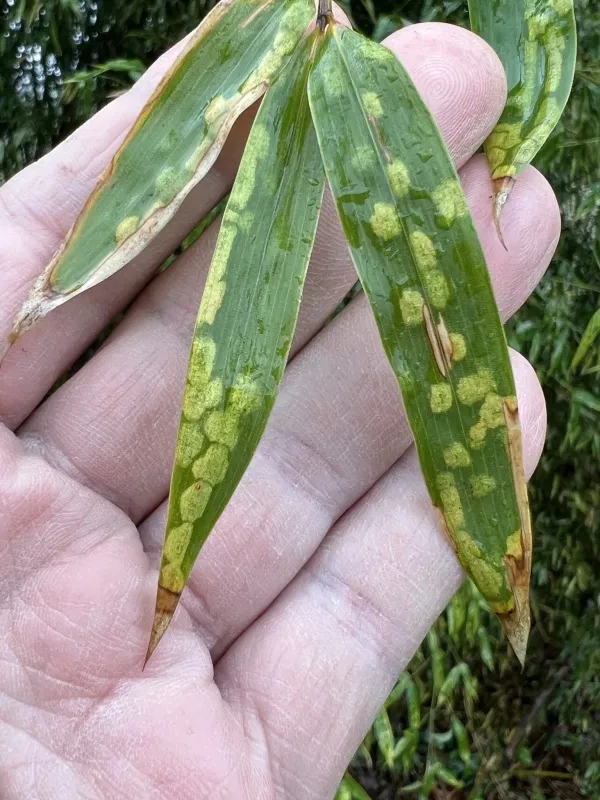
The aesthetic damage is particularly problematic for ornamental bamboo, as the leaves develop unsightly spotting and webbing that significantly decrease the plant's visual appeal.
Repeated feeding cycles can cause severe dieback of the plant's branches, impacting the growth rate and structural integrity of the bamboo grove over time.
Signs of infestation
The earliest signs of infestation are small, chlorotic dots on the upper surface of the leaves, which correspond to the mite feeding sites on the underside of the leaf.
Visible webbing is a diagnostic sign. Upon close inspection of the leaf underside, you will see thin, silken strands forming a webbed structure that houses the colony, eggs, and molted skins.
As the mite population grows, leaves begin to fade from a vibrant green to a dull, grayish or bronzed color, signaling extensive cell death and dehydration.
Leaf curling or distortion often occurs when the mite density is high, making the bamboo look unkempt and sickly. In advanced infestations, premature leaf drop becomes evident.
Using a handheld magnifying glass is essential for confirming the presence of these mites, as they appear as tiny moving particles within their protective silken galleries.
Control measures
Managing Stigmaeopsis celarius requires an integrated pest management (IPM) strategy that combines cultural practices with chemical or biological controls.
Maintaining plant health through adequate irrigation is a key cultural practice, as water stress often exacerbates spider mite damage and encourages higher reproduction rates.
- Applying specialized acaricides, focusing on systemic treatments that penetrate the leaf tissues.
- Introducing biological control agents, such as predatory phytoseiid mites, which effectively hunt and reduce spider mite populations.
- Regular pruning and removal of heavily infested leaves or branches to decrease the initial inoculum of the pest.
When using acaricides, it is critical to ensure thorough coverage of the underside of the leaves, as that is where the mites spend the vast majority of their lives.
Monitoring should be consistent throughout the growing season, with repeat applications of control agents often necessary to break the lifecycle of the mite before it becomes uncontrollable.
Taxonomy
- Latin name
- Stigmaeopsis celarius
- Order
- Mites
- Family
- Tetranychidae
- EPPO code
- SCZTCE
Discussion
No discussions yet — be the first.