
Mango weevil
Sternochetus olivieri
Description
How to identify
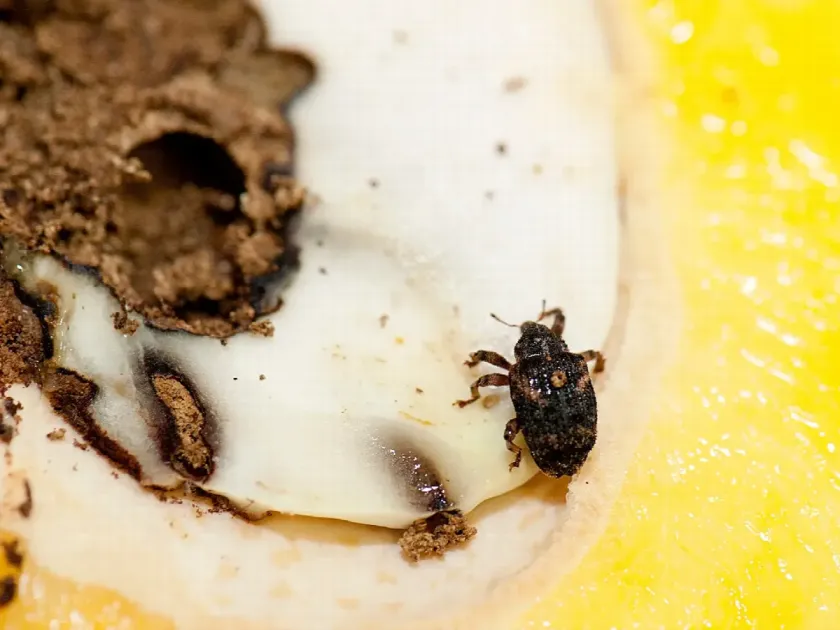
The mango weevil (Sternochetus olivieri) is a destructive insect pest belonging to the family Curculionidae within the order Coleoptera. Adult weevils are stout, oval-shaped beetles typically measuring about 8–10 mm in length, characterized by a dark brown or black coloration often with mottled markings on their wing covers.
These insects possess a very hard exoskeleton which makes them resilient to environmental stressors. Their rostrum (snout) is relatively short and broad, which is a distinctive feature of this sub-family of weevils. When disturbed, they exhibit thanatosis, or feigning death, by pulling their legs in close to their body, appearing like a small seed or debris.
Larvae of the mango weevil are legless, white or cream-colored, and typically C-shaped. They develop entirely inside the seed of the mango fruit, which makes them invisible to growers during the early stages of infestation.
The life cycle of Sternochetus olivieri is tightly synchronized with the flowering and fruiting season of mango trees. Adults seek shelter in bark crevices, leaf litter, or soil during the off-season, emerging when conditions are favorable to begin the reproductive cycle.
Females lay eggs on the surface of developing fruits, covering them with a protective, waxy secretion. Once hatched, the neonate larvae bore directly into the pulp and migrate into the seed, where they undergo multiple molts before pupating inside the damaged seed.
What it damages
The primary host for this pest is the mango tree (Mangifera indica). While some weevils affect other fruit, the mango weevil is highly specialized, concentrating its damage on the fruit's internal structures, which presents a significant challenge for orchard management.
Damage is caused almost exclusively by the larvae. As they feed, they tunnel through the flesh of the fruit to reach the seed, leaving behind frass and galleries that degrade the quality of the fruit. This process often leads to the fruit dropping prematurely from the tree.
Even if the fruit remains on the tree, the internal damage caused by the larvae acts as a gateway for secondary fungal and bacterial infections. This leads to flesh discoloration, rot, and the emission of foul odors, rendering the fruit completely unmarketable.
Seed damage is the most critical factor, as it prevents the seed from germinating properly. This is particularly devastating in nurseries or for farmers who rely on seed propagation, as the viability of the seed is compromised by the weevil's feeding activities.
In neglected orchards, infestation rates can be catastrophic, with nearly all fruits on a single tree showing signs of internal damage. Without systematic control, Sternochetus olivieri can significantly reduce both the quantity and the commercial value of the mango harvest.
Signs of infestation
The most common sign of infestation is the presence of small, brownish oviposition scars on the surface of young fruits. These scars are often obscured by the natural waxy layer of the fruit, requiring close inspection to detect.
As the larvae mature inside the fruit, dark, sunken areas may appear on the skin. However, in many cases, the fruit shows no obvious external symptoms until it is cut open, which creates major difficulties for quality control at harvest time.
Cutting into a suspected fruit often reveals a network of tunnels through the pulp, and the stone (seed) itself may be hollowed out or partially destroyed. Inside these cavities, one can frequently find the larvae, pupae, or even adult weevils preparing to emerge.
Premature fruit drop is a reliable indicator that the orchard is infested. Gathering and examining fallen fruits allows growers to assess the level of infestation and determine whether immediate remedial actions are required to save the remainder of the crop.
The presence of adult weevils in the orchard can sometimes be observed on the tree trunks, especially during the early morning or evening. They often hide in bark crevices, so inspecting these areas can help confirm their activity during the fruit setting season.
Control measures
The most effective strategy for managing the mango weevil is rigid orchard hygiene. Regularly collecting and destroying all fallen fruit is crucial, as this eliminates the primary reservoir where the larvae complete their development and pupate.
Chemical control involves the application of systemic insecticides during the fruit-set stage. Treatments must be carefully timed to target adult weevils before they have the opportunity to lay eggs on the developing fruit surface.
Integrated Pest Management (IPM) techniques, including the use of pheromone traps, have shown promise in monitoring population levels and timing insecticide applications more effectively, thereby reducing the need for broad-spectrum chemical sprays.
- Pruning trees to improve light penetration and air circulation.
- Utilizing entomopathogenic fungi as a biological control agent.
- Implementing strict quarantine measures for fruit transport between regions.
Cultural practices such as maintaining tree vigor through appropriate fertilization and water management also play a supporting role. Healthy trees are generally better equipped to compensate for minor pest damage and recover more efficiently after control measures have been applied.
Taxonomy
- Latin name
- Sternochetus olivieri
- Order
- Coleoptera (beetles)
- Family
- Curculionidae
- EPPO code
- SRNCOL
Discussion
No discussions yet — be the first.