
Common tern
Sterna hirundo
Description
How to identify
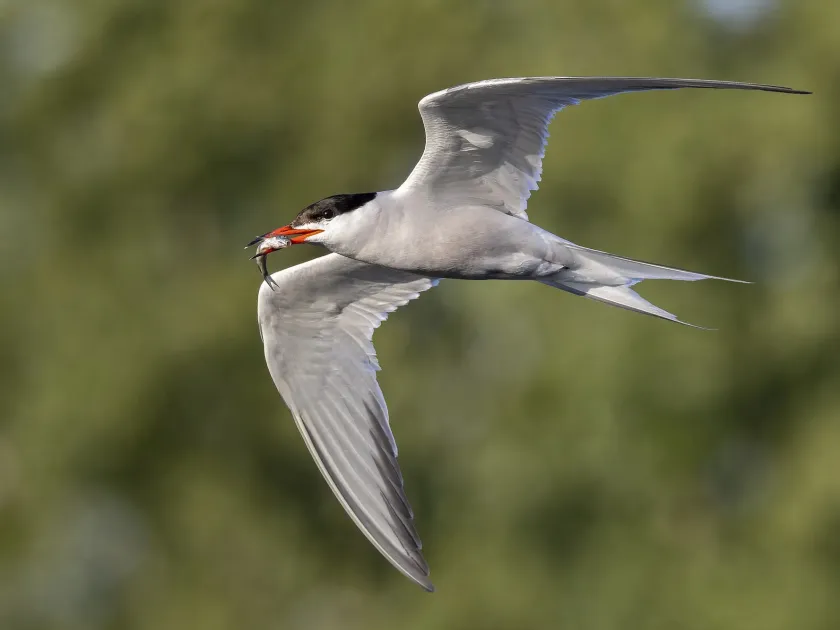
The Common tern (Sterna hirundo) is a seabird belonging to the Laridae family in the Charadriiformes order. It is characterized by a slender body, a deeply forked tail, and a sharp, pointed, reddish-black bill.
Adult birds exhibit a distinctive black cap on their heads during the breeding season, which contrasts sharply with their pale grey wings and white underparts, making them easily identifiable.
They typically nest in large, noisy colonies on sandy beaches, gravel spits, and islands, choosing locations that provide quick access to open water for hunting.
These birds are known for their exceptional agility in flight, performing aerial dives from significant heights to catch small fish near the surface of the water.
Their biological adaptations, including highly social behavior and predatory accuracy, make them successful inhabitants of various aquatic environments, including managed artificial ponds.
What it damages
In the context of aquaculture, the Common tern is viewed as a pest because its primary diet in freshwater environments consists of small fish, specifically the fry stocked in breeding ponds.
The most significant damage occurs when fish farmers introduce young fry into nursery ponds, where the high density of small fish provides an easy and abundant food source for the terns.
A single colony can consume thousands of fish over the course of a breeding season, leading to severe economic losses and reducing the overall productivity of the fishery operations.
Beyond the direct consumption of fish, terns can act as vectors for various parasitic infections, potentially introducing pathogens into closed water systems, which impacts fish health.
Constant foraging activities by these birds impose chronic stress on the fish, which inhibits their growth rates and increases their vulnerability to diseases and poor environmental conditions.
When it appears
The Common tern's activity in agricultural regions aligns with the spring and summer months, typically spanning from late April through August, coinciding with the peak aquaculture season.
The breeding cycle, which involves intense feeding of nestlings in June and July, represents the period of highest risk for fish farmers requiring the most rigorous protection protocols.
Late summer marks a transition as the young birds fledge and the colony prepares for autumn migration, resulting in a gradual decrease in foraging activity at managed pond sites.
Understanding the timing of their breeding cycle is crucial for fishery management, as it allows for the implementation of preventative deterrent measures before the colony establishes itself.
Proactive monitoring at the beginning of the season ensures that strategies are deployed before the birds become habituated to the feeding grounds provided by the artificial ponds.
Control measures
Effective management of Common terns requires non-lethal deterrent methods to comply with bird protection regulations while minimizing damage to aquaculture stocks.
Visual deterrents, such as spinning mirrors, reflective tape, or silhouettes of raptors, can successfully discourage terns from approaching the water surface if repositioned regularly.
Acoustic deterrent systems that play recorded distress calls or the sounds of natural predators can create an inhospitable environment that encourages the flock to abandon the site.
Physical exclusion methods are highly effective: stretching nylon monofilament lines or protective nets across the surface of the ponds prevents birds from diving for their prey.
Habitat management techniques, such as keeping pond banks free of dense vegetation and managing water levels during the breeding season, can make the site less attractive for nesting and hunting.
Taxonomy
- Latin name
- Sterna hirundo
- Family
- Sternidae
- EPPO code
- STNAHI
Discussion
No discussions yet — be the first.