
Steriphus diversipes
Steriphus diversipes
Description
How to identify
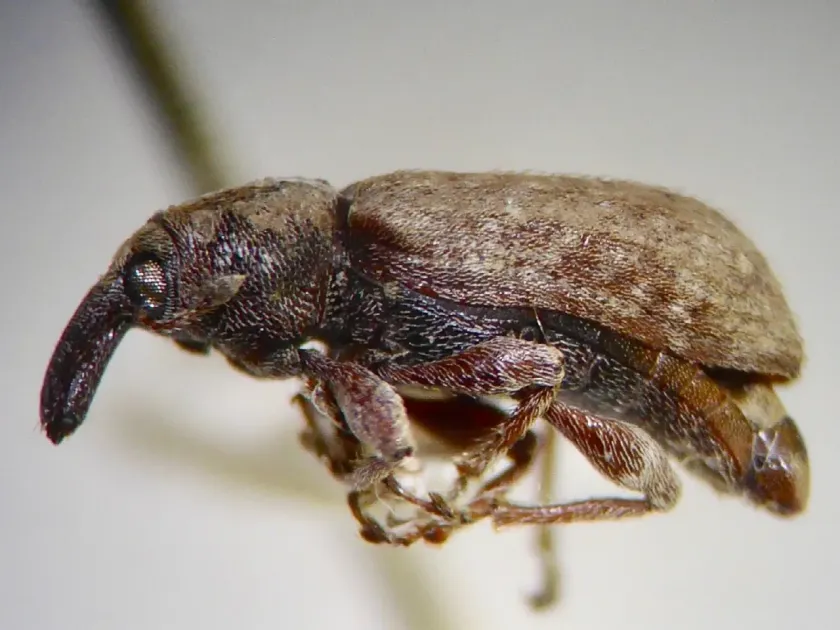
Steriphus diversipes belongs to the order Coleoptera and the family Curculionidae. It is a small insect characterized by a snout-like mouthpart, which is typical for members of the weevil family.
Adult individuals possess protective coloration, allowing them to blend into leaves and stems. A key identifying feature is the variation in leg structure, reflected in the scientific name, as well as the specific texture of their elytra.
The insect undergoes complete metamorphosis: egg, larva, pupa, and imago. The larvae are usually legless, white or cream-colored, and develop in hidden environments, making them difficult for agronomists to detect in fields.
Adult beetles are cryptic, preferring to be active during twilight hours or overcast weather. On hot sunny days, they often hide in leaf axils or in the topsoil layer near the base of the plant roots.
Reproduction occurs during the spring and summer. Females lay eggs directly into plant tissues or soil, providing the offspring with a nutrient-rich environment and protection from unfavorable external conditions.
What it damages
This pest species specializes in damaging a wide range of herbaceous plants, including various agricultural crops and weeds, which serve as reservoirs for the population.
Larvae cause primary damage to the root system by feeding on roots or boring into stems, disrupting nutrient and water transport throughout the plant. As a result, the crop shows stunted growth and may eventually wither and die.
Adult beetles feed primarily on above-ground parts, creating holes in leaf blades. In cases of high infestation, skeletonization of leaves occurs, significantly reducing the surface area available for photosynthesis.
The greatest economic damage is observed in young crops that have not yet developed sufficient regenerative capacity. Infested plants are more susceptible to secondary infections, including fungal and bacterial diseases that enter through feeding wounds.
The damage caused by this pest often leads to sparse crop stands, necessitating additional costs for reseeding or intensive protective measures during the growing season.
Control measures
Effective control of Steriphus diversipes requires an integrated approach that combines agrotechnical, biological, and chemical methods to monitor and manage population density.
A key agrotechnical measure is strict crop rotation, which breaks the insect's development cycle. It is crucial to perform deep autumn plowing to eliminate larvae and pupae residing in the soil.
Regular field monitoring is essential during the mass emergence of adults. The use of light traps and pheromone traps allows for accurate determination of peak activity, helping to time insecticide applications efficiently.
Chemical control involves the application of systemic or contact-stomach insecticides when the economic threshold of damage is exceeded. Treatments must be carried out in strict accordance with local regulatory guidelines.
- Regular weeding to remove reservoir hosts.
- Timely fertilization to improve plant immunity.
- Use of high-quality, certified seeds.
- Optimization of sowing dates to avoid peak emergence periods.
Taxonomy
- Latin name
- Steriphus diversipes
- Order
- Coleoptera (beetles)
- Family
- Curculionidae
- EPPO code
- DESIDI
Discussion
No discussions yet — be the first.