
Ash weevil
Stereonychus fraxini
Description
How to identify
The Ash weevil (Stereonychus fraxini) is a specialized beetle species belonging to the family Curculionidae. It is a well-known pest that primarily targets ash trees (Fraxinus spp.) in Europe and parts of Asia, significantly affecting forest health.
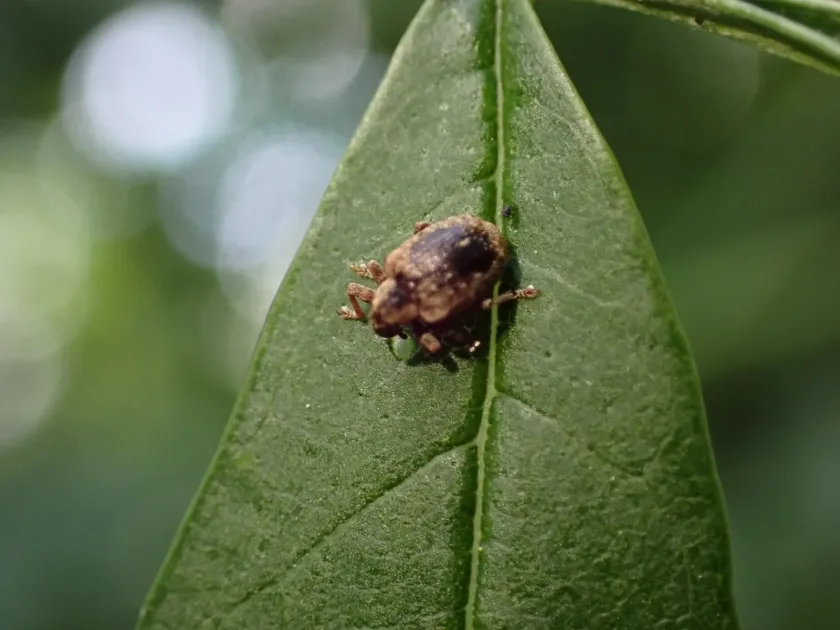
Adult weevils are small, measuring approximately 3–4 mm in length. Their bodies are covered in dense gray to brownish scales, providing an excellent camouflage that allows them to blend perfectly with the bark and foliage of the host tree.
The larvae are legless, sickle-shaped, and creamy-yellow in color. Unlike many other weevils that develop within the soil or stems, the larvae of Stereonychus fraxini feed openly on the surface of the leaves throughout their development.
A unique characteristic of this species is its pupation process. The larvae spin intricate, white net-like cocoons directly on the underside of the leaves, where they undergo metamorphosis into the adult stage.
The species completes one generation per year. Adult weevils overwinter in the leaf litter, under loose bark, or in other protected areas, emerging in the spring when temperatures rise sufficiently to trigger their reproductive cycle.
What it damages
The primary host for this pest is the European ash (Fraxinus excelsior). Both adults and larvae contribute to the damage, causing physiological stress to the trees through intensive defoliation of the canopy.
Adult weevils feed on the leaves by creating numerous small, characteristic holes. As the population density increases, these individual feeding spots can merge, leading to a significant reduction in the total photosynthetic surface area.
Larvae feed by scraping the leaf epidermis and parenchyma, leaving behind thin, irregular galleries. In cases of severe infestations, the leaves become heavily skeletonized and lose their functionality, eventually turning brown and falling prematurely.
Chronic infestation weakens the trees, making them susceptible to secondary pests such as bark beetles and wood-boring insects. This combination often leads to the decline and mortality of trees in infested stands.
Forestry and urban landscapes suffer economic and aesthetic losses due to the premature thinning of ash canopies, which is particularly detrimental in parks, street plantations, and biodiversity-rich forest ecosystems.
When it appears
Activity begins in early spring as ash trees start to flush. The overwintering adults emerge from their dormant state to feed on the tender, young foliage, which is critical for their maturation before mating.
Mating and oviposition occur throughout late spring. Females lay eggs individually on the underside of the leaves, ensuring that the hatching larvae have immediate access to a food source.
The most active feeding period for larvae is early summer. During this time, they rapidly consume leaf tissues, which is when the visual impact on the trees becomes most apparent to observers and forest managers.
Pupation is typically completed by mid-summer. A new generation of adults emerges in late summer, feeds briefly on the remaining leaves, and then seeks out suitable overwintering sites as the day length and temperatures decrease.
Signs of infestation
The first indication of an ash weevil infestation is the presence of small, characteristic perforation holes in the newly formed leaves. These holes are distinct and often appear in clusters across the foliage.
The presence of fine, white, net-like cocoons on the underside of the leaves is a diagnostic sign. These cocoons are clear evidence of the larval presence and are easily identified upon close inspection of the tree canopy.
When disturbed, the adult beetles often exhibit a defensive behavior known as thanatosis, where they drop from the branches to the ground, appearing dead. This reaction makes them difficult to spot during a quick visual survey.
Premature leaf drop during the summer season, in the absence of other obvious factors like drought or fungal diseases, strongly suggests a severe infestation of this pest within the tree canopy.
- Characteristic small holes in the foliage.
- Visible white net-like cocoons on leaves.
- Early summer defoliation and leaf yellowing.
- Adult beetles dropping to the ground when branches are shaken.
Control measures
Management often involves the use of systemic or contact insecticides during the early spring when the adults emerge from overwintering. This timing is crucial to interrupt the life cycle before the mass egg-laying phase.
Cultural control practices, such as the removal and destruction of leaf litter in the autumn, can be highly effective. By eliminating the primary overwintering sites, the population pressure for the following spring is significantly reduced.
In urban areas where chemical pesticides are undesirable, biological control using entomopathogenic fungi or predators can help maintain population levels below the economic threshold of damage.
Promoting a healthy environment for natural predators, such as insectivorous birds and parasitic wasps, plays a vital role in natural regulation and prevents population explosions of the ash weevil.
Maintaining tree vigor through proper irrigation and soil management improves the tree's natural defense mechanisms, allowing for better recovery after minor to moderate infestation events.
Taxonomy
- Latin name
- Stereonychus fraxini
- Order
- Coleoptera (beetles)
- Family
- Curculionidae
- EPPO code
- STRNFR
Discussion
No discussions yet — be the first.