
Ash weevil
Stereonychus
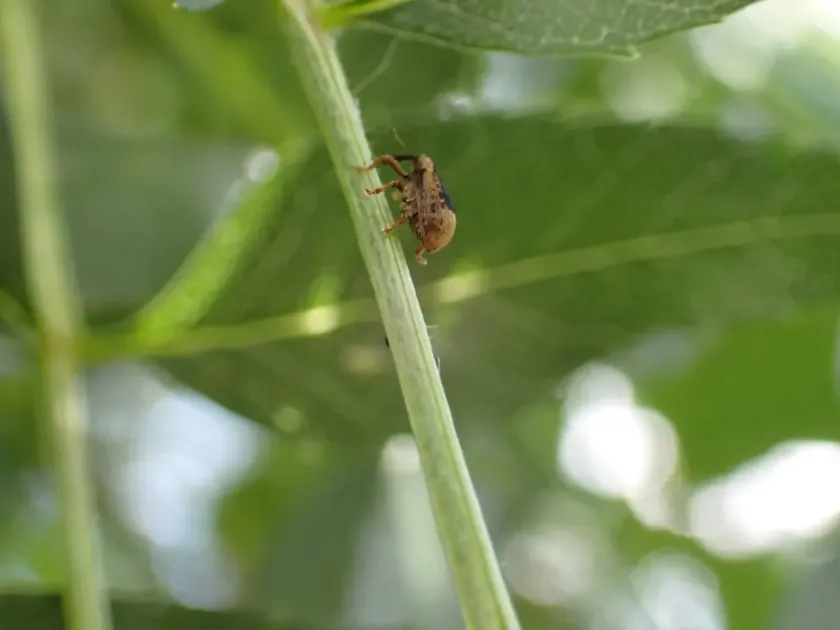
Description
How to identify
The Ash weevil (Stereonychus fraxini) is a small beetle belonging to the Curculionidae family. Adult beetles typically measure between 3 and 4 mm in length and possess a mottled brownish-grey appearance that provides excellent camouflage against tree bark.
The larvae are legless and possess a soft, arched body. A unique biological trait of this species is the construction of protective larval cocoons directly on the surface of the host leaves, which distinguishes them from many other leaf-feeding weevils.
What it damages
This beetle is a specialist herbivore restricted to plants of the genus Fraxinus (ash trees). Both the adults and the larval stages feed exclusively on the foliage of these trees, causing significant defoliation.
In high-density populations, the beetle can severely damage young ash forests and urban park plantations. Repeated annual defoliation weakens the trees, leading to reduced vigor and stunted growth of young plants.
When it appears
The lifecycle is highly synchronized with the leaf flushing of ash trees. Adult weevils emerge from hibernation in the spring as soon as the first leaves develop, starting a period of intensive maturation feeding.
The species completes one generation per year. After larval development and pupation on the leaves, the new generation of adults emerges in mid-to-late summer before seeking shelter in the forest litter or bark crevices for winter hibernation.
Signs of infestation
The primary symptom of infestation is characteristic leaf damage. Adults create small, circular shot-holes across the leaf surface, while larvae feed by skeletonizing the leaf blade, leaving only the complex network of veins intact.
Severe infestations result in a scorched appearance of the canopy. Trees may experience premature leaf drop, which impairs the tree's ability to produce necessary energy reserves for the following season.
Control measures
Integrated Pest Management (IPM) strategies for the Ash weevil emphasize regular monitoring of canopy damage. In forest environments, encouraging natural predatory insects and birds is considered the most sustainable approach.
If direct intervention is required, such as in high-value ornamental plantings or nurseries, systemic insecticides are applied during the initial spring feeding phase of the adult beetles to prevent egg-laying and further population growth.
Taxonomy
- Latin name
- Stereonychus
- Order
- Coleoptera (beetles)
- Family
- Curculionidae
- EPPO code
- STRNSP
Discussion
No discussions yet — be the first.