

Pest · Coleoptera (beetles) · affects Cereals, Winter wheat, Winter barley
Drugstore beetle
Stegobium paniceum
Description
How to identify
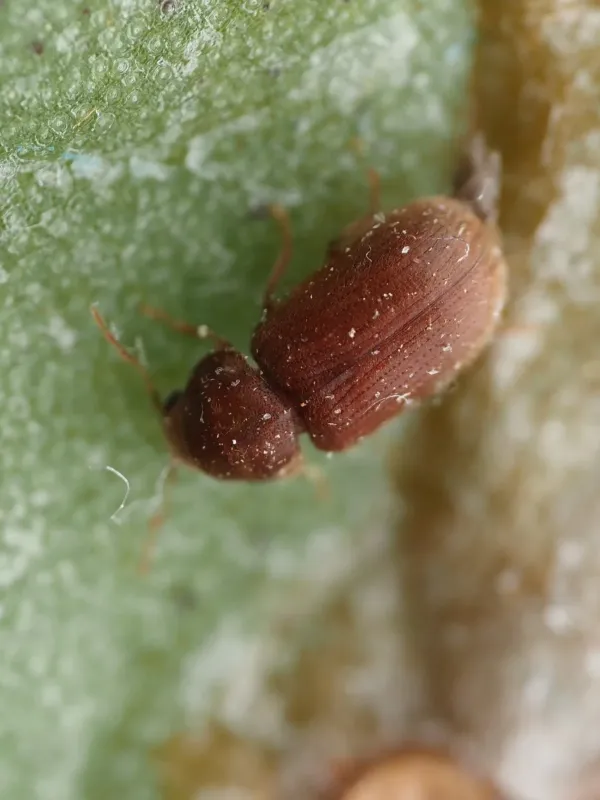
The drugstore beetle (Stegobium paniceum) is a small, light-brown insect belonging to the Anobiidae family. Adults typically measure about 2–3 mm in length and have a cylindrical, hairy body.
The head of the beetle is strongly bent downwards and almost hidden by the pronotum, which is a classic diagnostic feature. They are strong fliers and are attracted to light, which explains their presence in various parts of a facility.
Larvae are white, C-shaped, and possess well-developed mouthparts for boring into hard food sources. They develop inside the infested material, where they also pupate within a silken chamber created from food particles.
The lifecycle depends heavily on the ambient temperature. In favorable conditions, they can complete a full generation in under two months, leading to multiple overlapping generations per year.
Despite their name, drugstore beetles have a remarkably broad range of habitats. They are frequently found in warehouses, grocery stores, pharmacies, museums, and private homes where dry food is stored.
What it damages
This species is a generalist feeder that damages a vast array of plant-based products. Common targets include grain, flour, dry pet food, pasta, spices, and even dried medicinal herbs.
The beetle has earned its reputation due to its ability to consume extremely hard materials, such as dried roots, coffee beans, and even toxic substances like strychnine or belladonna.
In non-food environments, they pose a significant threat to archives and museums. They bore through book bindings, historical documents, stuffed animals, and leather goods, causing irreversible structural damage.
Damage is characterized by the presence of small, round exit holes and the accumulation of powdery debris. The infested material becomes contaminated with waste products, making it unusable and unhygienic.
Due to their ability to chew through paper, cardboard, and thin plastic, they can easily invade new supplies of food. Once inside, they reproduce rapidly, turning entire batches of stored products into dust.
When it appears
Infestation activity is highly correlated with environmental temperatures. In unheated areas, adult activity usually peaks during the warm summer months when the weather allows for rapid breeding.
In temperature-controlled indoor environments, such as houses or heated warehouses, the drugstore beetle can remain active and breed continuously throughout the entire year.
The pests overwinter in all developmental stages, mostly hiding deep within the infested material. This behavior makes them resilient to cold spells, as they are insulated by the product they feed on.
The emergence of adult beetles is often noticed in spring and summer. During this time, they migrate to find new substrates for egg-laying, expanding the area of infestation significantly.
Monitoring for adults should be consistent throughout the warmer months. If beetles are sighted on shelves or near lighting fixtures, it is a strong indicator of an established colony nearby.
Signs of infestation
The most visible sign of an infestation is the appearance of tiny, round pin-sized holes on the surface of packaging or stored goods. These holes are created by emerging adults.
When an infested bag or container is opened, one may observe fine, dusty material that differs in texture and color from the original food product. This is a mix of larvae frass and debris.
Living beetles can often be found crawling on surfaces, particularly near the site of infestation. They are more active in the evening and tend to congregate near windows or lamps.
A musty or moldy odor often precedes other physical signs. This scent is caused by the metabolic activity of larvae as they process the food material in large numbers.
In cases of severe infestation, one might find clumped masses of food held together by silk webbing. If you notice small holes in cardboard boxes or dry food bags, consider the product compromised.
Control measures
The first step in controlling drugstore beetles is strict sanitation. All spilled crumbs and old residues must be removed from shelving units and hidden corners where populations can build up.
Heat and cold treatments are highly effective for household use. Placing infested items in a freezer for at least 3-4 days at -15°C or heating them in an oven at 50-60°C will kill all lifecycle stages.
To prevent re-infestation, store all dry foods in glass, metal, or high-density plastic containers with airtight seals. Avoid keeping large quantities of dry goods in paper bags for extended periods.
In professional settings, fumigation with phosphine is the standard for large-scale infestations. This procedure should only be performed by licensed pest control operators using appropriate safety equipment.
- Inspect all bulk food items before storing them in the pantry.
- Use pheromone-based traps to monitor and reduce adult beetle populations.
- Maintain low humidity levels (below 60%) to deter development.
- Immediately dispose of any products found to be infested to prevent spread.
Content graph
Connections · Drugstore beetle
Most often together:
Marketplace
Products · 5
Biology
Taxonomy
- Latin name
- Stegobium paniceum
- Order
- Coleoptera (beetles)
- Family
- Anobiidae
- EPPO code
- STEGPA
Community
Discussion
No discussions yet — be the first.