
Angel shark
Squatina squatina
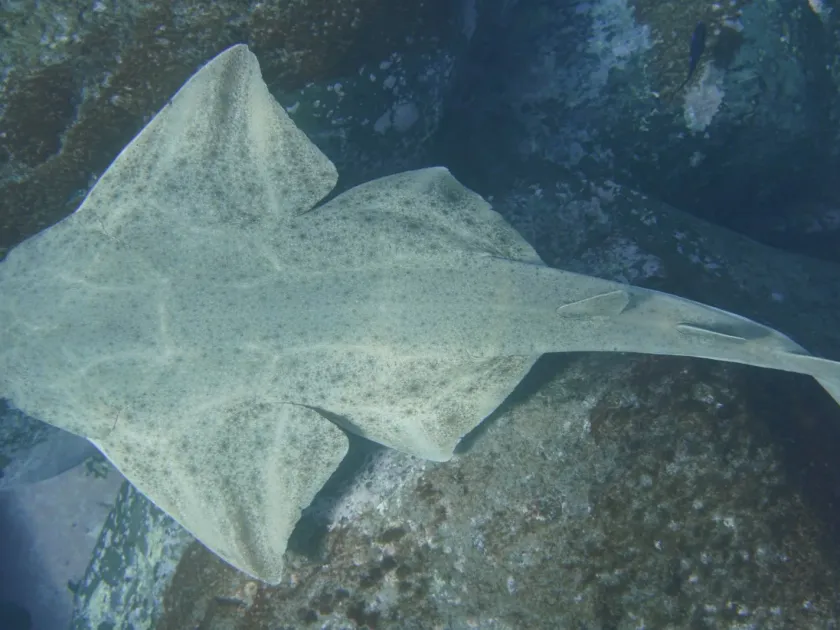
Description
How to identify
The Angel shark (Latin Squatina squatina) is a species of cartilaginous fish belonging to the family Squatinidae and the order Squatiniformes. Its flattened body structure often causes confusion with rays, though it is genetically a shark.
These sharks can grow up to 2.4 meters long. Their coloration varies from grey to reddish-brown, allowing them to remain perfectly camouflaged on sandy or muddy substrates where they lie in wait for prey.
The species is native to the eastern Atlantic Ocean, the Mediterranean, and the Black Sea. It lives at depths ranging from shallow coastal waters to about 150 meters.
The mouth is positioned terminally, and the shark is equipped with sharp teeth adapted for capturing fish, crustaceans, and cephalopods, which constitute its entire diet.
This species is strictly a marine vertebrate and has zero ecological interactions with terrestrial plant systems, crops, or farming environments.
What it damages
The Angel shark is not a pest. It does not cause damage to crops, forests, or ornamental plants. It lacks the biological mechanisms to affect plant health.
In agricultural science, there is no evidence of this species damaging any agricultural commodities. Any claim labeling it as a pest is scientifically incorrect.
The Shark does not interact with the soil, foliage, or roots of plants. It remains in its marine environment throughout its entire life cycle, including reproduction.
There are no economic or agricultural losses associated with this species. It is a part of marine biodiversity that does not intersect with human agriculture.
Agro-consultants should note that citing Squatina squatina as a pest is a common database error that should be ignored in professional practice.
Control measures
There are no control measures for this species in agriculture because it poses no threat to farming. No pesticides, traps, or management strategies are relevant.
On the contrary, the Angel shark is a critically endangered species protected by international conservation laws, including the IUCN Red List.
Efforts should focus on environmental protection rather than eradication, as this species contributes to the health of marine ecosystems.
For research purposes, verify scientific names carefully to ensure that marine animals are not accidentally included in lists of plant pests.
- Critically endangered species.
- Zero agricultural impact.
- No pest control needed.
Taxonomy
- Latin name
- Squatina squatina
- Family
- Squatinidae
- EPPO code
- SQUTSQ
Discussion
No discussions yet — be the first.