
Bud moth
Spilonota ocellana
Description
How to identify
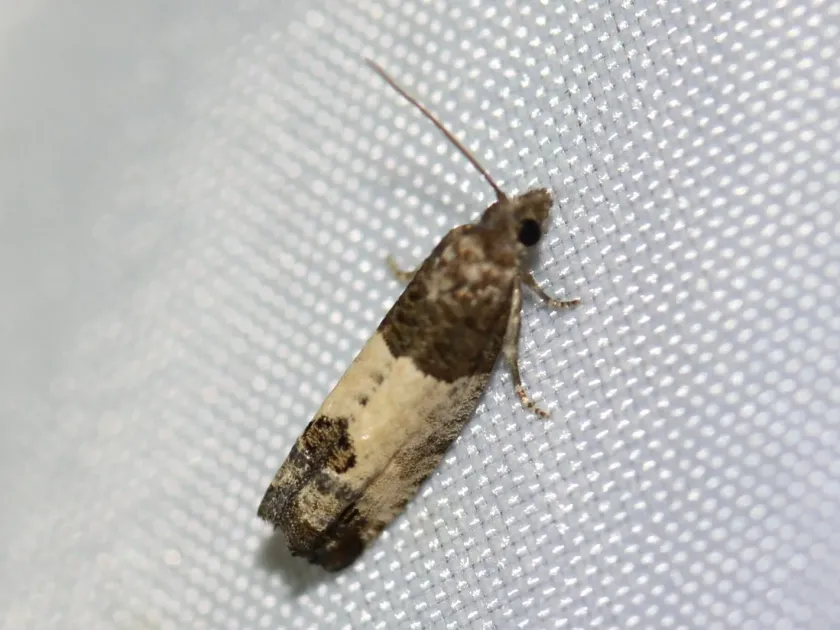
The Bud moth Spilonota ocellana is a significant pest belonging to the Tortricidae family. The adult moth has a wingspan of approximately 15–18 mm, with distinctive grey-brown forewings featuring a broad, irregular white band across the middle.
The larvae are typically 10–12 mm long when fully grown, characterized by a dark brown or chocolate-colored body and a shiny black or dark brown head capsule.
They overwinter as second or third-instar larvae within tough white silken cocoons, which are strategically placed in crevices of tree bark or near the buds of host plants.
The life cycle consists of one generation per year. In spring, as temperatures rise, the larvae emerge from their overwintering sites to feed on developing tissues.
Adult moths emerge in early summer, typically between June and July. Females lay their eggs singly on the upper surfaces of leaves, starting the cycle anew.
What it damages
The Bud moth is a polyphagous pest that affects a wide variety of Rosaceae species, including apple, pear, plum, cherry, and quince trees.
Spring feeding is the most destructive phase, as larvae target swelling buds, preventing proper leaf and blossom development.
By webbing together developing leaves, blossoms, and shoots, the larvae create protective enclosures that disrupt plant growth and photosynthesis.
Later in the season, larvae may feed on the surface of developing fruit, creating irregular shallow holes that ruin the appearance and market value of the crop.
High infestation levels can severely weaken young trees and lead to significant yield losses in mature orchards if not managed properly.
Signs of infestation
Early spring signs include buds that fail to open or appear chewed and withered at the base, often covered with silk webbing.
During the blooming period, look for tightly webbed clusters of blossoms and leaves, which indicate the presence of feeding larvae inside.
Damaged leaves often appear skeletonized or rolled into tubes, showing signs of necrosis or yellowing due to the feeding activity of the larvae.
The presence of small, white silken cocoons tucked into bark cracks during the dormant season is a clear indicator of the overwintering population.
Surface scars or shallow, corky spots on young fruit are typical indicators of larval feeding that occurred during the fruit-setting stage.
Control measures
Good orchard sanitation, including the removal of dead or loose bark from tree trunks, helps destroy the overwintering sites of the larvae.
Pruning out and disposing of infested shoots or "nests" in spring can significantly reduce the local population of the pest.
Chemical control should be timed to coincide with the larval emergence phase, typically during the "green tip" or "pink bud" stages of tree development.
Integrated Pest Management (IPM) practices, including the use of pheromone traps, help monitor moth flight and determine the precise timing for interventions.
- Regular monitoring of flight activity using pheromone-baited traps.
- Application of selective biological insecticides like Bacillus thuringiensis.
- Conservation of natural predators and parasitoids that help regulate pest populations.
Taxonomy
- Latin name
- Spilonota ocellana
- Order
- Lepidoptera (butterflies)
- Family
- Tortricidae
- EPPO code
- TMETOC
Discussion
No discussions yet — be the first.