
Larch tortrix
Spilonota laricana
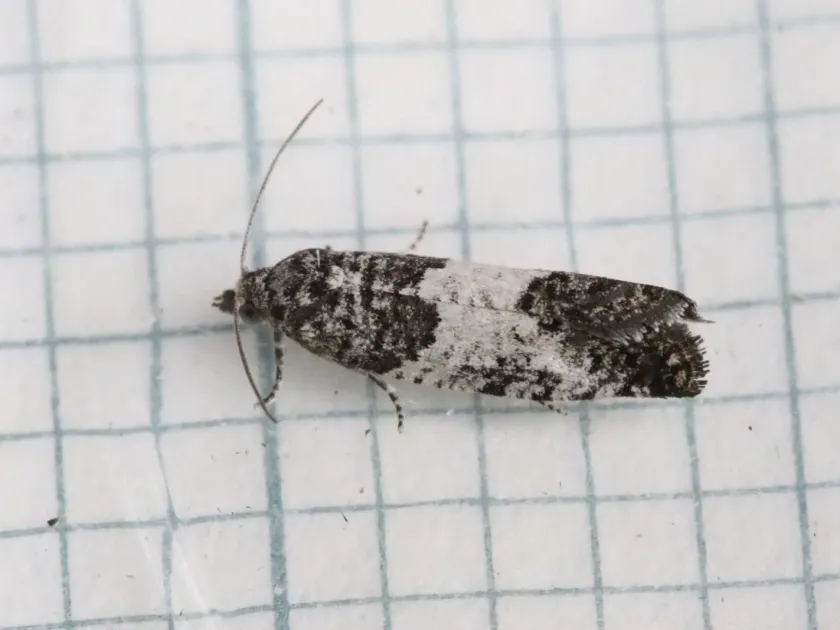
Description
How to identify
The Larch tortrix (Spilonota laricana) is a moth belonging to the family Tortricidae. The adult moth is small, typically having a wingspan of approximately 12–15 mm.
The forewings have a mottled, greyish-brown pattern that provides excellent camouflage against larch bark and needles. The hindwings are generally paler and fringed with fine hairs.
The larva, or caterpillar, is the stage responsible for damage. It typically possesses a brown head capsule and a body color that shifts from pale green to reddish-brown.
This species overwinters as a young larva, seeking refuge under bark scales or in small crevices on the tree trunk until spring temperatures rise.
The life cycle is closely synchronized with the larch host plant, ensuring that the larvae emerge exactly when the buds start to open and new needles appear.
What it damages
The Larch tortrix specifically targets the larch tree (Larix). Larvae feed voraciously on the opening buds and later on the soft, young needles.
Feeding damage results in skeletonized needles, which eventually turn brown and wither, leading to a thin and sickly appearance of the tree canopy.
High population densities can cause significant defoliation, which severely stresses the tree and can lead to a reduction in annual growth rates.
While mature trees can often withstand moderate infestations, young saplings and nursery stock are at high risk of permanent damage or death due to complete loss of foliage.
Repeated yearly defoliation weakens the trees' natural defenses, making them susceptible to secondary infestations by bark beetles and wood-boring insects.
When it appears
The active season begins in early spring as larvae emerge from their wintering sites and move toward the growing tips of the branches.
During May and June, larvae actively build silk-spun nests among the needles, creating a protected micro-environment where they feed and undergo pupation.
Adult moths emerge in mid-summer, typically in July, to mate and lay eggs on the needles or thin twigs, completing the single-generation cycle in many areas.
The newly hatched larvae from the summer eggs feed briefly before finding suitable wintering sites to survive the cold season.
Thus, the most critical window for observing the pest and implementing control measures is the spring period, coinciding with the rapid growth phase of the larch needles.
Signs of infestation
The most prominent sign of infestation is the presence of clusters of needles tied together with fine, silken webbing, forming loose and untidy nests.
Frass (larval excrement) is often visible, caught within the webbing or scattered on the branches beneath the larval nests.
Affected needles yellow and dry out prematurely, causing the tree to look as if it has been singed, especially if the infestation is heavy and localized.
The larvae themselves can be found by carefully inspecting the webbed nests; they are active and tend to drop on a silk thread when disturbed.
In mid-summer, the presence of adult moths, which are nocturnal, can be confirmed using light traps or by visual inspection near the foliage during dusk.
Control measures
Effective management of the Larch tortrix requires an integrated approach focusing on prevention and timely intervention.
In garden settings, manually removing and destroying webbed nests early in the spring is highly effective for reducing the local population.
Chemical control should be targeted during the early larval stage, using insecticides that effectively cover the foliage during the bud-burst phase.
- Application of approved systemic insecticides during the spring flush.
- Use of biological controls, such as naturally occurring parasitic wasps.
- Maintaining tree vigor through proper irrigation and soil nutrition.
Monitoring using pheromone traps is recommended for forestry and larger ornamental plantations to precisely time insecticide applications and minimize environmental impact.
Taxonomy
- Latin name
- Spilonota laricana
- Order
- Lepidoptera (butterflies)
- Family
- Tortricidae
- EPPO code
- SPLOLA
Discussion
No discussions yet — be the first.