
Bud moth
Spilonota
Description
How to identify
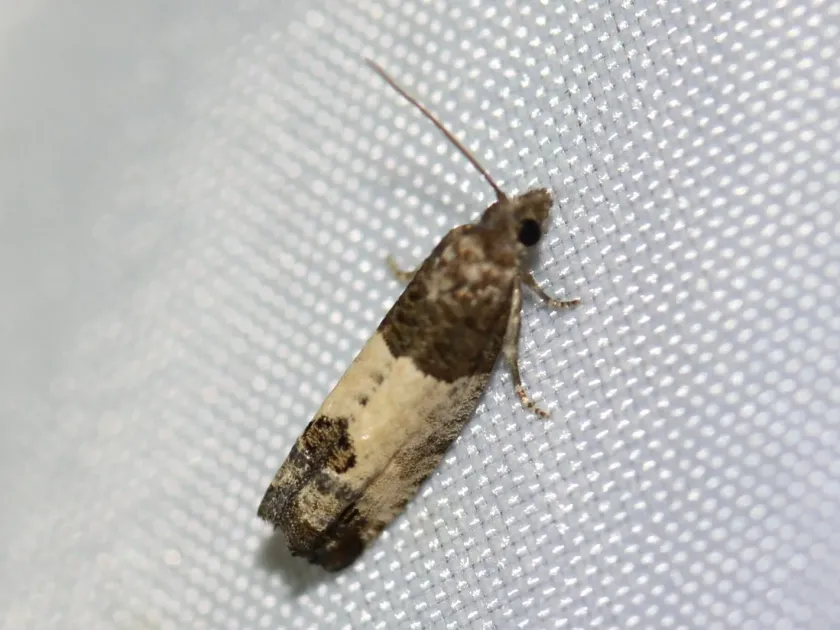
The bud moth (lat. Spilonota ocellana) is a member of the Tortricidae family. The adult moth has a wingspan of approximately 12–16 mm, featuring a mottled appearance with grey forewings and a distinct white band, which provides excellent camouflage against bark.
The larvae are small, roughly 10–12 mm in length, with dark brown bodies and shiny black heads. They possess characteristic light-colored tubercles, which help in distinguishing them from other similar leafroller species during field monitoring.
Bud moths overwinter as larvae in small, silken cocoons hidden in branch forks, crevices, or near buds. As spring temperatures rise, these larvae emerge from their winter dormancy to seek food and begin their life cycle.
The insect undergoes complete metamorphosis: egg, larva, pupa, and adult. In most regions, there is only one generation per year, making it easier to target control measures during specific developmental stages.
Adults are nocturnal and tend to hide in the tree canopy during daylight hours, making them hard to spot. Their cryptic coloration allows them to blend in perfectly with the tree's surface, requiring pheromone traps for effective monitoring.
What it damages
The primary damage is caused by larvae feeding on developing buds in the early spring. By consuming the contents of the buds, they effectively destroy the future blossoms, leading to significant yield losses in fruit-bearing trees.
Common hosts include apples, pears, cherries, and plums. In severe infestations, the bud moth can destroy a large percentage of potential flowers, drastically reducing the crop potential and weakening the overall vitality of the orchard.
After damaging the buds, larvae feed on young leaves, tying them together with silk to create protective shelters. Inside these nests, they feed on the leaf tissue, which hinders the tree's photosynthetic capability and retards shoot development.
Later in the season, larvae may damage young fruit by boring small holes into the skin. These injuries not only ruin the fruit's marketability but also serve as entry points for fungal pathogens like brown rot, leading to further crop degradation.
Repeated annual damage can significantly stress trees, leaving them more susceptible to environmental factors and other diseases. Healthy trees require more energy to recover from leaf loss, which may lead to reduced growth in subsequent years.
When it appears
Larval emergence typically coincides with the "green tip" or "bud burst" phase of fruit trees. This is the most critical window for surveillance, as once the larvae bore into the buds, they become much harder to control with standard insecticides.
Moth flight usually occurs in June and July. During this time, females lay eggs individually on the upper surface of leaves. Monitoring flight activity using pheromone traps is essential to determine the timing of summer spray programs.
After egg-laying, the embryonic development takes about two weeks. The newly hatched larvae of the summer generation begin feeding on foliage, often causing skeletonization of leaves, before they prepare for the winter months.
As autumn approaches, larvae move to protected areas on the trees to construct their overwintering cocoons. This behavior is triggered by day length and temperature, ensuring they are prepared for the onset of winter.
Weather patterns heavily dictate the severity of the infestation. Mild springs allow for earlier and more synchronous emergence, which can catch growers off guard if not monitored closely with local degree-day models.
Signs of infestation
The most obvious signs of infestation are damaged, dried, or unsprouted buds in early spring. These are often surrounded by silk threads and dried bud scales, which are easily visible upon close inspection of the branches.
Leaves rolled into tubes or clumps with silk indicate the presence of active larvae. Opening these nests reveals the larvae, which typically react by wiggling or dropping to the ground on a silk thread when disturbed.
Superficial "pitting" or boring holes on the surface of young fruits are clear indications of larval feeding activity during the summer. These marks are often accompanied by slight discoloration or sap flow around the injury site.
A sudden increase in adult moth catches in pheromone traps signals the peak of the mating season. This is a vital indicator for orchardists to initiate protective sprays to prevent a high population of the next generation.
Finding small, white, dense cocoons nestled in the bark of trunks or crotches of branches during winter maintenance is a sign that the pest is overwintering in your orchard, necessitating preventive cleaning.
Control measures
Effective management requires an integrated approach. Horticultural practices, such as removing damaged twigs and cleaning loose bark from trunks, can significantly reduce the number of overwintering sites for the larvae.
Chemical control must be timed precisely. The first application should target the larvae as they emerge in early spring, just before they enter the buds. Using systemic insecticides can be highly effective during this stage.
Biological control methods, including the use of Bacillus thuringiensis sprays, are suitable for managing younger larvae. These are less harmful to beneficial insects and fit well into an Integrated Pest Management (IPM) program.
Pheromone mating disruption can be used in larger orchards to confuse the adult moths, significantly reducing the success of mating and lowering the total number of eggs laid throughout the season.
- Use pheromone traps for monitoring.
- Practice regular canopy thinning and pruning.
- Apply targeted insecticides at the green tip stage.
- Use biological control agents for summer generations.
- Encourage natural predators like lacewings and ladybirds.
Taxonomy
- Latin name
- Spilonota
- Order
- Lepidoptera (butterflies)
- Family
- Tortricidae
- EPPO code
- SPLOSP
Discussion
No discussions yet — be the first.