
Magellanic penguin
Spheniscus magellanicus
Description
How to identify
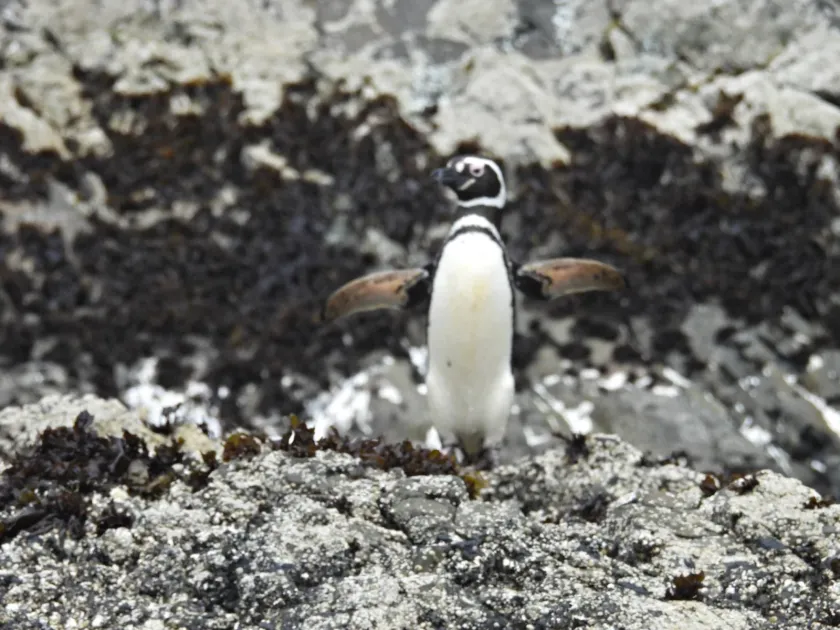
The Magellanic penguin (Spheniscus magellanicus) belongs to the order Sphenisciformes and the family Spheniscidae. It is a flightless marine bird that can reach up to 70 cm in height.
These birds are characterized by distinctive black and white plumage with two black bands across the chest and neck. During the breeding season, they migrate to coastal areas to build their nests.
The species is colonial, meaning that large numbers of individuals congregate in the same area to breed, which creates significant pressure on local vegetation.
The biological life cycle of these penguins involves intensive burrowing into the ground to protect their eggs and chicks from predators.
From an agronomic perspective, the species acts as a mechanical pest, as its nesting habits are incompatible with the cultivation of standard agricultural crops.
What it damages
Magellanic penguins primarily damage coastal crops, including pasture grasses, forage crops, and vegetable gardens located in proximity to the seashore.
The main form of damage is the total destruction of vegetation through trampling as thousands of penguins create paths from the ocean to their burrows.
Root systems are destroyed during the construction of deep nesting burrows, which often reach depths of up to 50 cm, causing severe soil disruption.
High levels of guano deposition lead to excessive soil salinization and chemical burns on plant roots, making the soil toxic for sensitive agricultural varieties.
Crop yields in areas affected by penguin colonies drop significantly, often rendering the land unsuitable for further cultivation without extensive soil remediation.
When it appears
The penguins arrive at their breeding grounds during the spring and summer, which coincides with the critical growth phase of many regional crops.
Active burrowing begins in September, causing immediate mechanical damage to field beds and freshly sown areas.
During the chick-rearing phase (November to December), the daily movement of penguins between the sea and the nest results in persistent trampling and soil compaction.
By February, the nesting season concludes, but the fields are left in a degraded state, characterized by holes, erosion, and contaminated soil.
The damage persists long after the colony has departed, requiring significant effort to restore the soil structure for the next growing season.
Signs of infestation
The presence of a penguin colony is easily identified by the regular pattern of deep holes in the ground, which serve as entrances to nesting burrows.
A noticeable decrease in vegetation density along established pathways indicates where birds traverse the field daily.
The characteristic pungent odor of ammonia caused by accumulated bird guano is a primary indicator of high population density.
Physical evidence includes distinct webbed footprints on soft soil and clear trampling marks across the growing area.
- Deep burrow entrances in the ground.
- Well-worn paths through crop fields.
- Accumulation of acidic bird guano.
- Visible mechanical crushing of plant stems.
Control measures
As the Magellanic penguin is a protected species in many coastal regions, control measures must be strictly non-lethal and ecologically sound.
The most effective strategy is to install robust wire fencing along the field perimeter to physically prevent penguins from entering the planting area.
Acoustic deterrents and visual repellents may provide temporary relief, but they are often limited in effectiveness as the birds become accustomed to such stimuli.
Agronomic management involves adjusting crop schedules or field locations to avoid high-risk zones near established breeding grounds.
Collaborating with environmental agencies to facilitate relocation of problematic colonies is the most sustainable approach for long-term land protection.
Taxonomy
- Latin name
- Spheniscus magellanicus
- Family
- Spheniscidae
- EPPO code
- ZPHNMA
Discussion
No discussions yet — be the first.