
Spathius agrili
Spathius agrili
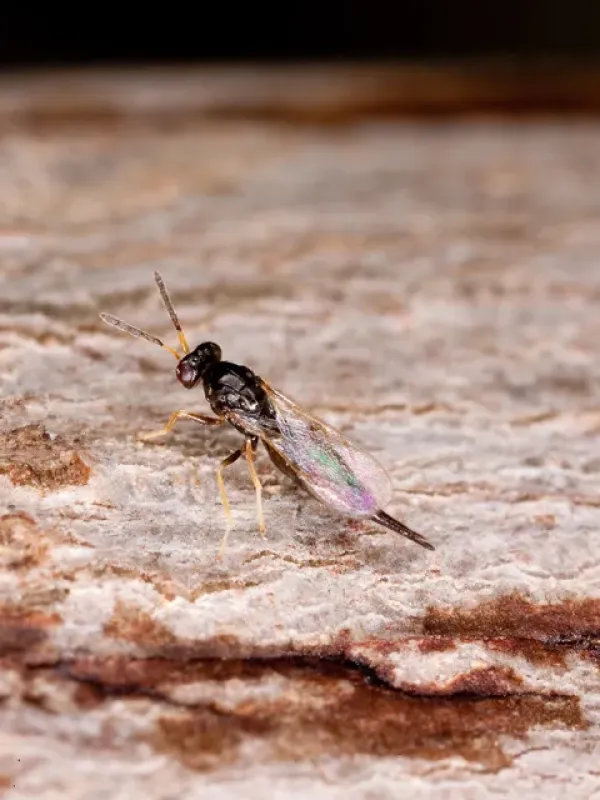
Description
How to identify
Spathius agrili is a gregarious ectoparasitoid wasp belonging to the family Braconidae. It is a small hymenopteran native to regions of East Asia, identified as a key natural enemy of the emerald ash borer (Agrilus planipennis).
Adult females are characterized by a long, slender ovipositor, which they use to drill through thick layers of tree bark to reach larvae feeding in the phloem and cambium layers. The adult body is dark brown, typically measuring between 3 to 6 millimeters in length.
The wasp utilizes chemical cues, or kairomones, emitted by the stressed host tree and the borer larvae itself to pinpoint the location of the host beneath the bark. This precise sensing mechanism makes it a highly efficient hunter.
Once the host is located, the female stings the borer larva, paralyzing it, and deposits her eggs on its surface. The developing wasp larvae then feed externally on the host, eventually forming silk cocoons within the borer's gallery.
Morphologically, Spathius agrili displays traits typical of its subfamily, with specialized sensors on its antennae and ovipositor that facilitate survival and reproduction in subcortical environments.
What it damages
Spathius agrili itself is not a plant pest; it is a specialized parasitoid that provides essential ecosystem services by controlling invasive ash borer populations. It serves as a natural defensive mechanism for ash trees (Fraxinus spp.).
The Emerald Ash Borer causes severe damage by tunneling into the tree's vascular system, which leads to canopy dieback and tree death. The wasp interrupts this process by killing the larvae before they can complete their destructive development.
Without the presence of such parasitoids, invasive borer populations can reach densities that destroy entire stands of ash trees within just a few years. Thus, the wasp is considered a vital asset in forestry protection.
The wasp's impact is observed as a reduction in the number of adult borers emerging from the tree in subsequent seasons. By lowering the larval survival rate, it reduces the reproductive potential of the pest.
In conservation efforts, maintaining a healthy population of these wasps is often the only sustainable way to prevent the total loss of ash species in infested areas.
When it appears
The activity of adult Spathius agrili wasps typically coincides with the presence of late-instar borer larvae, usually from late spring through the summer months, depending on the climatic conditions.
The wasp's life cycle is closely linked to the seasonal development of the emerald ash borer. In warmer temperate zones, the wasp may complete multiple generations per year, whereas in colder climates, it may be limited to fewer generations.
Overwintering occurs in the larval stage, protected within the silk cocoons located deep inside the galleries formed by the borer under the tree bark. This strategy allows the species to survive harsh winter conditions.
Emergence in the spring is triggered by rising temperatures and the resumption of the host's activity. The timing is crucial, as the adult wasps must be present when vulnerable larval stages are available.
Ecologists track the seasonal emergence of the wasp using specialized trunk traps, which help in timing the release programs or assessing the natural impact of existing populations.
Control measures
Control programs for the emerald ash borer emphasize the augmentation and conservation of Spathius agrili. The goal is to establish a self-sustaining population of this wasp in infested forest stands.
Management strategies involve several technical steps:
- Laboratory mass-rearing of the wasps for strategic field releases.
- Conservation of host-tree refuges where the wasps can persist when borer populations are low.
- Avoiding the use of broad-spectrum insecticides that could inadvertently kill the parasitoid population.
- Post-release monitoring to evaluate the establishment and spread of the wasp in new territories.
Integrated pest management (IPM) is essential, as the wasp is one component of a larger strategy that includes chemical treatments for high-value trees and the removal of heavily infested, non-recoverable trees.
Successful biocontrol implementation relies on climate matching, as the wasp's survival depends on its ability to endure local environmental stressors and synchronization with host availability.
Taxonomy
- Latin name
- Spathius agrili
- Order
- Hymenoptera
- Family
- Braconidae
- EPPO code
- SPAHAG
Discussion
No discussions yet — be the first.