
Sparganothis fruitworm
Sparganothis sulfureana
Description
How to identify
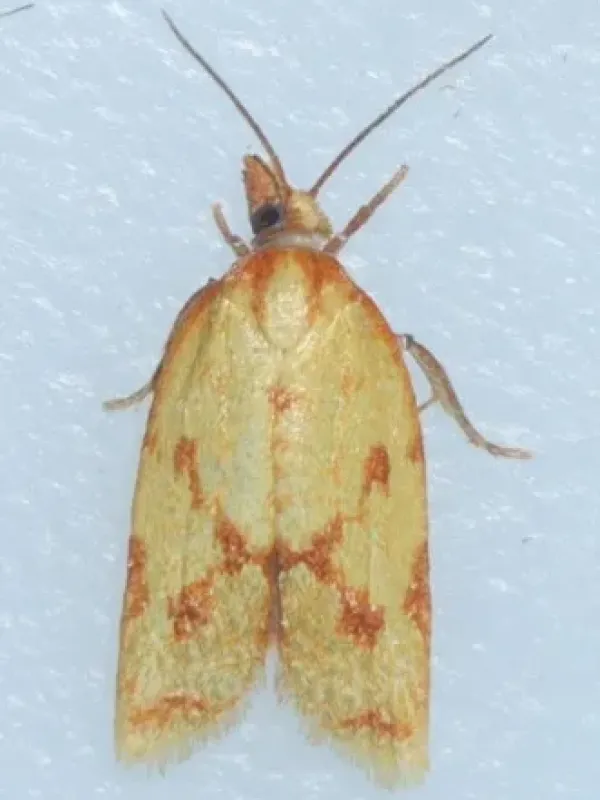
Sparganothis sulfureana, known commonly as the Sparganothis fruitworm, is a moth belonging to the Tortricidae family. The adult moth has a wingspan of approximately 15–20 mm, with yellow forewings featuring distinctive V-shaped brown markings.
The larvae, or caterpillars, progress through several instars, transitioning from a pale green color in early stages to a darker olive or brownish shade as they mature. They possess a prominent, darker head capsule.
Eggs are typically deposited on the upper surface of host leaves in overlapping, scale-like clusters. These clusters are initially light green and blend well with the leaf tissue, becoming darker as the embryos develop.
Pupation occurs within leaf shelters, where the larvae construct silk webbing to protect themselves. The pupae are brown and remain hidden within these foliage nests until the adult moth emerges.
This species is highly adaptable, exhibiting polyphagous behavior that allows it to thrive in diverse agricultural settings, ranging from commercial orchards to small-scale berry farms.
What it damages
As a polyphagous insect, the Sparganothis fruitworm can feed on a wide variety of plant hosts. It is particularly noted for causing significant economic losses in berry crops like cranberries and blueberries, as well as in orchard fruits.
The larvae are active feeders that consume leaf tissue, often causing skeletonization of leaves, which inhibits the plant's ability to perform photosynthesis and reduces overall vigor.
Besides foliage, the larvae target reproductive structures. They feed on flower buds and blossoms, which directly prevents fruit set and leads to reduced yields across the entire field or orchard.
Direct damage to maturing fruit involves surface feeding or shallow tunneling. These injuries not only degrade the quality of the harvest but also facilitate the entry of secondary pathogens, such as fungal rots.
Heavy infestations result in tangled masses of silk webbing and necrotic leaves, which are aesthetically damaging and create an environment that promotes moisture retention and disease development.
When it appears
The life cycle of S. sulfureana typically encompasses two generations per year. Overwintering occurs in the larval stage, usually as early-instar caterpillars hidden in crevices or under debris.
Larval activity resumes in the spring when temperatures rise, coinciding with the bud-break phase of host plants. This is the period when they cause the most severe early-season damage to new growth.
The first adult flight occurs in early summer, followed by the emergence of the second generation of larvae. This second wave of feeding is often the most detrimental, as it impacts ripening fruit.
By late summer and early autumn, the second generation of caterpillars prepares for diapause. They seek out protected sites such as bark fissures or leaf litter to survive the winter temperatures.
Understanding these phenological windows is crucial for integrated pest management, as it allows farmers to time their control measures during the most vulnerable stages of the insect's life cycle.
Signs of infestation
The most recognizable sign of infestation is the presence of webbed or curled leaves. Larvae draw leaves together with silk threads to create shelters, which serve as protection from predators and environmental stress.
Frass, or larval excrement, often accumulates within these webbed nests. Finding small, granular dark deposits on leaves is a definitive indicator of current larval presence and active feeding.
Superficial scarring on the surface of fruit, resulting from larval grazing, is a common indicator. In many cases, these scars turn dark or corky as the fruit continues to grow and ripen.
Sudden wilting of terminal shoots or flower clusters, held together by visible silken threads, is a diagnostic feature of a leafroller infestation requiring immediate attention.
Monitoring the adult population with pheromone traps provides valuable data. A spike in trap counts signals that egg-laying is occurring and that intervention may be necessary shortly thereafter.
Control measures
Effective management begins with sanitation. Clearing weeds and removing infested plant material helps reduce overwintering sites, significantly lowering the pressure for the following season.
Biological control options, such as the use of B.t. (Bacillus thuringiensis) based products, are highly effective against younger larvae and are safe for beneficial insects and pollinators.
Chemical control should be employed strategically, utilizing selective insecticides that target the specific larval stages while minimizing impact on the broader orchard or field ecosystem.
Encouraging natural enemies such as parasitic wasps (Ichneumonidae) and lacewings can provide long-term population suppression if the ecosystem is kept in balance through reduced pesticide use.
- Use pheromone traps to time pesticide applications precisely.
- Apply selective insecticides during peak larval hatching periods.
- Implement dormant pruning to remove potential overwintering sites for larvae.
Taxonomy
- Latin name
- Sparganothis sulfureana
- Order
- Lepidoptera (butterflies)
- Family
- Tortricidae
- EPPO code
- SPARSU
Discussion
No discussions yet — be the first.