
Sparganothis reticulatana
Sparganothis reticulatana
Description
How to identify
Sparganothis reticulatana is a species of moth belonging to the family Tortricidae, the leafrollers. Adult moths have a wingspan typically ranging from 18 to 22 mm.
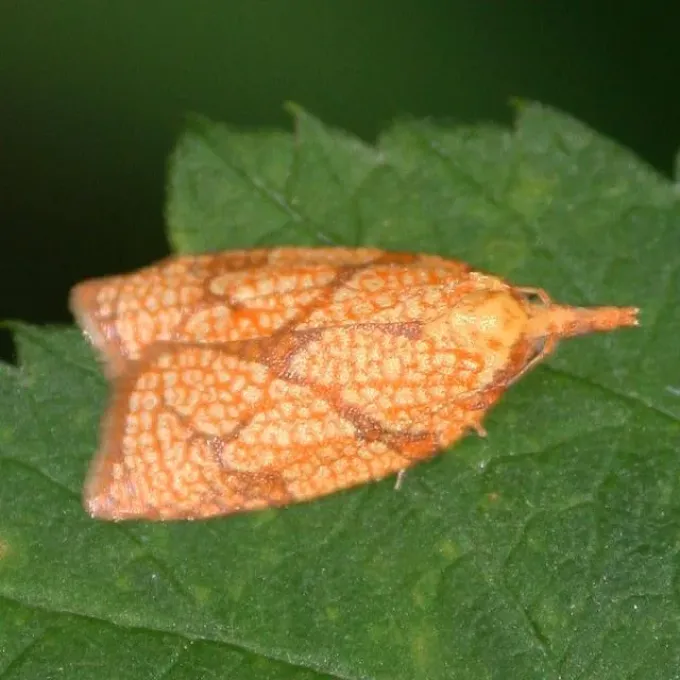
The forewings feature a distinctive reticulated or netted pattern in shades of ochre and brown, which serves as camouflage against tree bark and foliage.
The larvae, or caterpillars, are active feeders that change in appearance as they develop, generally exhibiting a shiny head capsule and a body that varies from light to olive green.
Pupation occurs in concealed locations such as rolled leaves or crevices in the bark, where the pupa remains protected from environmental stressors and many predators.
Accurate identification of this species often requires professional entomological assessment because many Tortricid moths share similar morphological characteristics in the adult stage.
What it damages
This pest is a polyphagous insect, meaning it feeds on a wide range of host plants, including various members of the Rosaceae family and other orchard crops.
Commonly attacked hosts include apple, pear, plum, and cherry trees, as well as various berry bushes like currants and raspberries, leading to potential yield losses.
The primary damage is caused by larvae feeding on tender buds, new shoots, and the surface of developing fruits, which often results in severe aesthetic and physical injury.
Leaf feeding involves skeletonizing or creating holes, which can compromise the photosynthetic ability of the plant, especially if the infestation is heavy.
When larvae move to fruit, they chew shallow or deep pits into the skin, which not only lowers the market value but also creates entry points for fungal pathogens and decay.
When it appears
The seasonal development of Sparganothis reticulatana is highly dependent on climate, with one or two generations typically occurring annually in temperate regions.
Overwintering usually takes place in the larval stage, with young caterpillars sheltering in small, tightly spun cocoons under loose bark or within plant debris.
In spring, as temperatures rise, the larvae emerge to feed on developing buds, which is a critical period for protecting fruit-bearing wood from early damage.
The adult moth flight period is generally observed during the summer months, during which mating and egg-laying occur on the leaves or bark of host plants.
Later generations often coincide with the ripening period of fruit crops, making them particularly damaging to late-season varieties that are nearing harvest.
Signs of infestation
The most visible indicator of an infestation is the presence of rolled or folded leaves, which the larvae secure with silken threads to create a sheltered feeding site.
Discoloration or wilting of the tips of young shoots is another common sign, occurring when larvae bore into the soft tissue or feed extensively on the terminal leaves.
Frass (larval excrement) found within webbed leaf clusters provides clear evidence of active feeding and is a reliable sign for scouting purposes in orchards.
Fruit damage often appears as irregular, shallow scarring or distinct pits on the skin, which can become more pronounced as the fruit continues to swell.
Webbing connecting leaves to fruit or to other branches is a signature sign of many leafroller species, indicating that a nest or feeding station is nearby.
Control measures
Managing Sparganothis reticulatana requires an integrated approach that focuses on monitoring populations and applying control measures only when necessary.
Pheromone traps are essential for monitoring the flight activity of adult moths, allowing growers to time pesticide applications precisely for maximum effectiveness.
Biological control, such as the use of formulations containing Bacillus thuringiensis, can provide effective and environmentally friendly control of early-instar larvae.
Cultural practices, including the removal of infested leaves and bark cleaning during the dormant season, help reduce the overwintering population density.
- Practice regular orchard sanitation by removing plant debris.
- Use pheromone-based monitoring to track population peaks.
- Encourage beneficial insect populations to predate on larvae.
- Apply systemic or contact insecticides based on economic thresholds.
Taxonomy
- Latin name
- Sparganothis reticulatana
- Order
- Lepidoptera (butterflies)
- Family
- Tortricidae
- EPPO code
- SPARRE
Discussion
No discussions yet — be the first.