
Sparganothis fruitworm
Sparganothis
Description
How to identify
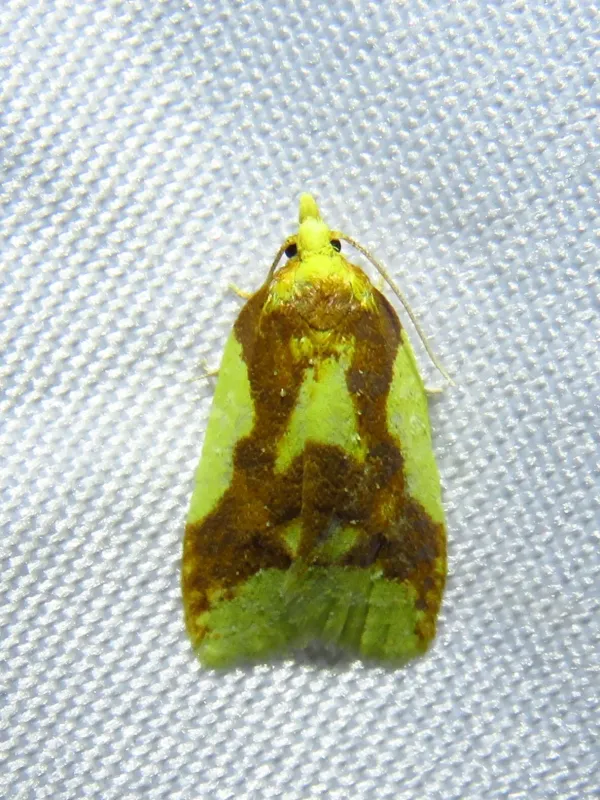
The Sparganothis fruitworm belongs to the Tortricidae (Leafroller) family, within the order Lepidoptera. Adults are small moths with a wingspan ranging from 20 to 25 mm.
The forewings of the moth typically exhibit a yellowish-brown or ochre coloration with darker cross-bands, serving as effective camouflage against the bark and foliage of host plants.
Larvae are highly mobile, characterized by a greenish or greyish-green body and a dark head. When threatened, the caterpillar often drops from the plant on a silk thread.
Females deposit eggs in clusters on the upper leaf surface, covering them with a protective secretion that forms a flat, shield-like structure that is difficult to spot.
Pupae are usually dark brown and develop within leaves rolled or tied together with silk, which provides protection against environmental stress and predators.
What it damages
This pest is highly polyphagous, causing significant damage to berry crops like currants, gooseberries, and raspberries, as well as various fruit trees.
The primary damage is caused by larvae that feed on the leaf tissue, skeletonizing the leaves shortly after hatching from the eggs.
By spinning leaves together with silk, the larvae create protective nests that act as barriers against many contact-based pesticides, making them harder to manage.
Damage to terminal shoots often causes stunted growth, leaf deformation, and total wilting, which can be devastating for young nursery stock.
High infestation rates result in severe defoliation, drastically reducing the photosynthetic capability of the plant and leading to significant crop yield losses.
When it appears
The species typically overwinters as young larvae within silk-lined hibernacula located in bark crevices, under leaf litter, or near the base of the host plant.
In early spring, as vegetation begins to grow, the larvae emerge from their overwintering sites and start feeding on developing buds and young foliage.
The first generation of adult moths usually emerges in early summer, coinciding with favorable weather conditions for mating and subsequent egg-laying.
Depending on regional climate conditions, the pest may complete one or two generations per season, prolonging the duration of its destructive activity.
Peak larval activity generally occurs from May through June, during the most critical phase of vegetative growth for most berry and fruit crops.
Signs of infestation
The first noticeable sign of infestation is the presence of rolled or folded leaves tied together with distinct silken threads.
Inspecting these nests will reveal larval frass, appearing as small, dark granular droppings trapped within the webbing.
Window-paning or skeletonized leaf patches serve as indicators that larvae are actively feeding on the internal tissues of the leaf.
Terminal shoot dieback or the wilting of growing points are serious signs that the larvae have compromised the plant's vascular development.
Observing small, shiny, shield-like egg masses on the top side of the leaves in spring is a clear indicator that a new generation of the pest is developing.
Control measures
Cultural control practices include the removal and disposal of old bark and leaf debris where the larvae typically congregate for overwintering.
Manual removal of infested leaf rolls is a highly effective method for small-scale gardens or low-intensity infestations, preventing population outbreaks.
Biological control using Bacillus thuringiensis-based products provides an effective and environmentally friendly way to suppress young larval populations.
- Monitoring moth flight patterns using pheromone traps.
- Applying systemic insecticides during periods of high pest pressure.
- Encouraging natural enemies and predatory insects to maintain low population levels.
Chemical treatments should be timed carefully to occur outside of bloom periods to protect pollinators and ensure the safety of the orchard ecosystem.
Taxonomy
- Latin name
- Sparganothis
- Order
- Lepidoptera (butterflies)
- Family
- Tortricidae
- EPPO code
- SPARSP
Discussion
No discussions yet — be the first.