

Pest · Lepidoptera (butterflies) · affects Apple, Tomato, Wild cabbage
Especially harmful
Beet armyworm
Spodoptera exigua
Description
How to identify
The beet armyworm (Spodoptera exigua) is a significant agricultural pest belonging to the Noctuidae family. The adult moth has a wingspan of approximately 25-30 mm, with mottled grey-brown forewings and a distinct light-colored spot in the center.
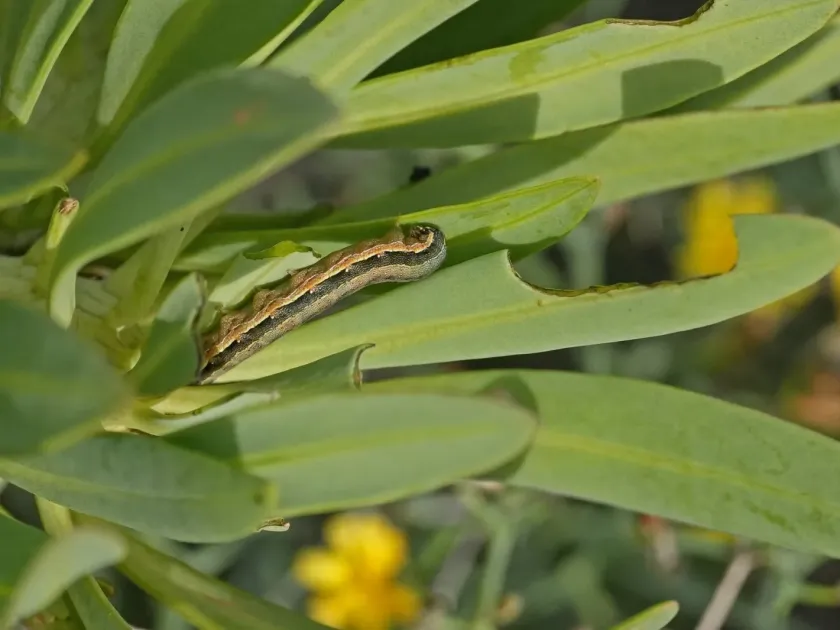
The larvae, known as beet armyworms, progress through five distinct stages (instars). They are highly variable in color, ranging from pale green to dark olive or almost black, often featuring light longitudinal stripes along the body.
The life cycle is rapid, typically completing in about a month under warm conditions. Because of this short duration, the species can produce multiple overlapping generations during a single growing season, leading to potential population explosions.
Females deposit eggs in masses on the undersides of leaves, covering them with specialized scales from their abdomen. This protective layer acts as a barrier, often shielding the eggs from direct contact with pesticides.
Beet armyworms pupate in the soil at a depth of several centimeters. While they often overwinter in warmer climates, in temperate regions, their presence is frequently reinforced by migratory moths carried by wind currents.
What it damages
This species is a generalist feeder (polyphagous), known to attack a vast range of crops, including vegetables (peppers, tomatoes, onions), field crops (cotton, corn, soybeans), and various ornamental plants.
Young larvae initially feed in colonies, skeletonizing the foliage by consuming the leaf tissue while leaving the veins intact. As they mature, they disperse and become solitary feeders, devouring entire leaves and damaging young stems.
In crops like tomatoes and peppers, the larvae frequently burrow into the fruit. This feeding behavior not only destroys the marketability of the produce but also introduces secondary pathogens that cause rapid decay.
On bulb crops like onions, the larvae may tunnel into the foliage or the bulb itself. This internal damage is particularly devastating as it remains hidden until the plant shows signs of wilting or secondary infection.
Severe infestations can lead to total crop failure. The potential for loss is compounded by the fact that the larvae are resilient and can rapidly adapt to various environmental conditions and food sources.
When it appears
Moth activity typically begins in late spring, depending on the latitude and local climate. Adults are nocturnal, making them difficult to observe during the day without specialized monitoring equipment.
The peak feeding period occurs in mid-to-late summer when temperatures are optimal for the development of larvae. It is during this time that growers face the highest risk of significant damage to developing crops.
Population cycles are often continuous, meaning that all life stages—eggs, larvae of varying ages, and pupae—can be present in the field simultaneously, complicating management efforts.
Migration patterns play a significant role in the seasonal occurrence of this pest. Wind-borne migration can introduce new populations into areas suddenly, leading to rapid increases in infestation levels.
As autumn approaches and temperatures drop, the activity of the beet armyworm usually decreases, although late-season crops may still sustain damage before the first hard frosts terminate the infestation.
Signs of infestation
The earliest sign of an infestation is the presence of small, transparent "windows" on the undersides of leaves, caused by the feeding of first-instar larvae. These areas are small but highly visible upon close inspection.
Frass (larval excrement) found on leaves or at the base of the plant is a clear indicator that the larvae are present and actively feeding. Accumulation of frass often indicates an older or larger larval population.
Wilting of foliage or deformed growth can suggest internal tunneling. If the larvae have entered the stem or fruit, the external symptoms may appear suddenly, often when the damage is already significant.
Farming operations often monitor the presence of adults using pheromone or light traps. An increase in trap catches is a critical warning signal for scouts to begin searching for egg masses and young larvae in the field.
Secondary infections, such as mold or rot developing on fruits or damaged stems, serve as a terminal sign of an advanced infestation, making the produce unfit for harvest and consumption.
Control measures
Managing the beet armyworm requires an Integrated Pest Management (IPM) approach that combines cultural, biological, and chemical interventions to keep populations below economic injury levels.
Cultural practices, such as deep plowing after harvest, can disrupt pupation sites in the soil. Furthermore, rigorous weed management is essential as weeds often serve as early-season host plants for the moth.
Biological control methods include the use of natural predators and parasitoids, such as Trichogramma wasps, which parasitize the egg masses, and the application of Bacillus thuringiensis (Bt) for larval control.
Chemical control should be timed to target the larvae during their early instars. Because older larvae are significantly more resistant to pesticides, accurate scouting is vital to ensure application occurs at the correct window.
- Use pheromone traps for precise monitoring and timing of insecticide applications.
- Rotate insecticides with different modes of action to mitigate the risk of resistance development.
- Perform applications in the evening when larvae are most active on the foliage.
- Ensure thorough spray coverage, focusing specifically on the underside of the leaves.
- Consult local extension offices for threshold levels and regional management guidelines.
Content graph
Connections · Beet armyworm
Most often together:
Marketplace
Products · 1
Biology
Taxonomy
- Latin name
- Spodoptera exigua
- Order
- Lepidoptera (butterflies)
- Family
- Noctuidae
- EPPO code
- LAPHEG
Community
Discussion
No discussions yet — be the first.