
Solpuga
Solpuga
Description
How to identify
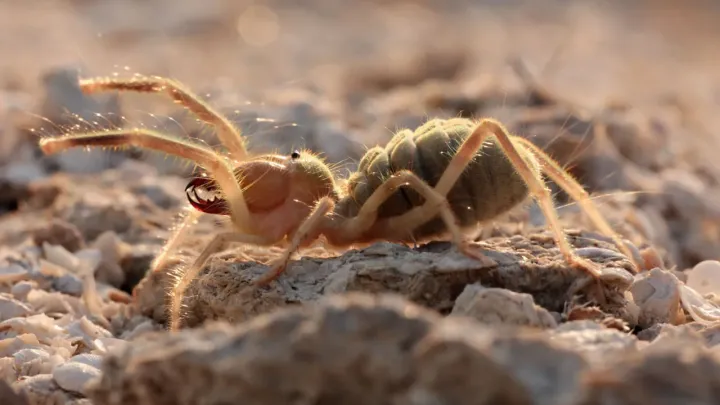
Solpuga, commonly known as camel spiders, wind scorpions, or sun spiders, belong to the class Arachnida and the order Solifugae. They are easily identified by their oversized, powerful chelicerae.
Their bodies are densely covered with hair and divided into a cephalothorax and a segmented abdomen. They possess four pairs of walking legs, allowing for rapid movement.
Unlike many other arachnids, solpugas do not have venom glands. They rely entirely on their massive jaws to crush and disable their prey during a hunt.
These creatures typically exhibit a sandy or brownish coloration, which helps them remain camouflaged in the arid environments where they are most commonly found.
Adults can grow quite large, sometimes reaching up to 7 centimeters in length, making them a formidable presence in the soil-dwelling invertebrate community.
What it damages
It is vital for agronomists to distinguish between pests and predators. The solpuga is a dedicated predator and does not consume plant material at all.
They do not cause damage to stems, roots, leaves, or fruits of agricultural crops. Therefore, they do not pose a direct threat to the health or yield of plants.
In fact, their presence in agricultural ecosystems is largely beneficial, as they actively hunt and consume various pests like locusts, crickets, and soil larvae.
Any perceived damage is purely accidental, occurring only if they disturb the soil near delicate seedlings while digging their burrow systems.
Because they do not feed on plant tissues, there is no economic justification for treating them as pests within a standard agricultural management program.
When it appears
The activity of solpugas is strictly regulated by environmental conditions, particularly temperature. They are most active during the warmer months of the year.
They are primarily nocturnal, preferring to hunt when the air temperature drops and relative humidity is slightly higher compared to the scorching daytime heat.
During the colder autumn and winter months, solpugas seek shelter in underground burrows, significantly reducing their metabolic rate and surface activity.
The reproductive season typically aligns with the warmest part of the year, ensuring that the environment provides enough prey for the development of offspring.
Surface activity peaks in late spring and summer, particularly in arid and semi-arid regions where these creatures thrive in the soil layers.
Control measures
No chemical control measures are recommended for solpugas, as they are not crop pests and contribute to natural pest suppression in the field.
If they become a nuisance near farm buildings or greenhouses, the best approach is to improve sanitation by removing wood piles, debris, and stones.
Physical barriers such as fine-mesh screening on doors and vents are effective at preventing these arachnids from entering indoor areas where they are not desired.
Routine soil cultivation and weeding discourage them from nesting in a particular area, as it destroys their sheltered habitats and disrupts their lifestyle.
Integrated pest management strategies focusing on true crop pests will naturally regulate solpuga numbers without the need for targeted extermination efforts.
Taxonomy
- Latin name
- Solpuga
- Family
- Solpugidae
- EPPO code
- SOLPSP
Discussion
No discussions yet — be the first.