
Solenodon
Solenodon
Description
How to identify
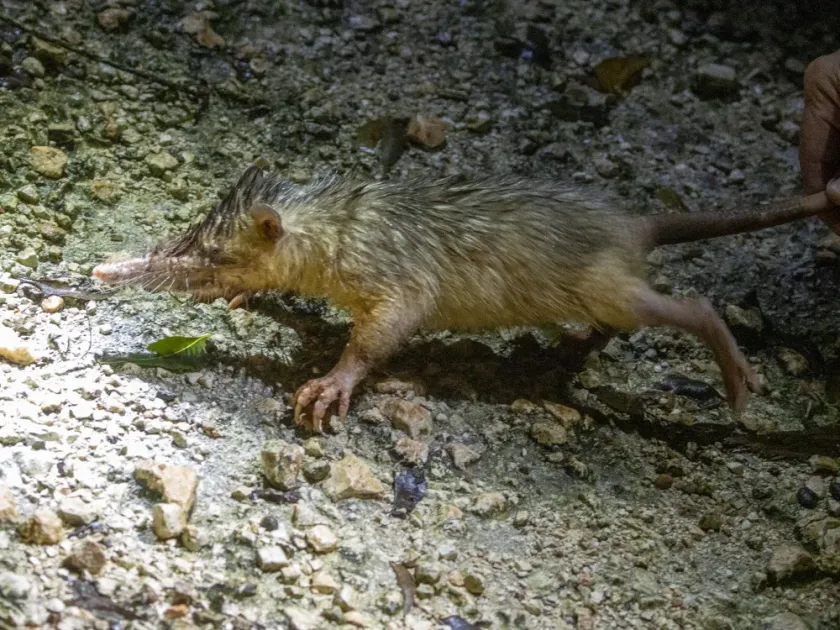
The Solenodon (genus Solenodon) is a rare, insectivorous mammal found exclusively in the Caribbean, specifically on Cuba and Hispaniola.
These animals are characterized by an elongated, flexible snout, a hairless tail, and strong claws designed for digging in soil to find food.
Solenodons are unique among mammals for their ability to deliver venom through specialized grooves in their lower teeth, which they use to subdue prey.
Taxonomically, they belong to the family Solenodontidae within the order Eulipotyphla, representing an ancient lineage of mammals that has survived for millions of years.
Despite their somewhat aggressive appearance, they are shy, nocturnal creatures that pose no danger to humans or agricultural systems.
What it damages
The Solenodon is not an agricultural pest. Its diet consists almost entirely of insects, earthworms, and other small invertebrates found in the forest floor.
There is no evidence to suggest that Solenodons feed on crops, vegetables, or fruits. They lack the digestive physiology to process plant matter.
The damage caused by these animals to soil structure is negligible, as their digging behavior is localized and incidental to their search for prey.
Farmers in regions where these animals exist do not report any loss of crop yields due to Solenodon activity.
In fact, as insectivores, they may provide a minor ecological benefit by consuming larvae and insects that could potentially be harmful to vegetation.
When it appears
Solenodons remain active year-round due to the stable, warm climate of their native habitats, which prevents the need for hibernation or winter dormancy.
Their activity patterns are dictated by the diurnal cycle; they are strictly nocturnal, spending the daylight hours in secluded burrows or rock crevices.
There is no distinct season for crop damage, as these animals do not interact with farming cycles or crop maturity schedules.
The intensity of their foraging is consistent throughout the year, driven primarily by the availability of soil-dwelling invertebrates.
As they do not interfere with agricultural operations, their seasonal activity has no implications for farming management or pest control strategies.
Signs of infestation
There are no signs of crop infection or infestation linked to the Solenodon, as they are not consumers of cultivated plants.
Small holes or upturned soil near field edges might be attributed to various causes, such as earthworm activity, birds, or other rodents, but not the Solenodon.
Observers should not mistake natural foraging behavior of wild animals for agricultural damage caused by pests.
Because they are not a threat, there is no need for farmers to identify "signs of infestation" or to monitor for these animals.
If you encounter a Solenodon, it is a rare event of ecological interest, not a sign of an impending pest outbreak in your field.
Control measures
There are no control measures for the Solenodon, and implementing such measures is strictly prohibited by international law and local environmental regulations.
As a highly endangered species, the protection of the Solenodon is a priority for global conservation efforts rather than an agricultural concern.
Farmers should focus their plant protection efforts on legitimate agricultural pests like beetles, aphids, and nematodes using standard Integrated Pest Management (IPM).
Protecting the natural habitat of insectivorous animals like the Solenodon can contribute to a healthier ecosystem, helping to naturally regulate insect populations.
In the unlikely event of a sighting, the animal should be left undisturbed to continue its role within the local biodiversity.
Taxonomy
- Latin name
- Solenodon
- Family
- Solenodontidae
- EPPO code
- SLNOSP
Discussion
No discussions yet — be the first.