
Water springtail
Sminthurides aquaticus
Description
How to identify
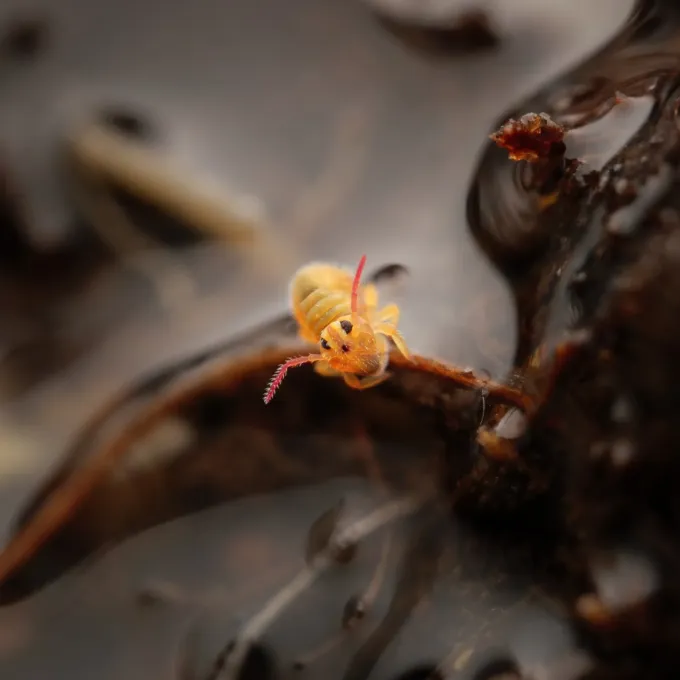
The water springtail (Sminthurides aquaticus) belongs to the class Entognatha, order Collembola (springtails), and family Sminthuridae. These are miniature arthropods, with body lengths rarely exceeding 1–1.5 mm.
Physically, they resemble tiny rounded spiders or fleas. The body of Sminthurides aquaticus is stockier than that of soil-dwelling springtails, often colored in dark, almost black or greenish-brown shades.
A distinctive feature is the presence of a spring-loaded abdominal appendage called a furcula, which allows the insect to perform sudden jumps. They are capable of moving on the water surface using surface tension.
The life cycle involves incomplete metamorphosis. Females lay eggs near water bodies or on moist parts of plants. Larvae are nearly identical in appearance to adults, passing through several molts before reaching the imago stage.
Optimal conditions for their development include high air and soil humidity, the presence of stagnant water, and an abundance of decomposing organic matter, which they often feed on in addition to living tissues.
What it damages
The primary damage is caused to young plants, seedlings, and crops grown under hydroponic conditions or in over-moistened greenhouses. Vegetable crops and ornamental plants are the most frequent victims.
The pests feed on the tender tissues of young leaves and the epidermis of stems. During mass outbreaks, they can gnaw small circular holes, leading to significant loss of aesthetic value and stunted growth.
The harmfulness is aggravated during the seedling period. Damaged cotyledons and the first true leaves are susceptible to infections, as the bite sites become entry points for fungal and bacterial pathogens.
The root system is also under attack. Springtails can eat the thinnest root hairs, which limits the plant's ability to absorb moisture and nutrients from the substrate.
The economic impact of the pest lies in slowing down the crop's growth rate, which leads to uneven emergence and the need for additional expenses on reseeding or seedling treatment.
Signs of infestation
The first sign of infestation is the discovery of the insects themselves on the surface of the substrate or water in trays. They actively jump when the pot is touched or during watering.
Visually, small, pin-point ulcers or punctures appear on the leaves. Leaves may look like they have been pricked with a needle, and in cases of severe infestation, chlorosis and leaf deformation occur.
The surface of the soil or substrate often looks dusty due to excrement and shed skins of the pests. A musty, unpleasant odor from stagnant water may also be observed.
Seedling growth noticeably stops, and lower leaves begin to turn yellow prematurely. Plants become more sensitive to temperature fluctuations and lack of moisture.
When using hydroponic systems, springtails accumulate in the nutrient solution, clogging filters and promoting the growth of pathogenic microflora within the supply system.
Control measures
The main control measure is the regulation of water management. Springtails cannot tolerate dryness, so drying out the top layer of the soil is the most effective and accessible agrotechnical method.
It is important to regularly disinfect tools, trays, and shelves where seedlings are grown. Replacing or sterilizing the contaminated substrate helps to radically reduce the population size.
Biological methods include the use of predatory mites (e.g., Stratiolaelaps scimitus), which actively hunt Collembola in the soil.
In extreme cases, chemical insecticides with contact and stomach action are used. Treatment is carried out by drenching the soil with a solution of preparations effective against soil pests.
- Optimizing irrigation (avoiding overwatering).
- Using sterile potting mixes.
- Biological control using predatory entomophages.
- Applying permitted systemic insecticides during high infestations.
Taxonomy
- Latin name
- Sminthurides aquaticus
- Family
- Sminthurididae
- EPPO code
- SMNDAQ
Discussion
No discussions yet — be the first.