
Smicronyx
Smicronyx
Description
How to identify
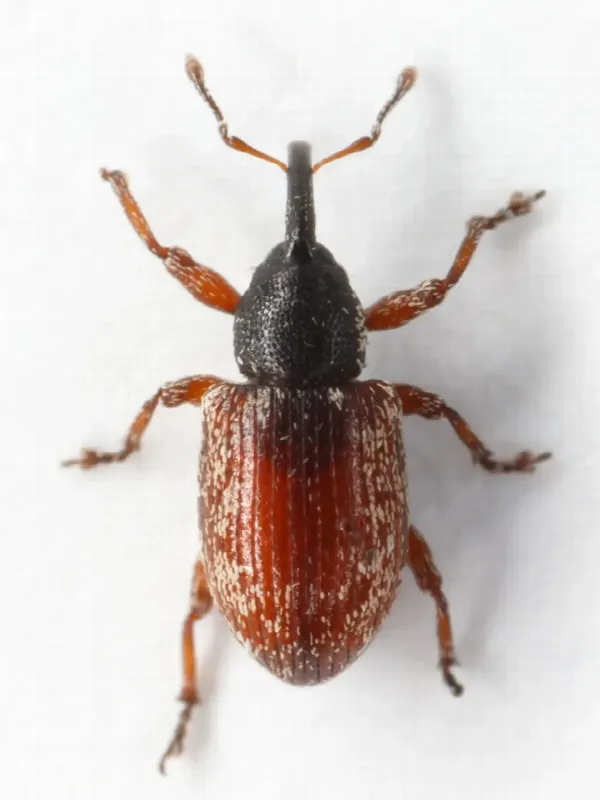
Smicronyx is a genus of weevils (family Curculionidae) known for their specialized feeding habits on specific host plants. These beetles are generally small, typically measuring between 3 and 5 millimeters in length, with a dark, often mottled appearance due to dense scales covering their bodies.
Like other members of the Curculionidae family, they possess a characteristic elongated rostrum (snout) which is curved and slender. This structure is essential for the females to drill holes into plant tissues to deposit eggs securely.
The larvae are small, legless grubs, white or creamy in color, with a sclerotized brown head capsule. Their morphology is adapted for an endophytous lifestyle, meaning they develop entirely within plant tissues, such as seeds or seed heads, which provides protection from environmental hazards and many predators.
Accurate identification of individual Smicronyx species can be challenging, as it often requires a detailed examination of genitalia and other micro-morphological traits. Field identification is usually based on the presence of the pest on specific host plants and the typical damage symptoms observed.
These insects are elusive, often remaining hidden among the foliage or deep within the plant structure. Their populations can go undetected until visible damage begins to affect the development of the host plant's reproductive organs.
What it damages
The genus Smicronyx is particularly recognized for its impact on the Asteraceae family. Species such as Smicronyx fulvus are notorious pests of sunflowers, where they cause significant agricultural damage.
The primary damage is caused by larvae feeding on the developing seeds within the sunflower head. By consuming the contents of the seeds, the larvae create empty or malformed achenes, which directly reduces the yield and overall quality of the sunflower harvest.
Severe infestations can lead to a substantial decrease in the oil content and weight of the harvested seeds. Furthermore, the larval feeding activity can compromise the integrity of the sunflower head, making it more susceptible to secondary infections by pathogens like fungi or bacteria.
While the adults also feed on the foliage and buds of the plants, their impact is usually secondary compared to the destructive feeding of the larvae. Heavy infestations during the flowering stage can result in significant economic losses for farmers.
The damage is most pronounced in areas where sunflowers are grown continuously, as this provides a stable food source and favorable conditions for the pest population to expand significantly over time.
When it appears
The life cycle of Smicronyx is closely synchronized with the phenology of its host plants. These weevils typically overwinter as larvae in the soil or within old plant debris, entering a state of diapause to survive the winter temperatures.
In the spring, as soil temperatures rise, the larvae pupate. Adult emergence usually coincides with the budding stage of the sunflowers, allowing them to start feeding and mating immediately upon surfacing.
Female weevils deposit eggs into the heads of young sunflowers. The larvae, upon hatching, bore into the seed-bearing tissues to feed. This larval development lasts for several weeks, during which the larvae grow and complete their maturation within the plant head.
Once the larvae reach maturity, they exit the seed heads and return to the soil to prepare for the overwintering period. This cycle completes the single generation that typically occurs within each growing season, although local conditions may influence specific timing.
Understanding these biological stages is crucial for timing agricultural interventions, as the window of opportunity to control the adult population before they lay eggs is relatively narrow and specific to the crop's development phase.
Control measures
Integrated Pest Management (IPM) is the most effective approach to mitigating the damage caused by Smicronyx. Cultural practices, such as crop rotation, are fundamental in breaking the life cycle of the pest, as they move the host plant away from the areas where overwintering larvae reside.
Tillage practices, particularly deep autumn plowing, are highly effective in disrupting the overwintering sites of the larvae, exposing them to unfavorable environmental conditions and significantly reducing their survival rate.
Effective weed management is another essential component of control. By removing wild host plants, such as various Asteraceae weeds, farmers can eliminate alternative breeding grounds and significantly reduce the pest pressure on commercial crops.
Chemical control may be necessary if monitoring reveals that the adult population exceeds the economic threshold. In such cases, insecticides should be applied during the early budding stages before the females have a chance to deposit their eggs.
- Monitor adult populations using yellow sticky traps or visual inspections.
- Ensure adequate spatial isolation between sunflower fields to limit migration.
- Use selective insecticides that minimize harm to beneficial insects and pollinators.
Taxonomy
- Latin name
- Smicronyx
- Order
- Coleoptera (beetles)
- Family
- Curculionidae
- EPPO code
- SMICSP
Discussion
No discussions yet — be the first.