
White-breasted nuthatch
Sitta carolinensis
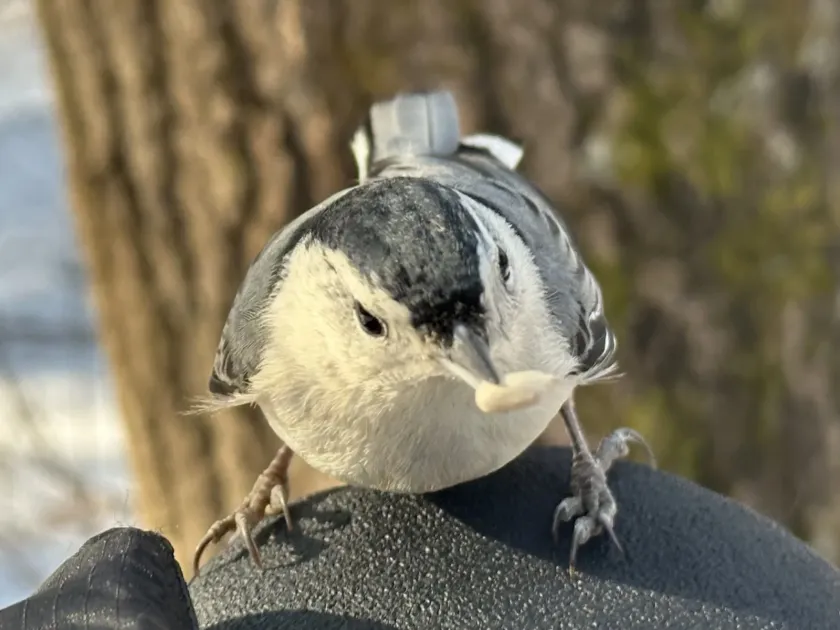
Description
How to identify
The White-breasted nuthatch (Sitta carolinensis) is a small songbird belonging to the Sittidae family, widely distributed across North American deciduous forests.
It is easily recognized by its slate-blue back, black cap, and striking white face and underparts, which give the bird its common name.
The most distinctive behavior of this species is its ability to move head-first down the trunks of trees, which allows it to inspect deep bark crevices for prey.
The bird possesses a strong, pointed beak that is perfectly adapted for extracting insects and larvae from wood without causing damage to the tree itself.
As a sedentary species, it remains in its territory year-round, making it a permanent resident of parks, orchards, and wooded residential areas.
What it damages
It is scientifically inaccurate to classify the White-breasted nuthatch as a pest. On the contrary, it is a highly beneficial insectivore for any garden or orchard.
Its diet consists primarily of arthropods, including many garden pests like beetles, caterpillars, spiders, and aphids that damage fruit trees.
Any exploration of the bark is purely for foraging purposes, and the bird does not consume or destroy live plant tissue or commercial crop yields.
While nuthatches may occasionally consume seeds or nuts from bird feeders, this is a minor impact compared to the immense value they provide by controlling insect populations.
Therefore, the species serves as a natural biological control agent rather than a threat to agricultural productivity.
When it appears
The White-breasted nuthatch is active throughout all four seasons, providing consistent monitoring of tree health in your garden.
During the spring and summer breeding seasons, their demand for protein-rich insects increases, leading to a significant reduction in pest populations during the peak growth period of plants.
In autumn, they remain active, often caching seeds in bark crevices, which demonstrates their high familiarity with the tree surfaces they inhabit.
During the winter, when insect activity is lower, they continue to forage for overwintering pests, pupae, and eggs hidden in bark, which helps prevent pest outbreaks in the spring.
Since the species does not migrate, it maintains a stable presence that contributes to the year-round phytosanitary health of the landscape.
Signs of infestation
Their presence is easily detected by their unique, nasal "yank-yank" call, which is frequently heard echoing through the tree canopy.
You may notice small, shallow disturbances on the bark of old trees, which are indications that the bird has been successfully extracting larvae.
The bird moves systematically around tree trunks, often stopping to tap and probe, which distinguishes its search patterns from the erratic movement of other birds.
Unlike woodpeckers, which bore deep holes, the nuthatch leaves only minimal, superficial traces on the outer bark layers.
The bird's presence is often a sign of a healthy, mature ecosystem, as they prefer environments with sufficient tree density and age.
Control measures
Because the White-breasted nuthatch is a beneficial species, no control measures are necessary or recommended.
Gardeners are encouraged to protect mature trees and dead branches where these birds can forage and nest, as this promotes biological pest management.
Installing nesting boxes specifically designed for nuthatches can encourage these birds to remain in your garden, providing long-term protection for your plants.
Reducing the use of broad-spectrum pesticides is the most effective way to support nuthatch populations, as chemicals eliminate their essential food source.
By fostering a friendly environment, you ensure that these birds continue to act as effective, natural guardians of your garden and orchard health.
Taxonomy
- Latin name
- Sitta carolinensis
- Family
- Sittidae
- EPPO code
- STTACA
Discussion
No discussions yet — be the first.