
Grey pea weevil
Sitona tibialis
Description
How to identify
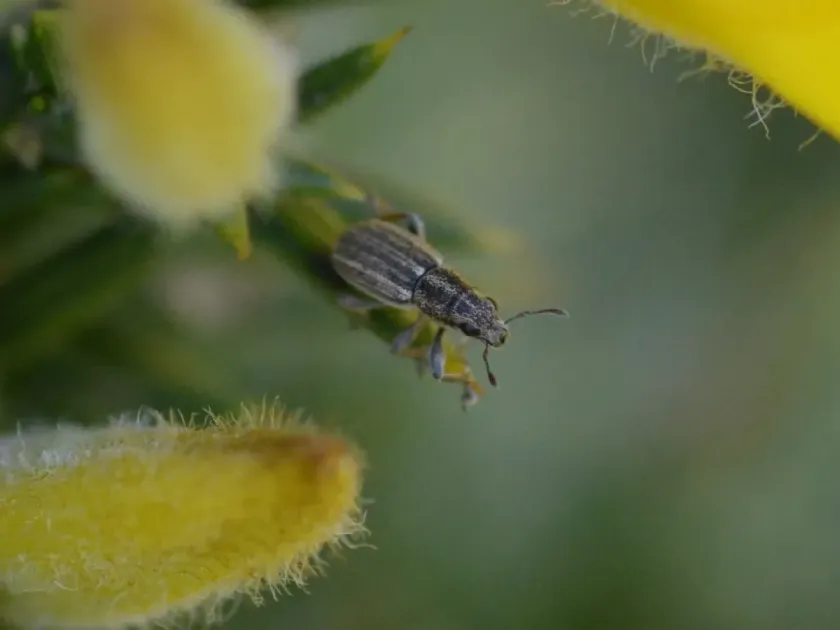
The grey pea weevil (Sitona tibialis) is a beetle species belonging to the Curculionidae family. These insects are small, typically ranging from 3 to 4 mm in length, with a body covered in greyish or brownish scales.
A key identifying feature is the short and broad snout, which is characteristic of the Sitona genus. They possess elbowed antennae ending in a club, helping distinguish them from other similar weevil species.
The larvae are white, legless, and have a distinct curved body shape with a brown head. They live entirely within the soil profile, focusing their activity on the root zone of host plants.
Adults are strong fliers and are capable of migrating over long distances. This mobility allows them to colonize new legume fields rapidly once the temperature rises in the spring.
Overwintering occurs primarily in the adult stage within the soil or under leaf litter, often in fields previously occupied by legumes or perennial clover/alfalfa fields.
What it damages
This pest affects a wide range of pulse crops including peas, alfalfa, clover, sainfoin, and vetch. Both the adult and larval stages are damaging, though in different ways and locations.
Adult weevils feed on the foliage by chewing distinct semi-circular notches into the edges of the leaves. This feeding reduces the plant's leaf area, hindering photosynthesis and overall vigor.
The larvae cause significant agricultural damage by feeding on root nodules. By consuming the contents of these nodules, they destroy the symbiotic bacteria responsible for nitrogen fixation.
The loss of functional nodules results in nitrogen deficiency for the host plant. This leads to stunted growth, yellowing foliage, and a measurable decrease in seed or biomass yield.
In high-infestation scenarios, the cumulative effect of foliage consumption by adults and root damage by larvae can cause severe crop thinning or even localized crop failure.
When it appears
Activity begins in early spring as soon as soil temperatures reach approximately 8–10 degrees Celsius. Adults emerge from their overwintering sites and begin seeking host plants.
The most critical period occurs when pulse crops are germinating. The weevils can quickly target young seedlings, causing severe stress to the crop at its most vulnerable developmental stage.
Egg-laying begins shortly after adult emergence. Females deposit eggs on the soil surface or directly onto the leaves and stems of host plants, starting the life cycle for the next generation.
The larval stage develops entirely underground. They pass through several instars while consuming root nodules throughout the spring and early summer months until reaching maturity.
Pupation occurs in the soil, and the new generation of adults typically emerges by late summer. After a short period of feeding, they prepare for the winter period.
Signs of infestation
The most visible sign of infestation is the serrated, semi-circular notches along the leaf margins, often referred to as "window-paning" or characteristic feeding patterns.
Evidence of larval activity can be found by carefully digging up the roots. Affected nodules will appear hollowed out, empty, or darkened, indicating they are no longer viable.
Plants may show reduced growth and an overall unhealthy appearance compared to non-infested crops, reflecting a disruption in their nutritional supply due to nodule loss.
Weevils exhibit a "thanatosis" behavior, meaning they fall from the plant and feign death when disturbed. This makes them appear as small pebbles on the soil surface.
Sweep netting in the early morning is a common technique used by agronomists to monitor the presence and population density of adults in legume fields.
Control measures
Cultural practices form the backbone of control. Spatial isolation between perennial legumes and new annual pulse crops helps prevent adult weevils from migrating into new fields.
Deep autumn plowing (tillage) is effective in reducing overwintering populations, as it buries the adults deep into the soil, hindering their ability to emerge the following spring.
Sowing at the optimal time helps the crop establish quickly, allowing plants to pass through the vulnerable seedling stage before adult weevil populations peak.
Insecticide applications are required when monitoring indicates that the population exceeds the economic threshold, typically utilizing contact or systemic insecticides.
- Implementing diverse crop rotations.
- Using insecticide-treated seeds.
- Maintaining spatial separation of fields.
- Timely cultivation to disrupt larval development.
- Targeted border spraying during initial adult migration.
Taxonomy
- Latin name
- Sitona tibialis
- Order
- Coleoptera (beetles)
- Family
- Curculionidae
- EPPO code
- SITNTI
Discussion
No discussions yet — be the first.