
Yellow-legged pea weevil
Sitona suturalis
Description
How to identify
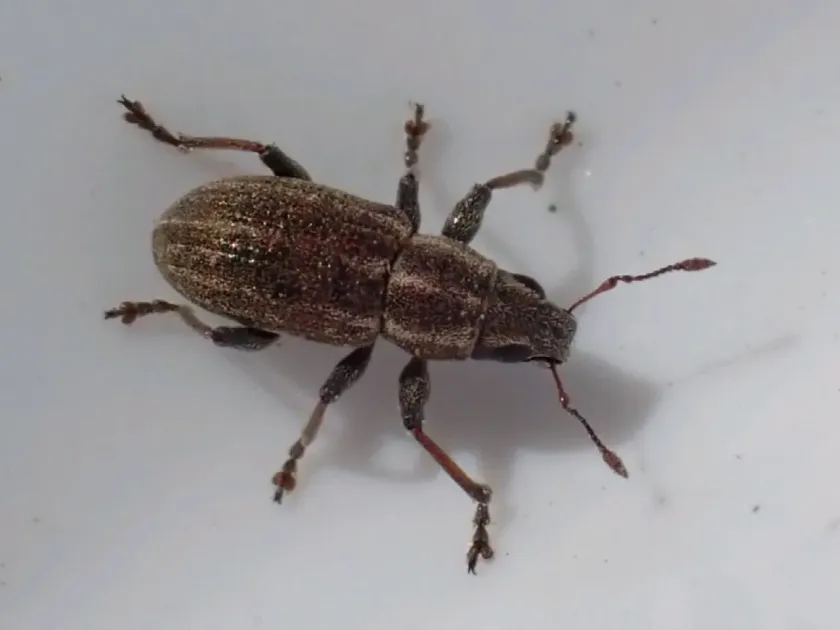
The yellow-legged pea weevil (Sitona suturalis) is a small beetle belonging to the Curculionidae family. Adult weevils are typically 3.5 to 4.5 mm long, with a coloration that ranges from brownish to grey-brown.
The defining physical characteristic, as the common name implies, is the yellowish tint of the legs. The body is covered in small scales, which provide a textured appearance to the exoskeleton.
Larvae are legless, cream-colored grubs with a distinct brown head. They are specifically adapted for subterranean life, residing in the soil to feed on plant root systems.
The species undergoes a complete metamorphosis, including egg, larval, pupal, and adult stages. Adults possess functional wings and can migrate significant distances in search of hosts.
The beetle is highly resilient, capable of overwintering as an adult in the soil or protected areas such as plant debris, ensuring survival through harsh winter conditions.
What it damages
The economic impact of S. suturalis is twofold: adults damage foliage, while larvae focus their destruction on the roots and root nodules of legume crops.
Adults consume the leaf margins, creating distinctive semicircular notches. While this damage is easily visible, it rarely kills the plant unless the infestation is extremely dense.
Larval feeding is much more detrimental. By consuming nitrogen-fixing nodules, they interrupt the plant’s nitrogen supply, leading to stunting, poor growth, and yield reduction.
Seedlings are particularly vulnerable. Heavy adult feeding on the seed leaves can lead to the death of the plant, resulting in stand gaps that reduce overall crop density.
The loss of nitrogen-fixing capacity forces plants to rely on soil nitrogen, which might not be sufficient for optimal production, especially in poor-quality soils.
When it appears
The pest emerges from hibernation in early spring as temperatures rise, typically coinciding with the development of the first legume seedlings.
Springtime (April to May) is the period of peak adult activity, involving active feeding, mating, and the initiation of the egg-laying phase on the soil or leaves.
Larval development occurs in the soil throughout the summer months. The duration of this stage is heavily influenced by soil moisture levels and ambient temperature.
Pupation occurs in the soil in mid-to-late summer, after which a new generation of adults emerges. These new adults feed briefly before preparing for winter.
As autumn approaches, the weevils seek protected overwintering sites in dense vegetation or the top layer of soil, effectively entering a state of diapause.
Signs of infestation
The most reliable field sign is the presence of U-shaped notches on the edges of leaves, which confirms the feeding activity of adult Sitona weevils.
Stunted plant growth and general yellowing of the foliage indicate that the roots and nodules have been compromised by larval feeding in the rhizosphere.
By carefully washing the soil away from the roots, one can find the larvae themselves or observe the hollowed-out remnants of nitrogen-fixing nodules.
Uneven crop stands and poor vigor in early-stage legume crops often point to severe subterranean infestation that occurred shortly after germination.
Using a sweep net in the evening hours allows agronomists to sample the population and determine if chemical intervention is necessary for crop preservation.
Control measures
Integrated pest management (IPM) for S. suturalis relies heavily on crop rotation to ensure that legume crops are not grown in the same field for consecutive years.
Effective weed management is essential, as many wild legumes can serve as alternative host plants, maintaining the pest population even in the absence of crops.
Seed treatments with systemic insecticides offer the most efficient protection for seedlings, preventing early-season damage when plants are at their most vulnerable stage.
Optimizing fertility and soil moisture levels helps the plants maintain vigor and regenerate root tissue, mitigating the impact of larval feeding damage.
- Application of foliar insecticides if adult population thresholds are exceeded.
- Promoting natural enemies, such as parasitic wasps, to control population levels.
- Early sowing dates to ensure plants grow past the susceptible stage before pest emergence.
Taxonomy
- Latin name
- Sitona suturalis
- Order
- Coleoptera (beetles)
- Family
- Curculionidae
- EPPO code
- SITNST
Discussion
No discussions yet — be the first.