
Clover root curculio
Sitona sulcifrons
Description
How to identify
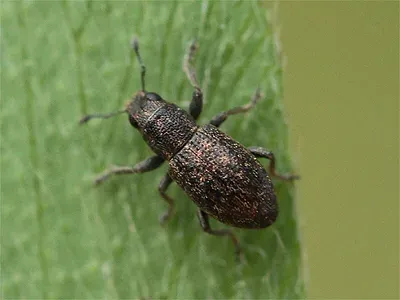
The clover root curculio (Sitona sulcifrons) is a small beetle belonging to the Curculionidae family. Adult beetles typically measure 3–4 mm in length, featuring a robust body covered in grayish-brown scales.
A key identifying feature of this species is the presence of distinct longitudinal furrows on the pronotum and a relatively broad snout, which is characteristic of the genus Sitona.
The larvae are small, legless, and white with a brown head, usually curled into a C-shape. They remain entirely in the soil, feeding on the root systems of leguminous plants throughout their development.
Adults overwinter in soil debris or protected areas within fields. As spring temperatures rise, they emerge to feed on the foliage of host plants, initiating the cycle for the new season.
These beetles are known for their defensive behavior of "playing dead" when disturbed, dropping from plants to the soil surface, which makes them difficult to spot during routine field scouting.
What it damages
The pest primarily targets leguminous crops, with clover, alfalfa, and various vetch species being the most susceptible hosts. Damage occurs both above and below the soil surface.
Adult beetles cause leaf-feeding damage, which is rarely fatal to established plants but can severely impact the growth of seedlings during the early stages of establishment.
The larvae represent the most damaging stage. They consume the root nodules where nitrogen-fixing bacteria reside, directly interfering with the plant's natural nitrogen-fixing capabilities.
Root destruction leads to a compromised water and nutrient uptake system. This makes plants highly susceptible to drought stress and secondary pathogens, often resulting in significant yield loss.
Heavy infestations can result in the thinning of stands and a noticeable reduction in the protein content and overall quality of forage crops due to reduced plant vigor.
When it appears
Adults emerge from hibernation early in the spring as soon as soil and air temperatures reach suitable levels, typically starting from +8°C to +10°C.
The egg-laying period spans late spring and early summer. Larvae hatch and move immediately to the roots to begin their feeding cycle, which lasts through the summer months.
Pupation occurs within the soil, and the emergence of the new generation of adults typically happens in mid-to-late summer, creating a second window for active damage.
Late summer and autumn are characterized by increased feeding activity as the beetles prepare for winter, accumulating the necessary energy reserves to survive the cold season.
Environmental factors, such as summer drought, can alter the activity patterns of the beetles, although their subterranean larval stage provides them with a level of protection against heat.
Signs of infestation
The most visible sign of infestation is the U-shaped or scalloped notches on the leaf margins, which are caused by adult feeding. This pattern is easily distinguishable from other insect damage.
In addition to leaf damage, plants may exhibit signs of nutrient deficiency, such as yellowing, even when soil nitrogen levels are adequate, due to the loss of root nodules.
If a field shows patchy growth or areas where plants can be easily pulled from the soil, it is a strong indicator of larval damage to the root system and nodule destruction.
Monitoring should include visual checks of foliage for feeding marks and digging up root crowns to inspect for the presence of larvae and the condition of nitrogen-fixing nodules.
- Characteristic scalloped leaf margins.
- Stunted plant growth and premature yellowing.
- Poor nitrogen fixation leading to decreased forage quality.
- Presence of larvae in the soil near the root zone.
Control measures
Crop rotation is the most effective preventative measure. Avoiding the planting of legumes in consecutive years or adjacent to existing perennial legume stands helps minimize pest pressure.
Cultural practices, such as maintaining healthy soil fertility and ensuring optimal planting density, help plants outgrow the initial damage caused by early spring beetle emergence.
Chemical control may be necessary in cases of severe infestation. Insecticides should be applied when adult populations reach economic thresholds, usually during the early spring before significant egg-laying occurs.
Deep autumn tillage can help disturb the soil and expose overwintering stages to cold temperatures and predators, reducing the survival rate of the population for the following year.
Integrated Pest Management (IPM) strategies, including the use of biological control agents and monitoring with sweep nets, are recommended to maintain sustainable pest levels without excessive chemical use.
Taxonomy
- Latin name
- Sitona sulcifrons
- Order
- Coleoptera (beetles)
- Family
- Curculionidae
- EPPO code
- SITNSL
Discussion
No discussions yet — be the first.