
Broom weevil
Sitona regensteinensis
Description
How to identify
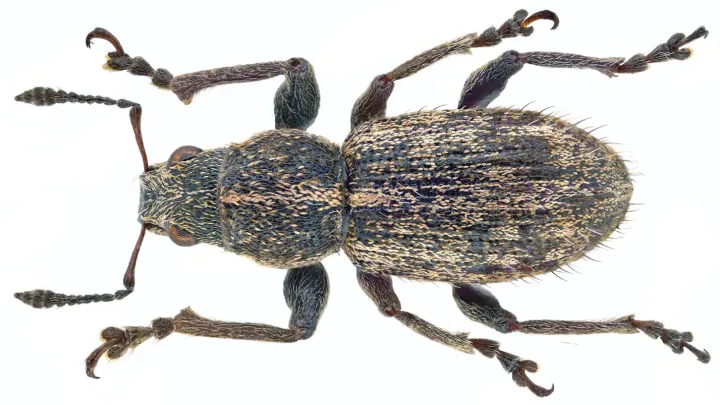
The broom weevil (Sitona regensteinensis) is a beetle belonging to the Curculionidae family, widely known as a specialist pest of leguminous plants. The adult beetle is characterized by a typically elongated body covered in small, protective scales, which blend perfectly with the environment.
The snout, or rostrum, of this species is relatively short and broad, which is a diagnostic feature of the Sitona genus. The color of the body ranges from light brown to greyish-brown, often displaying a mottled pattern that camouflages the insect on bark or soil surfaces.
Larvae of the broom weevil are typical for the Curculionidae family: they are legless, white or yellowish in color, and have a distinctively dark head capsule. Their bodies are usually curved in a C-shape, which is essential for identifying them while inspecting the root zone.
The life cycle of this pest involves complete metamorphosis, including egg, larva, pupa, and adult stages. In temperate climates, the species completes one generation per year, making it easier to predict periods of peak activity and implement timely control measures.
These insects are elusive, often exhibiting death-feigning behavior (thanatosis) when threatened, which makes them difficult to spot during routine field inspections. They are most active during the warmer parts of the day, specifically in spring and summer.
What it damages
The broom weevil primarily attacks plants from the Fabaceae (legume) family. Both adults and larvae contribute to the damage, though they affect the plant in different ways and at different stages of the plant's development.
Adult beetles cause damage to the foliage by creating distinct notches along the leaf margins. This feeding habit reduces the plant's photosynthetic capacity, which can be devastating for young seedlings if the population density is high.
The larvae, which live in the soil, feed primarily on the plant's root system and its nitrogen-fixing nodules. The destruction of these nodules is the most significant economic impact, as it interferes with the plant's ability to assimilate nitrogen.
Plants affected by larval feeding often show signs of stunted growth, chlorosis, and weakened resistance to secondary diseases. In severe cases, the damage to the roots leads to a significant decrease in biomass and overall crop yield.
The combination of adult leaf feeding and larval root damage creates a synergistic negative effect that can severely compromise the health of perennial legume pastures and commercial leguminous crops.
When it appears
The broom weevil overwinters as an adult, typically seeking refuge in the topsoil or under dense leaf litter at field margins. As spring temperatures rise, the adults emerge to feed and begin their reproductive cycle.
The peak activity period for adult mating and egg-laying occurs during late spring and early summer. Eggs are laid in the soil near the base of host plants, ensuring that the emerging larvae have immediate access to roots and nodules.
Larval development takes place throughout the summer months. During this phase, the larvae are at their most destructive, actively consuming root tissue while the host plants are in their period of most vigorous vegetative growth.
Pupation occurs in the soil, and new adults emerge towards the end of summer. These adults engage in a short period of feeding before preparing for the upcoming winter dormancy.
Understanding this seasonal timing is critical for effective management. Agronomists focus monitoring efforts on the early spring emergence phase to prevent the establishment of the next generation of larvae.
Signs of infestation
The most iconic sign of a broom weevil infestation is the characteristic semicircular or scalloped notches on the leaf edges. These patterns are easily identifiable during field surveys and serve as the first warning sign.
Weakened, yellowish, or stunted plants indicate potential root damage. By gently excavating the soil around the root zone, one can detect the absence of nodules or the presence of the cream-colored larvae near the roots.
Reduced crop vigor and overall patchy growth in fields are often secondary indicators of a severe infestation. These patches often expand as the larval population spreads through the root zones of adjacent plants.
The presence of the adults can be confirmed using sweep nets or by observing the ground around the base of the plants during the cool early morning hours when the insects are less mobile.
High seedling mortality in early spring, leading to bare patches, suggests that adults have heavily grazed on the emerging plants before they could establish a robust root system.
Control measures
Crop rotation is the most effective cultural control method. By avoiding planting legumes in the same field for consecutive years, farmers can significantly break the life cycle of the broom weevil and reduce local population pressure.
Deep autumn tillage is a recommended agrotechnical measure, as it exposes the overwintering adults to adverse environmental conditions and can physically destroy them in the soil.
Chemical control involving systemic or contact insecticides may be necessary during the peak of adult activity. Proper timing is essential: treatments must be applied after spring emergence but before significant egg-laying occurs.
Biological control, including the use of entomopathogenic fungi or beneficial nematodes, provides an eco-friendly option for managing larval populations in the soil without disrupting the balance of the local ecosystem.
Integrated Pest Management (IPM) practices, including the use of sticky traps and regular monitoring, help determine the economic threshold for intervention, ensuring that pest control is both efficient and cost-effective.
Taxonomy
- Latin name
- Sitona regensteinensis
- Order
- Coleoptera (beetles)
- Family
- Curculionidae
- EPPO code
- SITNRE
Discussion
No discussions yet — be the first.