
Pea leaf weevil (Sitona prominens)
Sitona prominens
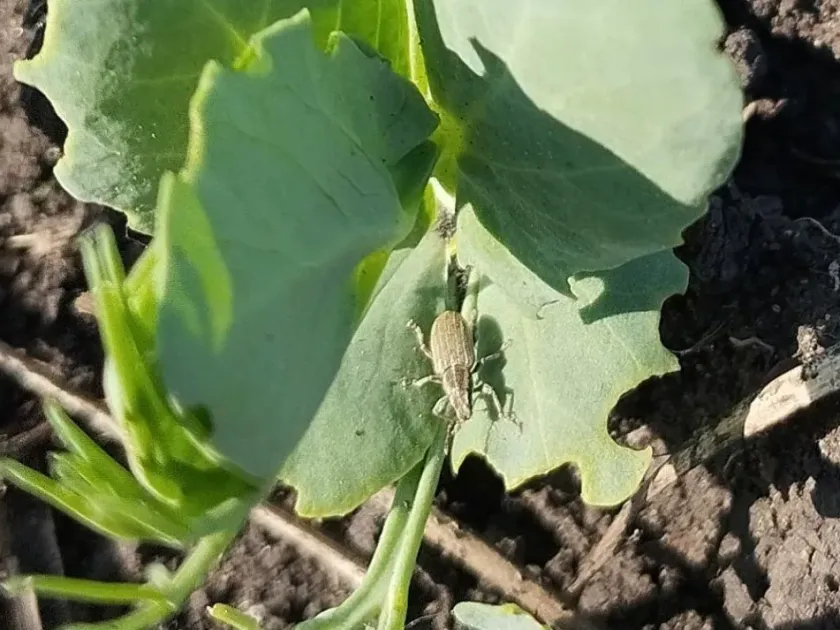
Description
How to identify
The Sitona prominens species belongs to the Curculionidae family within the Coleoptera order. These beetles are characterized by their snout-like head and are widely recognized as pests of legume crops.
Adult insects are typically small with an oval-shaped body, covered in light brown or greyish scales that help them blend into the soil and plant debris environment.
The larvae are white, legless, and reside primarily in the soil, which makes them particularly difficult to detect until significant damage to the roots has already occurred.
The life cycle of this weevil is heavily influenced by regional temperature patterns, as the species thrives in environments where legume cultivation is intensive.
The adult weevils are capable of migration, often moving from overwintering sites to nearby soybean or clover fields as soon as temperatures permit in early spring.
What it damages
This pest mainly affects various legumes, including soybeans, alfalfa, and peas, causing damage both at the adult stage and the larval stage.
Adult weevils feed on the leaves, creating distinct semi-circular notches along the edges, which reduces the plant's capacity for photosynthesis during early development.
Larvae, the most destructive stage, live underground and consume the nitrogen-fixing nodules on the roots, depriving the plant of essential nitrogen nutrition.
This root damage leads to stunted plant growth, yellowing foliage, and a significantly reduced ability of the crop to withstand periods of drought or stress.
In cases of heavy infestation, farmers may see extensive wilting and loss of yield potential, sometimes requiring replanting of heavily damaged field sections.
When it appears
Adult weevils emerge from their overwintering sites during early spring as soon as the soil temperatures reach approximately +8 to +10 degrees Celsius.
The peak period of adult activity generally aligns with the emergence of young crop seedlings, making it a critical window for crop protection efforts.
Oviposition, or egg-laying, typically occurs throughout late spring and early summer as females deposit eggs in the soil near the base of the stems.
The larval stage develops throughout the early summer months, eventually pupating and emerging as the new generation of adults by mid-summer.
As autumn approaches, the new adults move toward overwintering areas such as grassy borders, woody areas, or dense vegetation to survive the winter cold.
Signs of infestation
The most visible diagnostic sign of Sitona prominens infestation is the characteristic notched, scalloped edges on the leaves of young legume plants.
Plants that appear yellow, weak, or stunted despite adequate irrigation are likely suffering from larval feeding on their root nodules.
Inspection of the root system often reveals missing or damaged nodules, which are critical for the plant's symbiotic relationship with nitrogen-fixing bacteria.
In field surveys, adults can be detected using sweep nets in the early morning or late evening when the insects are most active above the soil surface.
- Semi-circular notches on leaf margins.
- Yellowing and wilting of young seedlings.
- Root system showing missing nitrogen-fixing nodules.
- Reduced vigor and stunted overall plant height.
Control measures
Effective crop rotation is a primary defense, ensuring that legumes are not planted in the same field for several years to break the pest's life cycle.
Cultural practices like deep plowing after harvest help bury and destroy the overwintering population of weevils, reducing the next season's infestation risk.
Chemical control involving systemic insecticides is often necessary when the density of adults exceeds the economic threshold during the early growth stages.
Seed treatments are highly recommended as they provide a preventative barrier against larval feeding, protecting the root zone during the crop's initial development.
Regular field scouting is essential for timely intervention, allowing farmers to apply targeted treatments before larvae cause irreversible damage to the nodules.
Taxonomy
- Latin name
- Sitona prominens
- Order
- Coleoptera (beetles)
- Family
- Curculionidae
- EPPO code
- SITNPR
Discussion
No discussions yet — be the first.