
Yellow-legged pea weevil
Sitona obsoletus
Description
How to identify
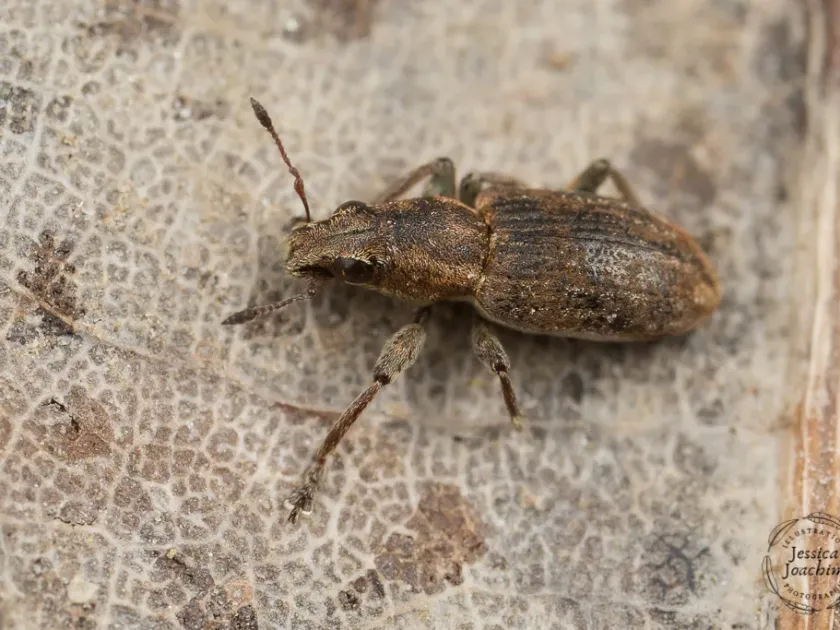
The yellow-legged pea weevil (Sitona obsoletus) is a significant coleopteran pest belonging to the Curculionidae family. Adult beetles measure approximately 3.5 to 4.5 mm in length, possessing a characteristic short and robust snout.
Their body is covered with dense, light-colored scales, creating a grayish-brown appearance. As the common name suggests, the presence of distinct yellowish legs is a key identification feature for this species in the field.
The larval stage is typical for the genus: a white, legless grub with a yellowish-brown head capsule. The body is slightly curved, facilitating movement within the soil profile toward the host plant roots.
This species is well-adapted to agricultural environments and specifically targets leguminous plants. It undergoes a complete metamorphosis, including egg, larval, pupal, and adult stages.
Overwintering occurs primarily in the adult stage within the top layer of the soil or beneath plant debris. They typically emerge from these sites during the first warm days of spring to begin their active cycle.
What it damages
Damage is caused by both adults and larvae, although they affect different plant organs. Adult beetles feed on the foliage, chewing semi-circular notches into the leaf margins, which is a signature symptom of Sitona activity.
The larvae are particularly destructive as they inhabit the soil and feed on the root nodules of legumes. By destroying these nodules, they prevent the plant from fixing atmospheric nitrogen, leading to nutrient deficiency.
The loss of nitrogen-fixing capacity manifests as reduced plant vigor, stunting, and yellowing of the foliage. In severe infestations, the nitrogen starvation can significantly impact the final seed yield.
Furthermore, larval feeding creates entry points for various soil-borne pathogens, including fungi and bacteria, which can cause root rot and further debilitate the plant's vascular system.
Seedlings are most susceptible to damage. High population densities during the emergence phase can lead to significant crop thinning or complete failure, necessitating corrective replanting strategies.
When it appears
Adults emerge from hibernation when soil temperatures consistently reach 8–10 degrees Celsius. They initially colonize established legume crops before moving to emerging spring sowings.
Mass activity and mating occur during the spring months. Females deposit eggs in the soil near the base of host plants, and the larvae migrate downward to locate and begin feeding on root nodules.
The larval stage lasts for 30 to 45 days. They continue to feed through the vegetative and reproductive phases of the host plant, making the timing of their activity overlap with critical yield formation stages.
Pupation occurs in the soil, usually in mid-summer. A new generation of adults emerges shortly thereafter, and these beetles engage in active feeding on the canopy before the onset of autumn temperatures.
As cooling weather approaches, the new generation seeks out overwintering sites. They move into deeper soil layers or dense vegetation to survive the winter, completing the annual lifecycle.
Signs of infestation
The most visible indicator of an infestation is the notched leaf margins. These characteristic half-moon-shaped bites distinguish Sitona feeding from other defoliating insects that leave jagged or irregular holes.
Plants struggling with larval root damage often appear chlorotic and stunted. Such plants may look nutrient-deficient even in fertile soil, as they are unable to utilize the atmospheric nitrogen essential for healthy growth.
Digging up root systems usually reveals missing or hollowed-out nodules. Instead of healthy, pink-colored nodules, one finds shredded tissue and a lack of proper nodulation along the primary and secondary roots.
Population density monitoring is achieved by using sweep nets or visual inspections of leaf margins during the early morning hours, when adults are most active and visible on the plant canopy.
High adult numbers at the end of the season serve as a predictive indicator for the following year's pest pressure. Tracking these numbers is essential for timely intervention planning.
Control measures
Cultural control is the first line of defense, utilizing crop rotation to maintain spatial separation between legume crops. This breaks the lifecycle and forces adults to seek alternative, non-host plants.
Deep autumn plowing is an effective mechanical method that disturbs the soil, causing mortality to overwintering larvae and pupae while exposing them to predatory birds and unfavorable winter conditions.
- Seed treatment with systemic insecticides to protect the early seedling stage.
- Foliar insecticide applications when population counts exceed the economic threshold.
- Nitrogen supplementation to mitigate the impact of nodule destruction on plant health.
Economic thresholds vary based on crop variety and growth stage, but a common trigger is 10–15 beetles per square meter. At this point, chemical intervention is typically recommended to prevent yield loss.
Biological controls, including entomopathogenic nematodes or fungi, can be deployed to manage soil-dwelling larval populations, offering a sustainable alternative to broad-spectrum chemical inputs.
Taxonomy
- Latin name
- Sitona obsoletus
- Order
- Coleoptera (beetles)
- Family
- Curculionidae
- EPPO code
- SITNLE
Discussion
No discussions yet — be the first.