
Pea leaf weevil
Sitona macularius
Description
How to identify
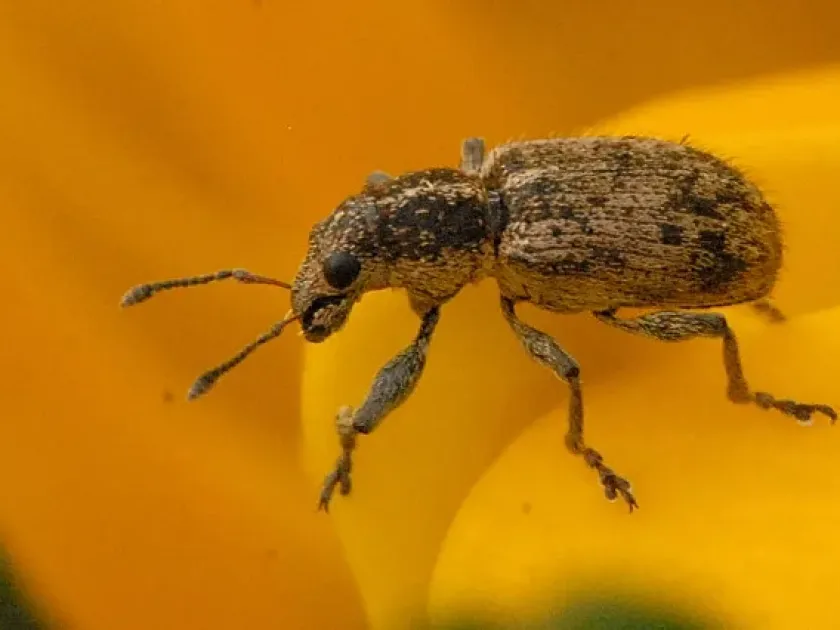
The pea leaf weevil (Sitona macularius) is a small beetle belonging to the Curculionidae family. Adults typically measure between 3 and 5 mm in length and are characterized by a greyish-brown color with fine bristles covering their body.
The larvae are legless, white, and have a distinctive brownish head. They grow up to 5 mm in length and live entirely underground, which makes them difficult to monitor throughout the development cycle.
The species undergoes a complete metamorphosis. Adults overwinter in the soil or under plant debris near host fields, including alfalfa and clover, before migrating to emerging legumes in the spring.
Females lay hundreds of eggs on the soil surface or plant stems. Once the eggs hatch, the larvae move into the soil to begin their feeding cycle on the root nodules of the host plants.
The total development time from egg to adult depends on soil temperature and moisture levels, generally taking about two months during the active growing season.
What it damages
The pea leaf weevil causes significant economic damage to legumes such as peas, lentils, and vetch. Both adults and larvae contribute to the negative impact on plant health and yield potential.
Adult weevils feed on the leaves of young seedlings, creating semi-circular notches along the margins. This significantly reduces the leaf surface area available for photosynthesis.
Larval feeding is particularly detrimental because they consume the nitrogen-fixing nodules on the roots. This prevents the plant from accessing symbiotic nitrogen, essential for healthy legume development.
Severe infestations can lead to stunted growth, yellowing of foliage, and, in extreme cases, the total death of young seedlings, forcing farmers to re-sow the affected areas.
Beyond the direct nutrient loss, damaged root systems become more susceptible to soil-borne pathogens and fungal diseases that further weaken the entire crop stand.
When it appears
Adult weevils emerge from their overwintering sites in early spring, typically when temperatures rise above 10 degrees Celsius, often coinciding with early spring tillage.
The period of peak adult activity and leaf feeding occurs as legume seedlings emerge from the soil. Farmers should be most vigilant during the initial vegetative stages of the crop.
Egg-laying and the subsequent larval stage in the soil continue through late spring and early summer, creating a prolonged risk period for the developing root systems.
New adults of the next generation emerge in mid-to-late summer, feeding briefly on available vegetation before looking for safe overwintering sites as temperatures drop.
The life cycle is tightly synchronized with the climate; cooler, wet springs can sometimes delay the emergence of adults, while dry conditions may increase the severity of larval damage.
Signs of infestation
The most visible sign of an infestation is the presence of U-shaped notches along the edges of leaves. This "scalloped" appearance is a classic diagnostic marker for Sitona activity.
If you suspect larvae are damaging the roots, carefully dig up a plant and examine the root system. A lack of healthy nodules or the presence of visible white larvae in the soil indicates an active infestation.
Stunted plant growth and a pale, yellowish color are secondary indicators that the plant is struggling to fix nitrogen due to the destruction of root nodules.
In bright sunshine, adults can be found hiding in the plant canopy or on the soil surface. They are quite sensitive to movement and often drop to the ground, playing dead to avoid predators.
- Semi-circular notches on leaf edges.
- Yellowing of leaves despite adequate soil fertility.
- Poor stand establishment and stunted seedlings.
- Destroyed or missing root nodules upon inspection.
Control measures
The most effective strategy is spatial isolation, keeping new annual legume crops as far as possible from alfalfa or clover fields, which serve as primary reservoirs for the pest.
Cultural control via early autumn plowing helps disturb overwintering sites, significantly reducing the survival rate of the adult population during the dormant winter months.
Chemical control involving systemic insecticide seed treatments is highly recommended in areas with historically high pest pressure to protect seedlings during the critical germination phase.
If adult feeding exceeds economic thresholds, foliar insecticide applications may be required in the early seedling stage to prevent excessive leaf loss and inhibit egg-laying.
Implementing a diverse crop rotation is crucial, as it breaks the life cycle of the weevil and prevents the buildup of larval populations in the soil over successive years.
Taxonomy
- Latin name
- Sitona macularius
- Order
- Coleoptera (beetles)
- Family
- Curculionidae
- EPPO code
- SITNMA
Discussion
No discussions yet — be the first.