
Pea leaf weevil
Sitona linellus
Description
How to identify
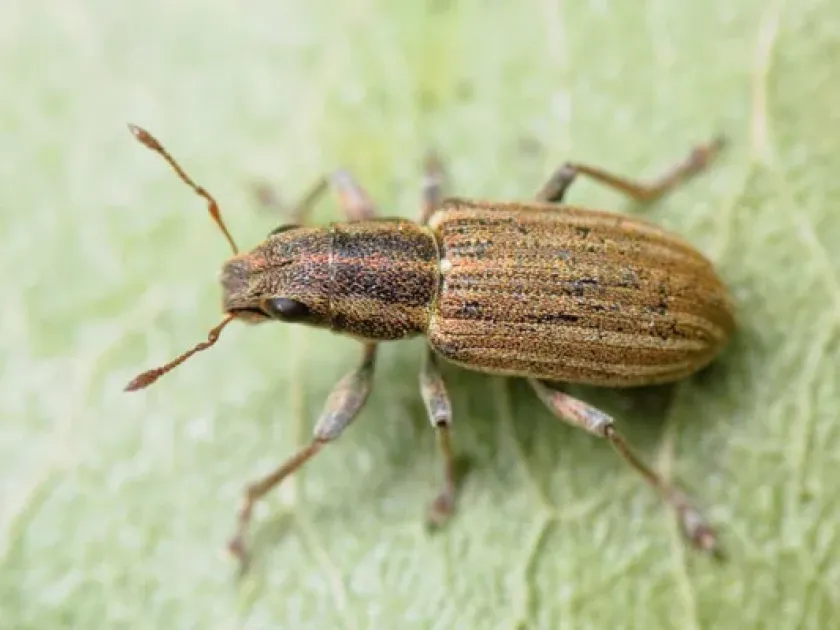
The adult beetle is small, typically measuring between 4 to 5 millimeters in length, with a grayish-brown body and a slight metallic sheen.
It is easily identified by three distinct light longitudinal stripes on the pronotum and wing covers, which are characteristic of this species.
The larva of the pea leaf weevil is legless, white in color with a yellowish-brown head, and maintains a slightly curved, C-shaped body posture.
Eggs are small, round, and initially pale yellow, turning black shortly after being laid on the soil surface or plant parts.
The life cycle involves complete metamorphosis: egg, larva, pupa, and adult, with one generation typically developing per year in temperate regions.
What it damages
The pea leaf weevil is a primary pest of various legumes, showing a strong preference for peas, fava beans, vetch, and lentils.
To a lesser extent, it can cause damage to alfalfa and clover, especially when these crops are grown in close proximity to major legume fields.
Adult beetles feed on the edges of leaves, creating characteristic notched patterns, which inhibits photosynthesis and weakens the plant.
The larvae are particularly destructive as they feed on root nodules, effectively preventing nitrogen fixation and stunting plant growth.
Heavy infestations can lead to a significant reduction in biomass and grain yield, compromising the overall quality of the leguminous crop.
When it appears
Overwintered adults emerge from hibernation in early spring as soon as soil temperatures reach approximately 5 to 8 degrees Celsius.
Mating and egg-laying occur during May and June, coinciding with the rapid vegetative growth stage of newly emerged legume seedlings.
Larval development takes place within the soil throughout the summer, while the new generation of adults typically emerges in July and August.
During late summer and autumn, adult beetles feed on the seedlings of winter legumes or various weeds before entering winter diapause.
The most critical window for damage is during the seedling emergence phase, when the crop is most susceptible to significant leaf area loss.
Signs of infestation
The most diagnostic sign of infestation is the presence of U-shaped or semi-circular notches along the edges of the leaves.
During a field inspection, one may find white larvae in the soil around the root zone, feeding on nitrogen-fixing root nodules.
Infected plants appear stunted and often exhibit signs of chlorosis, resembling a nutrient deficiency due to the lack of available nitrogen.
Increased mortality of young seedlings may occur, leading to uneven crop stands across the affected field areas.
- Characteristic semi-circular notched leaf edges.
- Yellowing of leaves indicative of nitrogen deficiency.
- Presence of small white larvae around the roots.
- Poor plant development compared to healthy sectors.
Control measures
Implementing early sowing dates is an effective cultural practice, allowing the plants to outgrow the critical stage of weevil susceptibility.
Strict crop rotation and maintaining distance from previous year's legume fields helps minimize the migration of overwintered populations.
Seed treatment with systemic insecticides is considered the most reliable method for protecting emerging seedlings from adult feeding.
Foliar application of insecticides from the pyrethroid or organophosphate groups is recommended if population thresholds are exceeded.
Providing nitrogen fertilization can help the crops recover or compensate for the loss of root nodules caused by larval feeding activity.
Taxonomy
- Latin name
- Sitona linellus
- Order
- Coleoptera (beetles)
- Family
- Curculionidae
- EPPO code
- SITNDE
Discussion
No discussions yet — be the first.