
Pea leaf weevil
Sitona lineatus
Description
How to identify
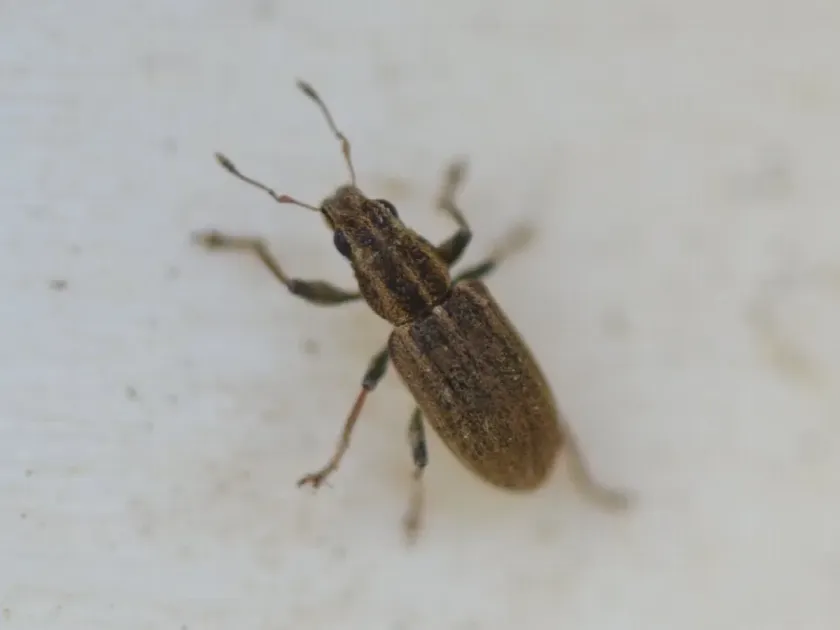
The pea leaf weevil (Latin: Sitona lineatus) is a member of the Curculionidae family in the order Coleoptera. It is a small snout beetle, approximately 4–5 mm long, characterized by a greyish-brown body with three distinct light-colored stripes on its pronotum and elytra.
The larvae are legless, white-bodied, and feature a light brown head. They are primarily soil-dwelling, specifically targeting the root system of leguminous host plants to complete their development.
Adult weevils overwinter in the soil, leaf litter, or adjacent grassy habitats. As temperatures rise in early spring, they emerge and migrate to host fields, feeding on the emerging foliage of legumes.
Females lay eggs either directly on the soil surface or on the leaves of host plants. The larvae hatch and burrow into the soil to feed on the root nodules, which are essential for nitrogen fixation.
The life cycle is univoltine, meaning one generation per year. After pupation in the soil, new adults emerge in mid-summer to feed before seeking overwintering sites during the autumn months.
What it damages
Pea leaf weevils target a variety of leguminous crops, with peas, broad beans, lentils, and vetches being the most susceptible. The damage occurs in two distinct phases: foliar feeding by adults and root damage by larvae.
Larval feeding is the most critical aspect, as it destroys the nitrogen-fixing nodules on the roots. This prevents the plant from accessing symbiotic nitrogen, significantly hindering growth and yield potential.
Adult weevils feed on the leaves, creating characteristic U-shaped notches along the leaf margins. While rarely fatal on mature plants, this feeding can be devastating to seedling crops by reducing leaf area.
Severe infestations often lead to stunted, yellowish plants that fail to thrive, particularly under drought stress or poor soil conditions where the plant cannot easily compensate for lost roots.
The economic impact can be substantial, with crop losses reaching 20–50% in cases of high larval density, necessitating early season intervention and consistent field monitoring.
When it appears
The primary period of adult activity begins in spring, coinciding with the germination and early vegetative growth of legume crops. This is when the insects migrate from overwintering sites.
Larval damage typically peaks during the flowering and pod-filling stages, as the larvae grow and consume more nodule tissue. This timing is critical for the nutrient balance of the crop.
Emergence of the new adult generation usually occurs in June or July. These beetles engage in active feeding during the summer before entering diapause or seeking overwintering locations.
Development is heavily dependent on regional climate, with warm, moist springs providing the optimal conditions for larval survival and migration to the host plant roots.
Monitoring should be most intense during the initial emergence of seedlings, as this is when the crop is at its most vulnerable state to adult feeding damage.
Signs of infestation
The most recognizable symptom is the presence of scalloped, crescent-shaped notches along the edges of the leaves, which clearly indicates adult weevil feeding activity.
During the growing season, a lack of vigor, stunted growth, or premature yellowing of the lower leaves often points to larval damage below the soil surface, specifically on the root nodules.
In infested fields, one may observe clusters of damaged plants, especially near field edges that border perennial forage areas where the weevils may have overwintered.
Observing the beetles is often difficult because they are cryptic and drop to the ground or hide beneath soil clods when disturbed, playing dead to avoid detection.
For confirmation, soil around the roots can be carefully examined for the presence of larvae or empty, damaged nodule remains during the mid-season growth phase.
Control measures
Integrated pest management is essential, starting with crop rotation to ensure that legumes are not planted in close proximity to the same fields year after year.
Early sowing can help plants reach a stage where they are better able to tolerate foliar feeding before the peak migration of the overwintering adults occurs.
Seed treatment with systemic insecticides is a standard and highly effective preventive measure, protecting the roots from larval damage early in the crop's development.
Foliar insecticide applications may be required if adult weevil populations exceed the economic threshold, usually measured by the number of notches on the leaves of the seedlings.
- Maintain a spatial buffer between new legume crops and overwintering sites.
- Use of early-maturing varieties to bypass peak larval damage cycles.
- Nitrogen supplementation to help mitigate the effects of nodule destruction.
- Field margin spraying in early spring to intercept migrating beetles.
Taxonomy
- Latin name
- Sitona lineatus
- Order
- Coleoptera (beetles)
- Family
- Curculionidae
- EPPO code
- SITNLI
Discussion
No discussions yet — be the first.