
Pea leaf weevil
Sitona limosus
Description
How to identify
The pea leaf weevil (Sitona limosus) is a beetle species belonging to the family Curculionidae, widely recognized as a significant pest of various leguminous crops globally.
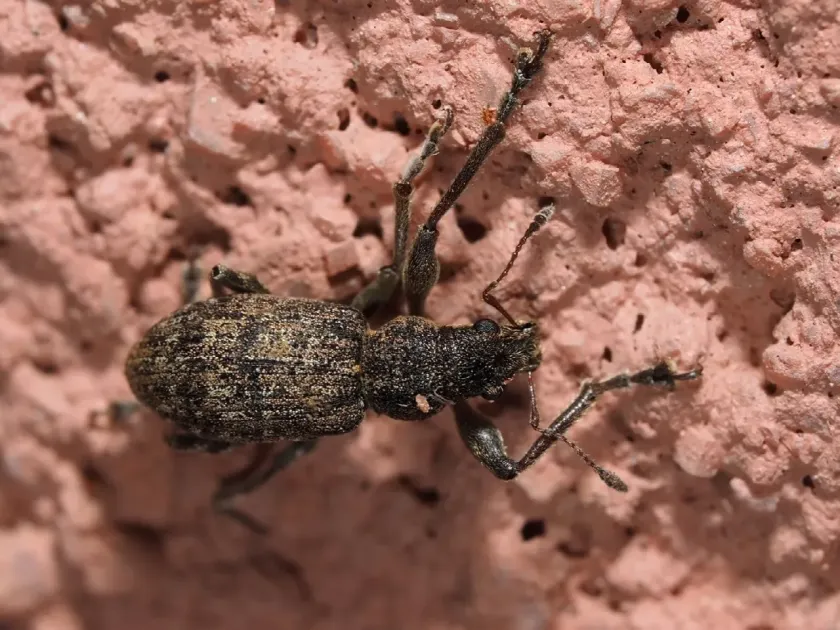
Adult beetles are typically 3–5 mm in length, characterized by a greyish-brown coloration that blends into the soil surface, providing camouflage against predators.
The life cycle involves four stages: egg, larva, pupa, and adult. They predominantly overwinter as adults within the soil layer or in nearby perennial vegetation.
The larvae are small, white, legless, and possess a brown-colored head, living entirely in the soil where they feed on the root systems of host plants.
Their activity usually commences in early spring as temperatures rise, leading to the migration of adults toward young legume seedlings.
What it damages
This pest primarily attacks pulse crops, including peas, beans, lentils, alfalfa, and clovers, significantly impacting plant health from emergence.
Adult beetles feed on the margins of leaves, creating distinctive semi-circular notches, which can lead to complete defoliation of very young seedlings under heavy infestation.
The most severe damage is caused by the larvae, which feed on the nitrogen-fixing nodules attached to the roots, preventing the plant from synthesizing essential nitrogen.
Impacted plants often display stunted growth, chlorosis, and reduced vigor, which directly correlates with a lower production of biomass and seeds at harvest time.
Large infestations can result in significant yield losses, especially in early-sown fields where the growth rate of seedlings is slower due to cool temperatures.
Signs of infestation
The most visible indicator of an infestation is the presence of scalloped edges on the leaves of young legume plants, a classic symptom of adult beetle feeding.
If the field is heavily infested, gardeners and agronomists can observe adult beetles on the plants, particularly during warm, calm periods of the day.
Below-ground, the symptoms include poor root nodulation and a visible reduction in the size and number of nitrogen-fixing nodules on the taproot system.
A general lack of crop vigor and uneven emergence across the field, despite favorable soil moisture, may point to a high larval population attacking the roots.
Monitoring can be performed by carefully inspecting leaves in the morning, when the beetles are less active and easier to count on the foliage.
Control measures
Cultural control is essential, involving crop rotation and spatial separation of new legume fields from last year’s crop residue to limit pest migration.
Seed treatment with systemic insecticides is considered the most effective proactive strategy to protect seedlings during the critical stages of early development.
Timely application of nitrogen fertilizers can assist crops in recovering from root damage, helping them to compensate for the loss of natural nitrogen fixation.
In cases of severe economic damage, foliar application of approved insecticides is recommended to manage the adult population before egg-laying intensifies.
Good agricultural practices, such as ensuring optimal soil fertility and avoiding moisture stress, improve the plant's ability to withstand and recover from pest feeding.
Taxonomy
- Latin name
- Sitona limosus
- Order
- Coleoptera (beetles)
- Family
- Curculionidae
- EPPO code
- SITNLM
Discussion
No discussions yet — be the first.