
Alfalfa weevil (Sitona inops)
Sitona inops
Description
How to identify
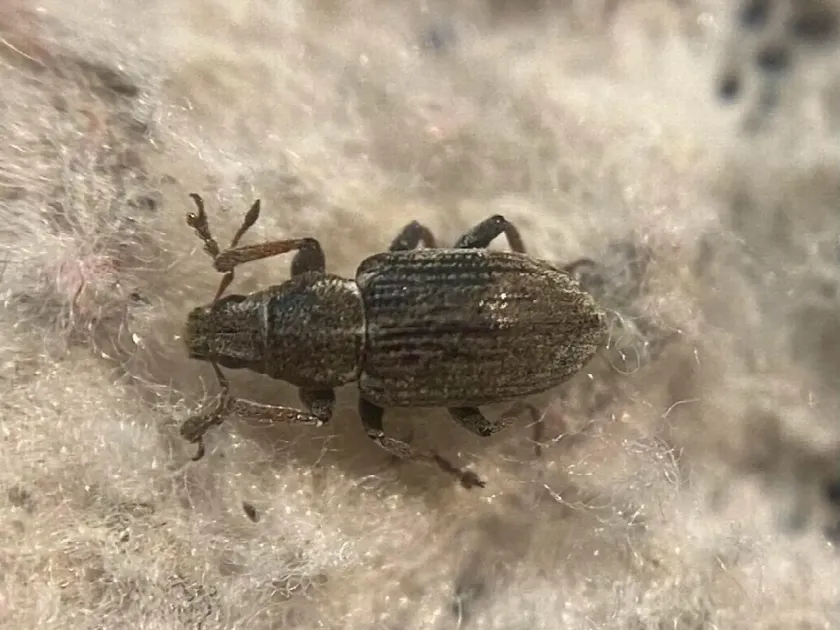
The alfalfa weevil (Sitona inops) belongs to the order Coleoptera and the family Curculionidae. It is a small insect, typically measuring between 3.5 and 4.5 mm in length, with a body covered in scales that give it a grayish-brown to brown appearance.
The snout, or rostrum, is relatively short and thick, which is a diagnostic feature of the Sitona genus. The larvae are white, legless, and C-shaped, featuring a well-developed light brown head, growing to approximately 5 mm in size.
Eggs are small, oval-shaped, and change color from yellowish to black as they mature. The pupal stage occurs within a soil cell at a depth of 10 to 15 cm, providing a stable environment for transformation.
Adult weevils are capable of active flight, enabling them to migrate to and infest new fields of alfalfa and other legume crops. They overwinter as adults, hiding in plant debris, under the soil surface, or in dense perennial grass stands.
Adult activity begins in the spring when soil temperatures reach 10–12°C. This timing coincides with the regrowth phase of alfalfa, making it an ideal period for monitoring the pest.
What it damages
This pest primarily attacks alfalfa (lucerne) but also impacts other legumes such as clover and sainfoin. The damage occurs in two distinct stages: larval feeding on roots and adult feeding on foliage.
Larvae feed exclusively on the root nodules of the host plants, which are responsible for nitrogen fixation. Destroying these nodules severely inhibits the plant’s ability to utilize atmospheric nitrogen, leading to reduced productivity.
Adults consume the leaves, creating characteristic notched, semicircular, or jagged edges along the leaf margins. Heavy infestations can result in the complete defoliation of young shoots and seedlings.
The combination of root damage by larvae and foliage damage by adults significantly weakens the plants, making them susceptible to secondary infections and drought stress.
Fields experiencing high weevil populations show poor vigor, yellowing, and stunted growth. In extreme cases, young stands may require reseeding due to high mortality rates of the seedlings.
When it appears
The emergence of overwintered adults typically occurs in the early spring, following the initial growth of alfalfa. Adults feed actively for several weeks before entering the egg-laying phase.
Females deposit eggs on the soil surface or at the base of the stems from late spring through early summer. A single female can produce hundreds of eggs, contributing to rapid population expansion.
Larvae hatch after approximately 10–15 days and move immediately into the soil to begin feeding on root nodules. This larval development period lasts throughout the summer months.
Pupation takes place within the soil, and the next generation of adults emerges in late summer. These individuals continue to feed before seeking overwintering sites as temperatures drop in the fall.
The life cycle is generally completed in one year. While the species is well-adapted to varied climates, its activity is highly dependent on spring temperatures and moisture levels in the soil.
Signs of infestation
The most reliable sign of a Sitona inops infestation is the presence of distinctive semi-circular notches along the edges of the leaves. Observing these notches early in the season is critical for management.
Stunted growth, uneven stand establishment, and yellowing foliage are strong indicators that the root system has been compromised by larval feeding. Digging up plants to inspect the roots often reveals an absence of healthy, pinkish nodules.
Adult weevils are often shy and hide near the base of the plant during the hottest parts of the day. Using an insect sweep net during the early morning is an effective method for detecting their presence.
The presence of fecal spots on leaves and stems is another secondary sign of adult feeding activity. In heavily infested areas, the field may appear ragged or patchy.
Producers should watch for sudden declines in forage quality, as the damage to the nitrogen-fixing nodules results in lower protein content and biomass accumulation in the harvested crop.
Control measures
Integrated pest management (IPM) is essential for controlling the alfalfa weevil. Proper crop rotation, particularly keeping young alfalfa stands away from older ones, is the first line of defense.
Cultural practices, such as clean tillage and maintaining soil fertility, help plants withstand damage. Strong, healthy plants with robust root systems are better able to compensate for minor nodule losses.
Chemical control should be employed only when monitoring indicates that the population has exceeded the economic injury level. Timing of application is critical to target the adults before egg-laying occurs.
When insecticides are necessary, systemically active products can provide protection against both foliar feeding and larval populations in the root zone, depending on the chemical’s mobility.
- Implement strict crop rotation schedules.
- Maintain adequate phosphorus and potassium levels to promote root growth.
- Monitor populations using sweep nets to guide intervention decisions.
- Promote natural enemy habitats to provide biological suppression of the pest.
Taxonomy
- Latin name
- Sitona inops
- Order
- Coleoptera (beetles)
- Family
- Curculionidae
- EPPO code
- SITNIN
Discussion
No discussions yet — be the first.