
Alfalfa nodule curculio
Sitona humeralis
Description
How to identify
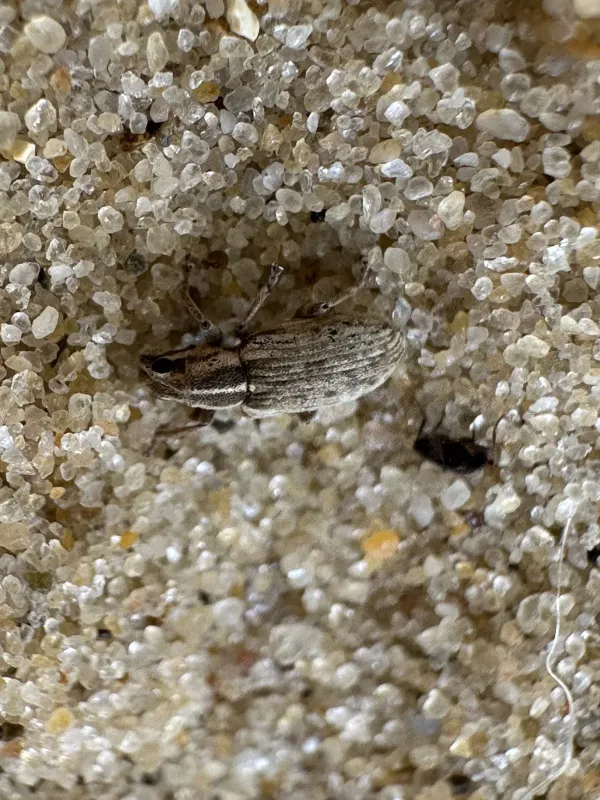
The alfalfa nodule curculio (Sitona humeralis) is a significant pest belonging to the Curculionidae family. Adult beetles measure between 3.5 and 4.5 mm in length and possess a characteristic short, stout snout.
Their bodies are typically brownish with scaly surfaces that create a mottled appearance, often featuring distinct patterns on the elytra and head. The pronotum is usually covered with finer, lighter-colored hairs.
Larvae are legless, creamy-white in color with a distinctive brown head capsule. They are C-shaped and spend their entire developmental period in the soil feeding on root nodules.
Adults are strong fliers and can migrate over long distances to colonize new fields, making them a persistent threat to legume-rich areas during the spring season.
As an oligophagous species, it specifically targets plants in the Fabaceae family, with alfalfa and various clovers being their preferred hosts for both feeding and reproduction.
What it damages
The pest causes damage through two distinct life stages. Adult beetles feed on the foliage, while larvae cause more insidious damage by destroying the root system's nitrogen-fixing nodules.
Adult feeding results in characteristic scalloped or semi-circular notches along the margins of the leaves. While usually not lethal to established plants, this feeding can significantly stress seedlings.
The larvae are far more damaging as they burrow into the soil and consume the bacterial nodules on the roots, which are essential for biological nitrogen fixation in legumes.
This disruption of nitrogen metabolism leads to stunted growth, reduced biomass yield, and an increased vulnerability of the crop to environmental stresses such as drought.
Significant infestations often result in uneven stands, where seedlings may die off entirely during periods of high pest density, requiring potential reseeding.
When it appears
Adults emerge from their overwintering sites in the soil during early spring as temperatures rise consistently above 8–10°C, coinciding with the growth of spring alfalfa.
Mating occurs shortly after emergence, followed by oviposition. Females deposit their eggs near the base of host plants or directly onto the soil surface.
After hatching, the young larvae migrate into the root zone to begin their feeding cycle, which typically spans approximately 40 to 60 days depending on soil moisture and temperature.
Pupation takes place within a small earthen cell created in the soil profile. The new generation of adults typically emerges during the mid-summer months.
Following a period of summer feeding, the beetles either enter a brief diapause or begin seeking suitable protected sites in the soil or under debris to overwinter.
Signs of infestation
The most visible symptom of an infestation is the notched leaf appearance. Regularly inspecting leaf margins for these semi-circular bite marks is a key early warning sign.
Plants displaying chlorosis or general yellowing despite adequate soil moisture may be suffering from larval root damage that inhibits effective nutrient uptake.
During the seedling stage, poor stand establishment and patches of missing plants often correlate with high populations of larvae destroying root systems early in the season.
Inspecting the soil around the roots can reveal the absence of healthy pinkish nodules, often accompanied by the presence of small, white, legless larvae in the surrounding soil.
- Scalloped leaf margins (characteristic bite patterns).
- Yellowing and stunting of the plant canopy.
- Depletion of nitrogen-fixing nodules on the root system.
- Visible presence of adults on foliage during warm, sunny days.
Control measures
Cultural control strategies include optimizing planting dates to ensure plants are well-established and vigorous before the peak emergence of the adult curculio.
Deep autumn plowing is a highly effective mechanical method to disrupt the soil and destroy larvae and pupae residing within the soil profile, reducing overwintering survival.
Chemical control involving systemic or contact insecticides may be necessary if monitoring reveals that pest populations have exceeded established economic thresholds.
Providing balanced fertilization, particularly with potassium and phosphorus, promotes root health and helps plants recover faster from the impact of larval feeding.
Biological control using entomopathogenic fungi or the encouragement of native parasitic wasps can provide sustainable management of the population within integrated pest management programs.
Taxonomy
- Latin name
- Sitona humeralis
- Order
- Coleoptera (beetles)
- Family
- Curculionidae
- EPPO code
- SITNHU
Discussion
No discussions yet — be the first.