
Sitona hispidulus
Sitona hispidulus
Description
How to identify
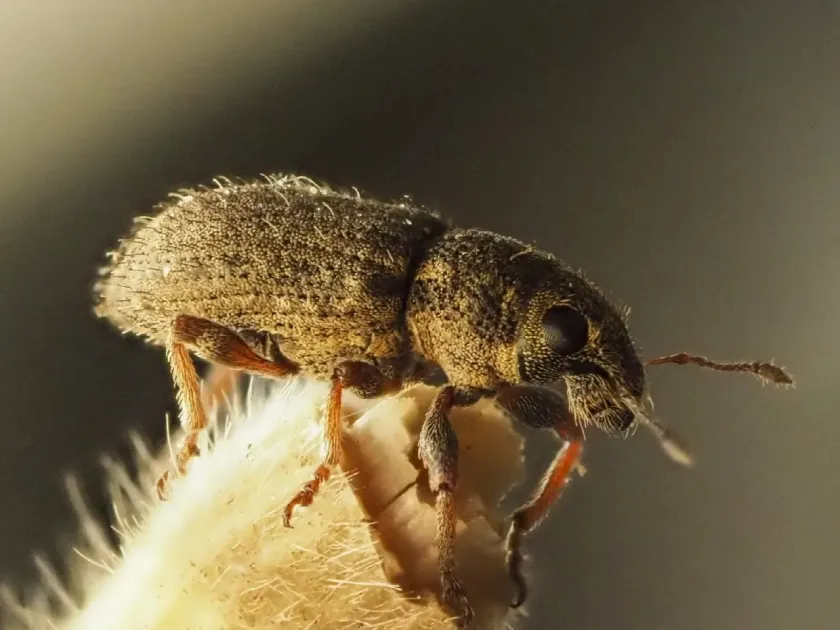
Sitona hispidulus, commonly known as the clover root curculio, belongs to the Curculionidae family. The adult beetle is small, measuring between 3 to 4 mm in length, with a body covered in dense bristles.
The coloration of the beetle ranges from brownish-black to greyish-brown. It features a short, broad snout and characteristic longitudinal striae (grooves) on its elytra, which are diagnostic traits for species identification.
Larvae are legless, white, and curved, with a distinct brown head. They are primarily soil-dwelling, living in the rhizosphere of legume plants, where they remain hidden from surface inspections.
The life cycle involves four stages: egg, larva, pupa, and adult. The insect typically overwinters as an adult in soil or plant debris, but sometimes as larvae in the soil depending on climate.
Reproduction initiates in early spring. Females deposit eggs in the soil around the roots of host plants, ensuring immediate access to food for the emerging larvae.
What it damages
This pest is a significant threat to various legume crops, most notably alfalfa, clover, vetch, and various forage legumes, causing substantial yield reductions.
Adult beetles cause damage to the foliage by feeding along the leaf edges, creating characteristic crescent-shaped notches. This feeding reduces the photosynthetic capacity of the plants.
The primary economic damage is caused by larvae that feed on root nodules. By destroying these nodules, they impair the plant's nitrogen-fixing ability, causing nutritional deficiencies.
Severe root feeding weakens the plant, making it more susceptible to environmental stress, particularly drought, and increasing the risk of secondary infections from soil-borne pathogens.
Infestations often result in overall stand thinning, reduced vigor of the crop, and lower biomass production, which is particularly evident in the first and second cuttings of forage crops.
When it appears
Adults emerge from hibernation early in spring as soon as soil temperatures reach 6-8 degrees Celsius, often coinciding with the initial regrowth of forage legumes.
The period of active adult feeding occurs throughout late spring and early summer, during which mating and egg-laying activities are at their peak.
Larval development takes place during the summer months in the soil. The peak period for larval feeding on root nodules is typically June and July.
Pupation occurs in the soil during mid-to-late summer. New generation adults emerge in August, feed briefly, and then enter a state of diapause or prepare for winter.
Autumn feeding by adults is crucial for their survival through the winter. Managing this period is important to reduce the overwintering population for the next season.
Signs of infestation
The most recognizable field symptom is the presence of small, crescent-shaped notches on the leaf margins, which are highly indicative of Sitona species feeding.
In cases of heavy infestation, farmers may notice stunted plant growth, yellowing foliage, and an overall reduction in the density of the forage stand.
Field diagnostics involve digging up plants and inspecting the root system for missing or scarred nodules and the presence of white, legless larvae near the crown area.
Poor performance of nitrogen-fixing crops despite favorable soil conditions often points toward root-feeding pest activity, which disrupts the symbiotic relationship with rhizobia.
Sweep net sampling in the field during warm, sunny days is an effective method to monitor adult activity and assess the population density before it reaches economic injury levels.
Control measures
Cultural control is the cornerstone of management. Early planting and ensuring optimal soil fertility help plants develop robust root systems that can tolerate minor feeding damage.
Maintaining spatial distance between new legume plantings and old, infested fields is a critical strategy to limit the migration of adult beetles.
Deep plowing after harvest can significantly reduce larval and pupal populations by exposing them to desiccation and predation, lowering the carry-over for the next season.
- Use of registered insecticides applied at the appropriate threshold during the adult activity window.
- Seed treatments with systemic insecticides to provide early-season protection to seedlings.
- Promoting healthy crop growth through balanced fertilization to aid plant recovery.
Biological control agents, including entomopathogenic nematodes and fungi, show promise in reducing larval populations in the soil when environmental conditions are conducive.
Taxonomy
- Latin name
- Sitona hispidulus
- Order
- Coleoptera (beetles)
- Family
- Curculionidae
- EPPO code
- SITNHI
Discussion
No discussions yet — be the first.