
Sand weevil
Sitona griseus
Description
How to identify
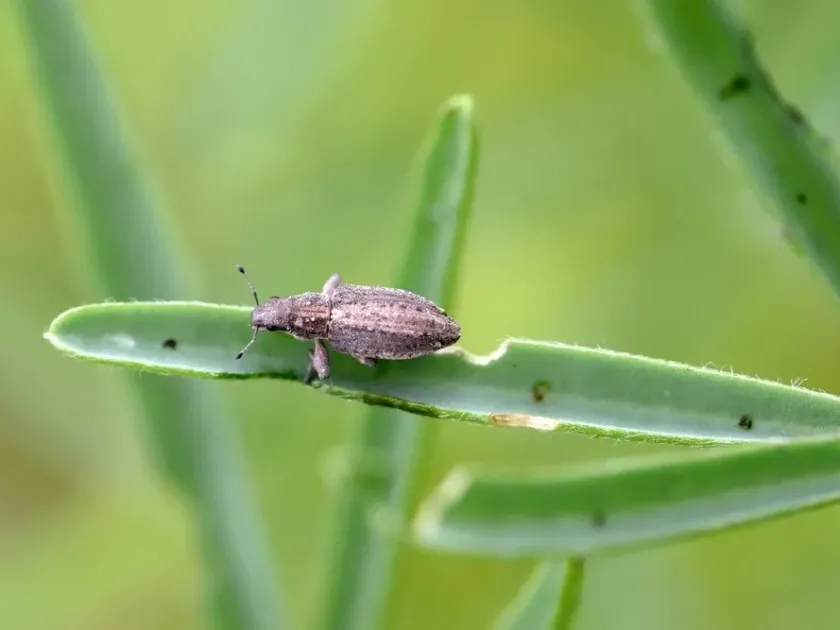
The sand weevil (Sitona griseus) is a beetle belonging to the Curculionidae family within the order Coleoptera. Adult beetles are typically 4 to 5 millimeters long, featuring a mottled grey or brown appearance due to small, dense scales covering their bodies.
The snout is characteristically short and broad, a defining trait of the Sitona genus. The larvae, which are white, legless, and C-shaped, spend their entire development phase underground, living in the soil profile.
Their coloration is an evolutionary adaptation that mimics the texture and color of sandy soils and dry organic debris, providing excellent camouflage against natural predators and making them hard to spot in fields.
These insects are strong fliers, which allows them to migrate between fields or search for suitable host plants if the primary food source is depleted. They are particularly adapted to drier, sandy soil environments.
Adults overwinter in various sheltered locations, including crop residues, soil cracks, or surrounding vegetation, emerging as soon as the spring temperatures become favorable for their activity.
What it damages
The sand weevil is a specialized pest of leguminous plants. It poses a significant threat to lupines, peas, vetch, and various clover species, frequently causing economic losses in agricultural production.
Adult beetles cause damage to the foliage by consuming the leaf margins, while the larvae are responsible for destruction below the surface. They feed on the roots and, most importantly, on the nitrogen-fixing root nodules.
Root system damage directly impacts the plant's ability to take up water and essential soil nutrients. This stress results in stunted growth, yellowing foliage, and, in severe cases, the complete collapse of the plant.
By destroying the nitrogen-fixing nodules, these weevils compromise the symbiotic relationship between the plant and bacteria, reducing the soil improvement benefits typically expected from legume rotations.
Heavy infestation levels can lead to significant thinning of the crop stand, which often necessitates costly replanting or results in reduced yields at the end of the harvest season.
When it appears
Overwintered adults emerge from the soil in early spring, typically once temperatures rise above 8-10 degrees Celsius. They immediately begin feeding and mating as host plants begin to sprout.
Egg-laying takes place in the soil surrounding the root zone of host plants. The eggs hatch into larvae that move deeper into the soil to begin their feeding cycle on the roots of the legumes.
The larval stage is the most prolonged, lasting several weeks. During this time, they grow and consume root tissues, often remaining protected from environmental fluctuations by the soil layer.
Pupation occurs within the soil, and the newly formed adults emerge during the mid-to-late summer period. This new generation then feeds actively to store energy before finding winter hibernation sites.
As autumn progresses, these beetles gradually cease activity and move towards areas where they can safely hibernate throughout the winter months, completing their annual biological cycle.
Signs of infestation
The most iconic sign of sand weevil activity is the distinct "notching" of leaves. Adults feed by biting the edges of the leaves, creating characteristic semi-circular or scalloped patterns along the leaf margins.
When populations are high, the feeding can be so extensive that the entire leaf lamina is eaten away, leaving behind only the primary midrib, which significantly restricts the photosynthetic capacity of the plant.
- Characteristic semi-circular notches on leaf edges.
- Yellowing and drooping of legume plants in early growth stages.
- Poor plant development compared to adjacent uninfested areas.
- Reduced plant vigor and poor flower production.
- Presence of small white larvae in the soil near the root zone upon digging.
Control measures
Integrated Pest Management (IPM) is essential for controlling this weevil. Crop rotation is the primary defense; avoiding planting legumes in succession prevents the local build-up of larvae populations in the soil.
Deep autumn plowing or effective seedbed cultivation can significantly reduce overwintering populations by exposing the insects to predators and unfavorable environmental conditions.
Optimizing planting dates to ensure vigorous early plant development helps the crop "outrun" the damage caused by the emerging adults. Ensuring optimal fertility can also help plants compensate for minor root damage.
Chemical control with systemic or contact insecticides is recommended if monitoring indicates that the population has crossed the economic threshold. Early morning applications are most effective when beetles are active.
Biological control alternatives, including the use of entomopathogenic fungi, are becoming increasingly popular for sustainable management in small-scale farming and organic crop production programs.
Taxonomy
- Latin name
- Sitona griseus
- Order
- Coleoptera (beetles)
- Family
- Curculionidae
- EPPO code
- SITNGI
Discussion
No discussions yet — be the first.